Voyager Suite
 Breeze
 Virtuoso
 Investment Suite
 RentCafe
 CommercialCafe Suite
 Elevate Suite
 Procure to Pay Suite
  Energy Suite
 Aspire
 RightSource
 Care Suite
 Matrix
 WorkCafe
 Yardi Kube Suite
 ScreeningWorks Pro
  Yardi Corom



















Modular single-family homes are old news in the United States. Modular multifamily, however, is just catching on. American multifamily firms are experimenting with modular apartments—and they love the results.
Residential modular construction in the US has increased by 32.8 percent since 2007 according to the Modular Building Institute. The boost in projects comes as builders begin to realize the benefits of off-site construction.
Benefits include:
- shorter cycle time since units are built in a controlled environment with fewer unexpected delays and setbacks
- improved energy efficiency
- minimal-to-zero material cost overrun
- lower labor costs
- consistent finished products
Tricorp Hearn Construction of Sacramento experienced these benefits firsthand with its most recent multifamily project. Tricorp chose a modular construction plan for its Eviva Midtown complex.
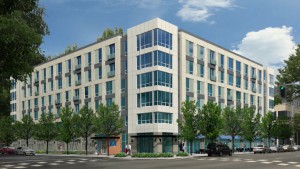
The finished product will be six stories high, including 118 units, each at 12 x 64 feet and weighing 35,000 lbs. The pre-fabricated units will rest atop 5,000 square feet of retail space and an underground parking garage. The project is slated for completion in spring 2016. Total production time for the modular complex is just 18 months. That’s notable savings over the 24-month estimate used for conventional construction. So far, the project is on schedule, on budget, and already piquing the interest of apartment seekers.
Modular construction does have its disadvantages.
Disadvantages include:
- increased lead time
- as much as 150% more resource usage, since units do not share walls, floors, or ceilings
- high product transportation costs
- lack of skilled labor, as few architects and contractors have experience with large-scale modular projects and fewer laborers know how to combine units
For most developers, the benefits outweigh the disadvantages. Since modular buildings have faster cycle times, they can begin earning rents faster. This can result in greater profits than their site-constructed counterparts.
Equity Residential’s Domain community in San Jose, Calif, is a shining example of the trade-off between benefits and disadvantages. Domain’s modular construction price tag came in $2 million more than its site-constructed estimate. Yet since construction completed nine months sooner than the site-constructed estimate, the property generated $15 million more in gross revenues than it would have with conventional construction.
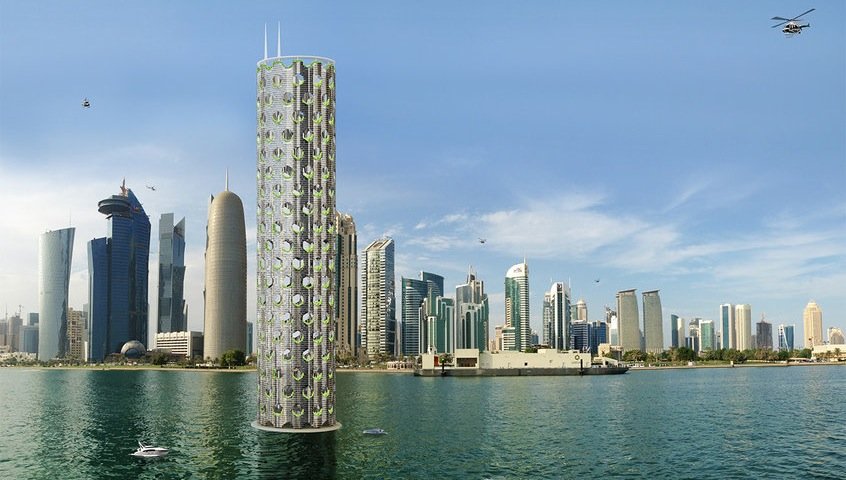
While the US is finally catching on to modular multifamily, we are still decades behind Europe and Asia. Eviva and Domain are lovely communities with luxury amenities, but they aren’t pushing any architectural boundaries. This is where the lack of experienced architects and contractors is really holding back America. For example, Italian firm Luca Curci Architects has a concept in the works for an island community that is mind-blowingly beautiful and more daring than any modular projects that we’ve seen in the US thus far.
Vertical City towers over the waters at 180 stories tall. It will accommodate 25,000 residents in addition to guests. The structure rises around a central atrium, accentuated with hexagonal voids throughout its sides. These openings bathe the building’s gardens in natural light. Fresh air circulates through each level of the building. On the lower levels, residents have access to spas, gyms, and a hotel with sub-marine views. Also below sea level, guest and residents can enjoy shops and restaurants. In addition to its beauty and amenities, Vertical City is scheduled to be energy independent. It will produce electricity via 10 modular layers covered in a membrane of photovoltaic glass.
It is not for a shortage of creativity that such projects aren’t breaking ground (or sea) America. The nation lacks the quantity of experienced architects and contractors found in Europe and Asia. Yet as The Modular Building Institute continues to offer education and opportunities to interested professionals, we can expect more elaborate and efficient modular multifamily structures in the future.