Voyager Suite
 Breeze
 Virtuoso
 Investment Suite
 RentCafe
 CommercialCafe Suite
 Elevate Suite
 Procure to Pay Suite
 Energy Suite
 Aspire
 RightSource
 Care Suite
 Matrix
 WorkCafe
 Yardi Kube Suite
 ScreeningWorks Pro
 Yardi Corom


Every property management operation runs on data. Lease terms drive rent charges, work orders drive vendor payments, screening decisions drive lease records. The question is whether they’re connected well enough to use it.
Yardi Virtuoso Enterprise is built on the premise that an AI platform is only as useful as the data it can see. With Yardi Voyager at its core, leasing,customer relationship management (CRM), accounting, maintenance and compliance all run on one shared database, so the AI works from a complete picture.
What data does property management software manage?
Property management software manages property, leasing, resident, vendor, owner and financial data. This includes unit availability, lease terms, rent payments, maintenance requests, invoices and accounting records. Some platforms also incorporate market data, such as local rents and occupancy trends, to support pricing and portfolio decisions. Centralizing this information helps teams keep records consistent across leasing, maintenance, accounting and reporting.
Resident & applicant data
Every prospect who contacts your property starts generating data: contact details, income documentation, rental history and tour notes. That record moves on through screening, returns a decision and, if approved, becomes a lease. From that point forward, the resident profile keeps growing: payment history, maintenance requests, communication logs and renewal decisions.
As a portfolio grows, so does this stream of data events: rent payments, partial payments, nonsufficient funds (NSF) returns, maintenance requests opened and closed, lease amendments and move-out notices.
When a platform centralizes those events, your team can query any of them in real time. With separate systems, someone has to reconcile data whenever an owner or regulator asks a question that spans more than one system. The larger the portfolio, the more often that happens.
Vendor & maintenance data
Maintenance generates its own data stream: work orders from resident requests, scheduled inspections and preventive maintenance calendars. The platform assigns each one, tracks it through to completion, logs materials and labor and closes the loop with a vendor invoice that posts directly to accounts payable.
Every step leaves a record: who requested it, who completed it, what it cost and how long it took. That record feeds cost analysis by unit, building and property type, and supports insurance claims, habitability compliance and vendor reviews.
Owner & investor data
Owners set the financial parameters the platform operates within: ownership structures, distribution preferences, capital expenditure approval thresholds and reporting formats. For a single owner, that’s manageable. For a partnership, a syndication or a fund structure with multiple ownership interests and waterfall distributions, the platform needs to hold and enforce all of it simultaneously, correctly, for every entity, every period.
As ownership complexity increases — more entities, more asset types, more markets — it costs more to keep that data consistent across separate systems. An integrated platform removes much of that reconciliation work.
Market & external data
Yardi Matrix aggregates rent trends, occupancy benchmarks, cap rate movement and supply pipeline data at the metro and submarket level across multifamily, commercial, affordable housing and self storage. When you view it alongside your portfolio records, every operational data point has a market reference.
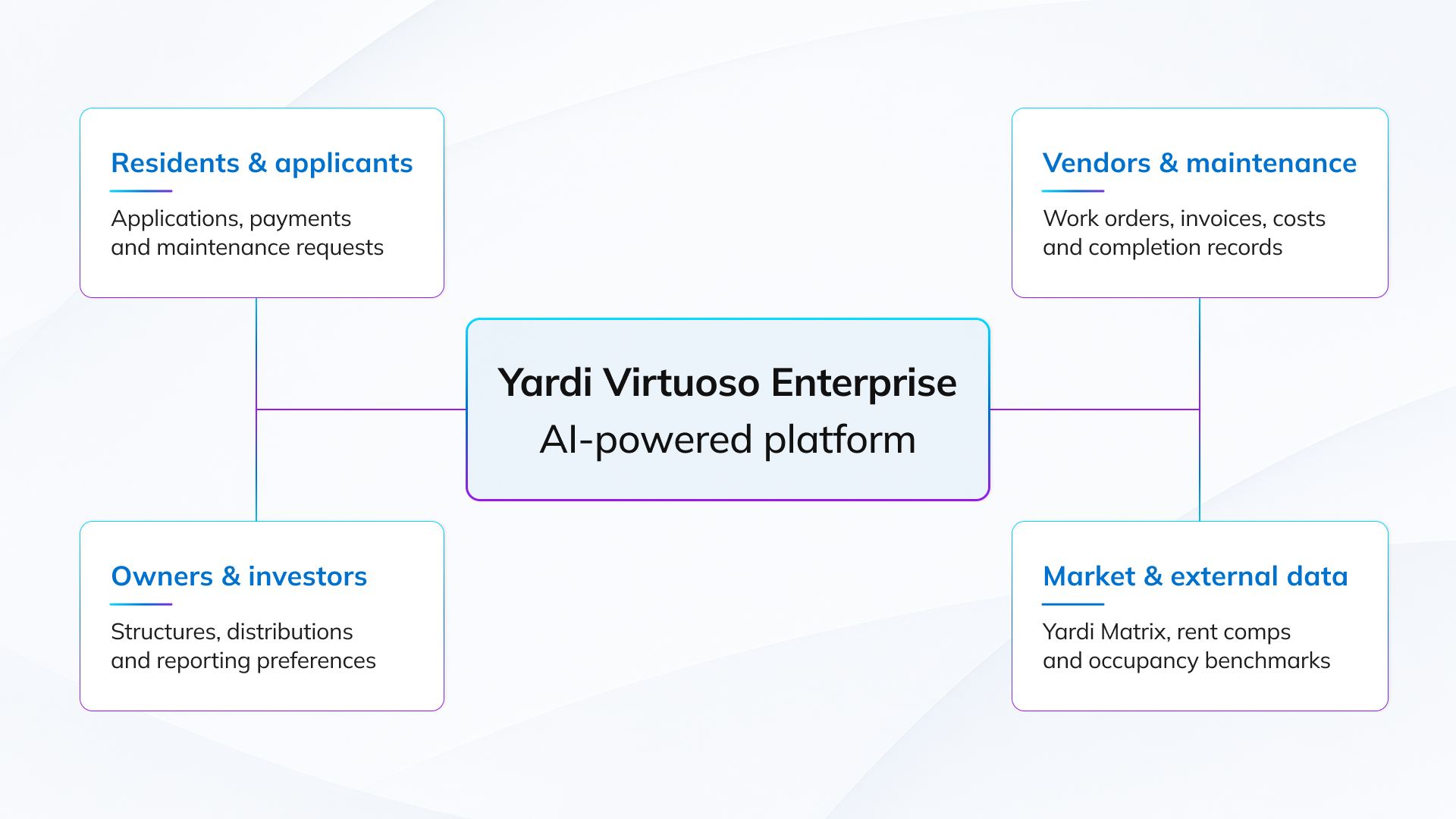
The four input sources that feed a property management platform. In Yardi Virtuoso Enterprise, all four connect to a single shared data layer.
How property management software automates core workflows
Property management software automates leasing, accounting, maintenance and compliance. When all four run on a shared database, each workflow feeds the next with fewer manual handoffs.
How the leasing workflow runs in property management software
Your leasing workflow starts the moment a prospect makes contact and ends at the signed lease. Every step in between (inquiry capture, tour scheduling, application, screening, lease generation, move-in inspection, deposit processing) produces a record and feeds the next step.
The platform enforces the sequence (a lease can’t generate before a screening decision clears) and timestamps every action for compliance purposes. Yardi’s AI-powered leasing tools, including Chat IQ and CRM IQ, help your team keep up with prospect follow-up when they’re stretched, allowing human agents and AI agents to seamlessly work together. For affordable housing portfolios, the workflow also enforces income certification and waitlist management rules.
The executed lease is the source document for everything that follows in accounting. Rent charges, concessions, pet fees and parking all derive from what gets entered here. Errors travel downstream and surface as discrepancies at month end, during owner reporting or in an audit. The Lease Audit Agent in Virtuoso Enterprise helps catch them first by comparing executed leases against Voyager records and charge codes. It flags mismatches before they reach the ledger.
How property management software handles accounting
Because property accounting runs on the same data layer as leasing and maintenance, most of the manual work that slows down month end disappears:
- Rent charges post automatically from lease terms
- Payments by ACH (automated clearing house), check, credit card and money order post to the resident ledger in real time
- Delinquency logic flags balances past your configured thresholds and triggers notices
On the owner side, NOI (net operating income) is calculated from rental income, ancillary income and operating expenses in the same system. Distributions run on a schedule you set, and owner statements generate automatically for each ownership interest.
Commercial portfolios add common area maintenance (CAM) reconciliation. The platform tracks actual operating costs throughout the year, compares them with estimated billings and produces reconciliation statements at period close. In Yardi Voyager, this runs as a configured workflow rather than a manual process.
How property management software manages maintenance
A maintenance request comes in through the resident portal, a call logged by staff or a scheduled inspection. The platform routes it to the right person, the technician completes the work and logs materials and labor, and the ticket closes. If a vendor is involved, the work order converts to a purchase order and posts automatically to accounts payable, with no separate step.
That connection matters. If work orders live in a standalone maintenance tool, closing one doesn’t update your expense ledger or vendor payment queue. Someone has to make those updates manually, often in batches, so your financials can fall behind your operations.
In Yardi’s connected platform, that loop closes in real time. Maintenance IQ adds AI triage to incoming requests, so each job gets to the right person and the right cost posts to the right ledger.
Preventive maintenance runs on its own track. The platform generates recurring work orders from equipment service schedules, such as HVAC (heating, ventialtion, and air conditioning) filters, elevator certifications and fire suppression inspections. It also helps make sure completion records exist before regulatory deadlines.
How property management software tracks compliance
Compliance requirements depend on what you own and where. Affordable housing carries the heaviest load: income certifications, unit inspections, regulatory agreement audits and annual reports to state housing finance agencies. The platform tracks certification deadlines, flags documents approaching expiry and generates the reports each funding program requires.
- For residential, the compliance workflow covers habitability inspections, security deposit accounting and notice period enforcement
- For commercial, the compliance workflow covers lease option tracking, tenant improvement allowance management and CAM audit rights
In compliance, timing is everything. A platform that surfaces compliance actions before they become violations helps you get to a clean audit instead of a finding.
How property management software processes each workflow
Workflow
Key inputs
What it automates
Primary output
Leasing
Applications, screening results, lease terms
Prospect routing, fair housing review, lease generation and validation
Executed lease, resident record
Accounting
Lease terms, payments, operating expenses
Charge posting, delinquency escalation, CAM reconciliation, owner distributions
General ledger, owner statements, NOI
Maintenance
Resident requests, inspection triggers, service schedules
Work order routing, purchase order creation, AP posting, preventive scheduling
Cost records, compliance trail, vendor payments
Compliance
Certification deadlines, inspection records, regulatory rules
Deadline flagging, document generation, regulatory filing
Audit trail, agency reports, deficiency alerts
Each workflow in a connected platform draws from the same data and feeds the next.
What data does property management software produce?
Property management software generates three types of output:
- Financial records serve accountants, lenders and investors
- Operational dashboards support day-to-day decisions
- Compliance documentation supports audits and regulatory filings
Financial records
Every financial event at the property and portfolio level posts to the general ledger with a timestamp and a source record. From the general ledger, the platform produces income statements, balance sheets, cash flow statements and owner distribution records — the source documents your accountants, lenders and investors are asking for, generated from data that’s already there rather than assembled by hand.
At the resident level, the platform generates move-out account statements that reconcile deposits against charges, late fee histories and ledger printouts for collections. Because every document is generated from live data rather than a manual export, the figures are current.
Operational intelligence
- Leasing workflow data aggregates into occupancy dashboards your team can use in real time — which units are occupied, leased but not yet occupied, on notice, available — broken down by unit type, floor, building or market, as the day moves
- Maintenance dashboards show open work order counts, average close time and cost per work order by trade and property
These dashboards become strategic tools when they sit next to Yardi Matrix market data. Your occupancy rate in isolation tells you where you are. The same figure against submarket peers (across millions of units tracked by Yardi Matrix nationally) tells you whether you’re ahead of the market, behind it or drifting toward a problem. Virtuoso Enterprise surfaces those comparisons automatically.
Compliance documentation
Inspection records, certification histories and regulatory filing confirmations stay in the system with timestamps and user attribution. When an auditor asks for documentation, you’re not reconstructing a trail from emails and spreadsheets. You pull it directly from the platform: when each inspection occurred, who performed it, what the result was and how deficiencies were resolved.
For affordable housing operators, compliance documentation is the deliverable. Yardi Voyager Affordable Housing generates Low-Income Housing Tax Credit (LIHTC), HOME and U.S. Department of Housing and Urban Development (HUD) program reports, plus state-specific reports, formatted to agency specifications, directly from the data the compliance workflow already accumulated.
What property management software produces
Financial records
Operational intelligence
Compliance documentation
General ledger
Vacancy & occupancy dashboards
Inspection records
Income statements
Maintenance close rates
Certification histories
Balance sheets
Cost per work order by trade
Regulatory filing confirmations
Owner distribution records
Portfolio benchmarks
LIHTC & HOME reports
Resident ledger statements
Yardi Matrix peer comparisons
HUD program reports
Tax & lender documents
AI-surfaced anomalies
Deficiency alerts & audit trail
The three output categories every property management system should produce. In an end-to-end platform, all three generate from the same underlying data record.
How property management software integrates with other systems
Property management software integrates with banking systems, internet listing services, smart building systems and reporting platforms. The deeper each integration goes, the more reconciliation runs automatically.
Banking & payment integrations
The depth of your banking integration determines how much of your payment reconciliation is automatic versus manual.
- A full two-way integration posts payments to the resident ledger in real time, flags exceptions automatically and reconciles the bank account against the system ledger daily
- A partial integration means someone imports a payment file and matches records by hand, which works until the portfolio gets large enough that it doesn’t
Yardi supports two-way banking integration, so payments and reconciliation stay in step with your ledgers.
Listing & marketing integrations
When a unit goes on notice, that information should reach your listings the same day. Vacancy data flowing from the leasing workflow pushes automatically to internet listing services and your property website when the integration is in place.
RentCafe, Yardi’s resident experience platform, maintains that connection natively. Your listing sites and resident portals stay in sync with your leasing data.
Smart building & internet of things (IoT) integrations
Smart building systems (access control, thermostats, water sensors, elevator monitoring) generate operational data that’s only useful if you can read it and act on it. A water sensor connected to your maintenance workflow generates a work order the moment it fires. An access control system connected to your leasing workflow deactivates a former resident’s credentials at move-out, automatically.
Through the Yardi Standard Interface Partnership Program (SIPP), Yardi connects with a broad ecosystem of certified partners, so you can choose the hardware that fits your properties.
Reporting and analytics integrations
Ownership reporting portals, lender reporting systems and investment management platforms all need data from your property management system. How much of that transfer is automatic versus manual depends on how deeply your systems are connected.
For institutional owners with multiple lender relationships, a closer connection can save significant staff time that now goes to exporting, formatting and checking numbers before they go out. Yardi’s built-in analytics draw on both your portfolio records and Yardi Matrix market data to produce standard reports without an export step.
All-in-one vs. modular property management software: How to choose
One shared database reduces reconciliation work, while specialized tools rely on integrations to keep records in sync. The choice comes down to data consistency.
AI-powered, all-in-one platforms
All-in-one AI-powered property management software like Yardi Virtuoso Enterprise runs every workflow on a single database. A lease executed this morning appears in the accounting ledger immediately. A work order closed this afternoon updates the expense ledger before the day ends.
Automation handles routine work like payment posting, so your team can focus on exceptions and relationships. A single platform gives every authorized user access to consistent records and gives AI the context to work across business areas. Agents can connect steps across leasing, resident services, maintenance and accounting, carrying workflows from one team to the next. That shared foundation enables coordinated action that would otherwise be difficult when data and processes sit in separate systems.
Modular & point-solution approaches
A point-solution approach assembles specialized tools for each function: a standalone accounting system, a separate leasing and CRM platform, a third-party maintenance tool and a dedicated reporting solution. Each one may do its specific job well, but none of them share data natively.
The trade-off is integration complexity. Moving data between systems requires synchronization logic through APIs (application programming interfaces) or middleware, and synchronization introduces delays. A payment posted in your accounting system may not appear in your leasing platform’s resident record until the next sync runs. If a sync fails, records can diverge until staff find the discrepancy during reconciliation.
AI tools in a modular setup can only see the data inside their own system, which limits the scope of their recommendations.
Which approach fits your portfolio?
- Large portfolios, multiple ownership structures or compliance-intensive asset classes: these typically gain the most from an all-in-one, AI-powered platform.
- Single-asset portfolios with specialized needs: a modular approach may work in the early stages, but it becomes harder to manage as complexity grows.
All-in-one vs. modular: how the two architectures compare
Factor
AI-powered all-in-one (Yardi Virtuoso Enterprise)
Modular and point-solution
Data consistency
Single shared record across all workflows. Every team works from the same real-time data.
Records sync between systems. Latency and sync failure introduce divergence risk.
AI accuracy
AI operates on complete, real-time portfolio data across leasing, accounting, maintenance and compliance.
AI tools in individual systems operate on partial data, which limits recommendation accuracy.
Reconciliation overhead
Every lease event, payment and work order posts to one ledger automatically. No manual reconciliation required.
The burden grows with portfolio size and the number of integrations required.
Staff learning curve
One interface, one workflow logic, one system of record for every function.
Multiple interfaces. Process logic and data location vary by system.
Functional capability
Depth in each area is shaped by the platform roadmap.
Each tool can be best-in-class for its specific function.
Best fit
Portfolios of 50 or more units, complex ownership structures, compliance-intensive asset classes.
Simpler portfolios with highly specialized needs that a single platform doesn’t fully address.
Choosing the right property management software
The right software decision is about data. Multiple ownership entities, diverse asset types, complex compliance requirements, high transaction volume and institutional reporting obligations all put pressure on data consistency.
For most large portfolios, keeping data consistent across separate systems costs more than the extra capabilities are worth. Below that size, the answer depends on your mix of asset type, ownership structure and compliance requirements. There’s no universal cutoff.
Yardi is built to grow with your portfolio, supporting small and midsized operators as well as large companies managing multiple property types. Yardi Breeze streamlines everyday operations across residential, commercial, affordable housing, self storage, HOA/condo and manufactured housing properties. Yardi Virtuoso Enterprise, with Voyager 8 at its core, brings AI-powered accounting, reporting and end-to-end workflow automation into one connected real estate management platform, helping your team work efficiently as your needs grow, from lead to lease to ledger.
Frequently asked questions about property management software
What is property management software?
Property management software is a platform that brings the operational and financial functions of a real estate portfolio into one connected system: leasing, rent collection, maintenance, compliance tracking and owner reporting. Yardi Virtuoso Enterprise is an AI platform built for real estate. It automates routine work across workflows and surfaces insights from portfolio data.
How does property management software handle accounting?
Property management software handles accounting by posting rent charges automatically from executed lease terms, applying incoming payments to resident ledgers in real time and generating owner financial statements from the same data. CAM reconciliation, security deposit accounting and subsidy calculation all run as configured workflows. In Yardi’s end-to-end platform, the general ledger, resident ledgers and owner statements stay synchronized because they share a single data layer. There’s no manual export or reconciliation step between them.
What is the difference between property management software and accounting software?
Property management software generates financial transactions automatically from operational events, such as an executed lease, a completed work order or a received payment. It ties each financial record to the event that created it, which enables automated posting, delinquency tracking and owner reporting. General-purpose accounting software only records transactions after they happen. An AI-powered property management platform like Yardi Virtuoso Enterprise adds another layer: AI agents like the Lease Audit Agent use that context to flag mismatches before they reach the ledger.
Does property management software work for different asset classes?
Property management software platforms can vary significantly in asset class coverage. Enterprise platforms like Yardi Voyager support residential, commercial, affordable housing, mixed-use and self storage in a single system. Smaller platforms typically specialize in one asset class and may not include the lease abstraction, CAM reconciliation and compliance modules that other property types need. Asset class depth matters most for portfolios that span multiple property types.
How does property management software integrate with other systems?
Property management software connects to banking systems, internet listing services, smart building systems and reporting tools through APIs, direct database connections and certified partner programs. How deep each integration goes, from real-time two-way to periodic one-way, determines how much manual reconciliation is left. Yardi integrates with a broad ecosystem of certified partners through the Yardi Standard Interface Partnership Program (SIPP).
What should I look for when evaluating property management software?
When evaluating property management software, the most important criteria are:
–Data architecture: whether leasing, accounting, maintenance and compliance share a single database or need to sync between systems
–Workflow automation depth
–Asset class coverage
–Integration breadth
–Compliance capability
For larger portfolios of 50+ units, removing manual reconciliation between systems typically delivers the highest return on investment (ROI). The right choice depends on your ownership complexity, asset types and compliance requirements.