Voyager Suite
 Breeze
 Virtuoso
 Investment Suite
 RentCafe
 CommercialCafe Suite
 Elevate Suite
 Procure to Pay Suite
 Energy Suite
 Aspire
 RightSource
 Care Suite
 Matrix
 WorkCafe
 Yardi Kube Suite
 ScreeningWorks Pro
 Yardi Corom


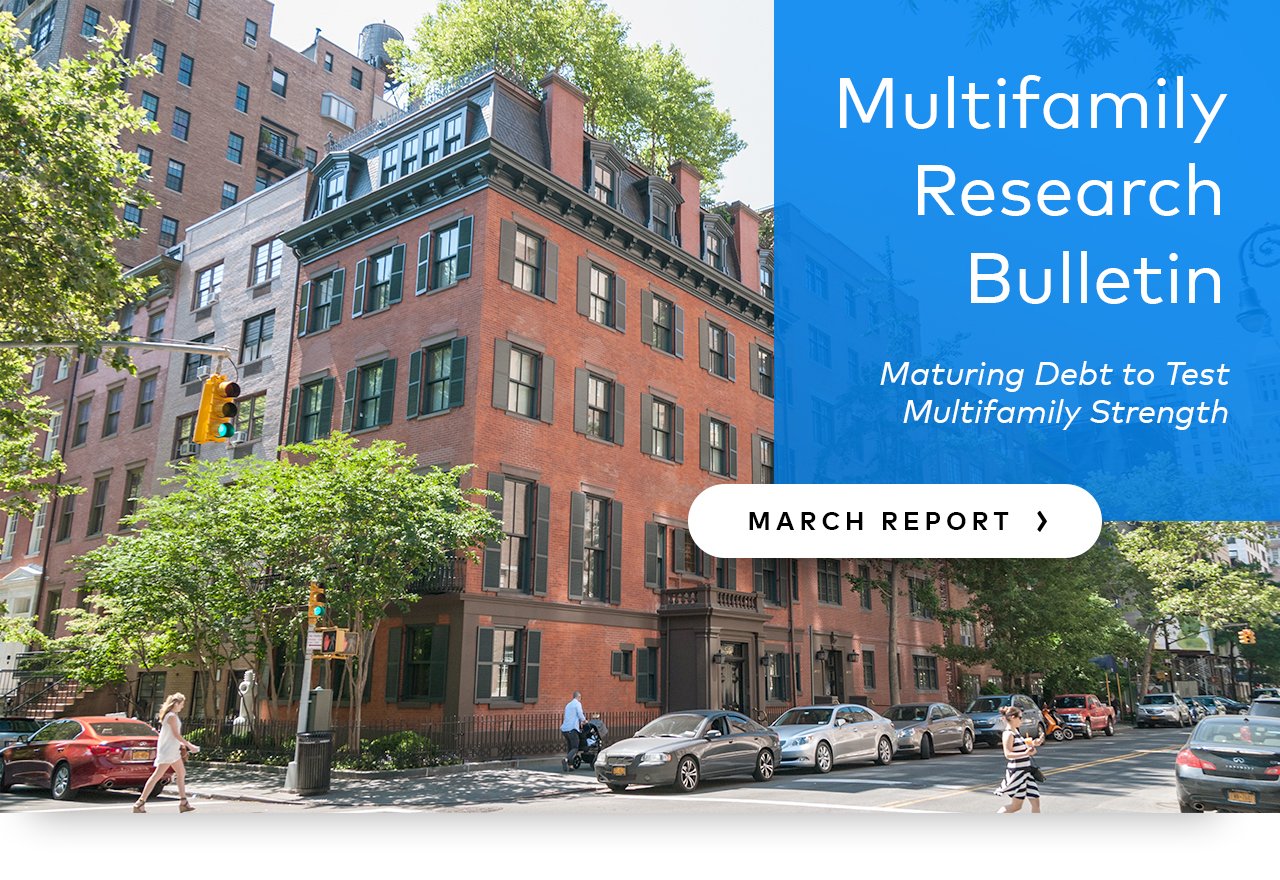
The multifamily market has 58,533 properties with loans set to mature over the next five years, representing $525 billion of the total $1.1 trillion of loans currently backed by apartments, according to a new special report from Yardi Matrix.
Metros with the largest volume of maturities include Atlanta ($34.9 billion), Dallas ($26.6 billion), Denver ($22.9 billion), Houston ($20.8 billion), New York ($19.9 billion) and Chicago ($18.8 billion). Markets with the highest percentage of loans coming due through the end of 2029 are Atlanta (65.9 percent), Denver (56.9 percent), Nashville (56.2 percent), Las Vegas (55.9 percent), Houston (53.6 percent) and Chicago (53.2 percent).
More than half of the multifamily loans found in Yardi Matrix’s database, $641.8 billion (56.3 percent) was originated by Fannie Mae and Freddie Mac. Next in line, at $187.3 billion (16.4 percent) came from commercial banks, followed by the federal government/HUD ($115.7 billion, 10.1 percent), debt funds (69.9 billion, 6.2 percent), life companies ($67.6 billion, 5.9 percent) and CMBS ($25.2 billion, 2.2 percent).
“Multifamily originations peaked during years with record transaction volume, including 2021 (when $194.7 billion of loans were originated) and 2022 ($209.8 billion), as investor demand reached a high point during a time of strong fundamental performance and low interest rate,” note Matrix analysts.
Of the loans in the database, $61.8 billion are set to mature in 2024, with another $84.3 billion in 2025, $89.3 billion in 2026, $77.9 billion in 2027 and $107.3 billion in 2028. By percentage, 5.4 percent of the loans will mature by the end of this year, 12.8 percent by the end of 2025, 27.5 percent by the end of 2027 and 46.1 percent by the end of 2029.
Markets with a high percentage of loans maturing over the short term and recent negative rent growth include Atlanta, Houston, Raleigh–Durham, Orlando and Austin. In addition, markets with strong deliveries and a high percentage of units under construction include Austin, Charlotte, Raleigh-Durham, Denver, Orlando and Miami.
Factors that will determine distress include interest rates, strategies around loan extensions, property fundamental, regulatory issues and loan seasoning.
Read the latest Multifamily Loan Maturity report from Yardi Matrix.
Yardi Matrix offers the industry’s most comprehensive market intelligence tool for investment professionals, equity investors, lenders and property managers who underwrite and manage investments in commercial real estate. Yardi Matrix covers multifamily, student housing, vacant land, industrial, office, retail and self storage property types. Email [email protected], call 480-663-1149 or visit yardimatrix.com to learn more.