Voyager Suite
 Breeze
 Virtuoso
 Investment Suite
 RentCafe
 CommercialCafe Suite
 Elevate Suite
 Procure to Pay Suite
 Energy Suite
 Aspire
 RightSource
 Care Suite
 Matrix
 WorkCafe
 Yardi Kube Suite
 ScreeningWorks Pro
 Yardi Corom


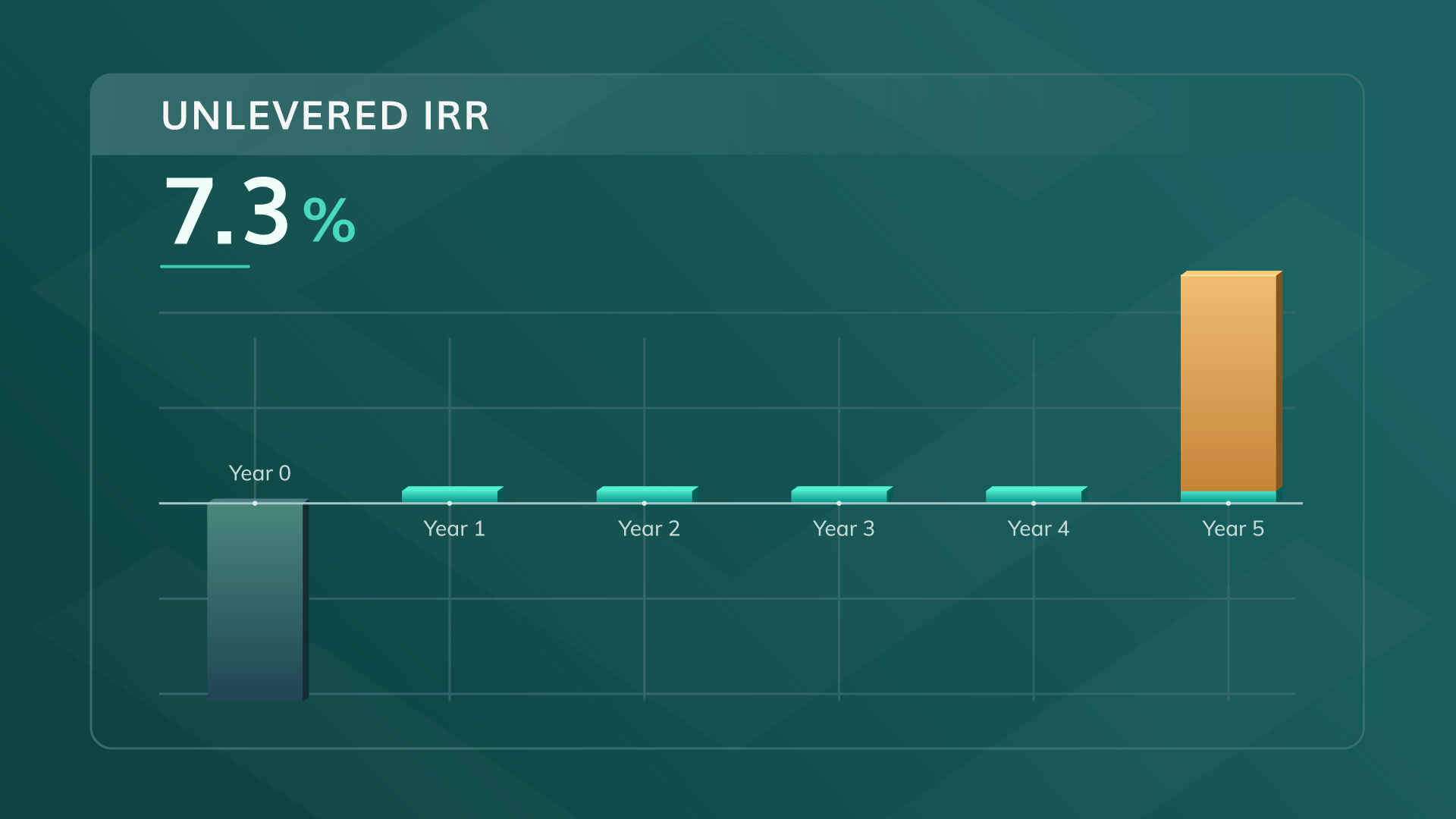
The internal rate of return (IRR) is one of the most widely used metrics in real estate investing because it accounts for the size and timing of every cash flow, from purchase to sale. IRR lets investors compare deals with different prices and hold periods on equal terms. To calculate IRR, list every cash flow and solve for the discount rate that sets their net present value (NPV) to zero.
This guide explains how to calculate IRR in real estate step by step, how to interpret the results and where the metric falls short.
What is IRR in real estate?
IRR is the average annual return a real estate investment earns over its hold period, adjusted for when each cash flow is received. Technically, it’s the discount rate at which the NPV of all of a property’s cash flows equals zero.
IRR captures both sources of return from a property: periodic cash flow from net operating income (NOI) and the net proceeds from selling or refinancing at the end of the hold. Acquisition teams use IRR to underwrite deals against a hurdle rate, fund managers report it to limited partners and asset managers compare projected IRR with realized results.
IRR formula
The IRR formula sets the NPV of every cash flow equal to zero and solves for the discount rate.
0 = CF₀ + CF₁ ÷ (1 + IRR)¹ + CF₂ ÷ (1 + IRR)² + … + CFₙ ÷ (1 + IRR)ⁿ
In summation form: NPV = Σ CFₜ ÷ (1 + IRR)ᵗ = 0
- CF₀: The initial investment at time zero, entered as a negative number
- CF₁ to CFₙ: The net cash flow in each period, with the final period including net sale proceeds
- t: The period in which each cash flow occurs
- n: The number of periods in the hold
- IRR: The discount rate that makes the sum equal zero
IRR can’t be isolated algebraically, so it’s solved iteratively. In Excel or Google Sheets, use =IRR(values) for evenly spaced cash flows or =XIRR(values, dates) for cash flows on irregular dates.
Step-by-step IRR calculation
Calculating IRR follows five steps:
- Set the hold period: Many models use a 5- to 10-year hold with annual cash flows.
- Enter the initial investment as a negative cash flow: Include the purchase price, closing costs and upfront capital expenditures, or only the equity for a levered IRR.
- Project annual cash flows: Start with NOI and subtract capital reserves and, for a levered IRR, debt service.
- Estimate net sale proceeds: Divide the following year’s NOI by an exit cap rate, then subtract selling costs and, for a levered IRR, the loan balance.
- Solve for IRR and compare it with your hurdle rate: Then stress-test rent growth, exit cap rate and hold period.
IRR calculation example
Let’s calculate the IRR for a multifamily acquisition with a five-year hold:
- Purchase price: $20,000,000, including closing costs
- Year 1 NOI: $1,100,000, a 5.5% going-in cap rate, growing about 3% per year
- Exit: A 5.75% exit cap rate on Year 6 NOI of about $1,275,000, less 2% selling costs, for net sale proceeds of about $21,700,000
For simplicity, the example assumes NOI is net of capital reserves.
| Year | NOI | Net sale proceeds | Total cash flow |
| 0 | – | – | –$20,000,000 |
| 1 | $1,100,000 | – | $1,100,000 |
| 2 | $1,135,000 | – | $1,135,000 |
| 3 | $1,170,000 | – | $1,170,000 |
| 4 | $1,205,000 | – | $1,205,000 |
| 5 | $1,240,000 | $21,700,000 | $22,940,000 |
Solving for the rate that sets the NPV of these cash flows to zero gives an IRR of about 7.3%. This is the property’s unlevered IRR, or its return before financing.
Levered vs. unlevered IRR
Unlevered IRR measures the property’s return as if it were bought with all cash. Levered IRR measures the return on the investor’s equity after debt service and loan payoff.
Adding a $13,000,000 loan to the same deal, at 65% loan-to-value (LTV) and 6% interest-only, cuts equity to $7,000,000. Year 1 NOI covers the $780,000 in debt service 1.41 times, a comfortable debt service coverage ratio (DSCR).
| Metric | Unlevered | Levered (65% LTV) |
| Year 1 cash-on-cash return | 5.5% | 4.6% |
| Equity multiple | 1.38x | 1.52x |
| IRR | 7.3% | 9.5% |
Debt at 6% costs more than the 5.5% going-in cap rate, so leverage lowers the Year 1 cash-on-cash return. It still raises the IRR because the property’s 7.3% full-hold return exceeds the cost of debt.
What is a good IRR in real estate?
A good IRR exceeds the investor’s hurdle rate for the risk taken. StepStone Group, in the Winter 2025 PREA Quarterly, cites these typical net target returns for private real estate funds:
| Strategy | Typical net target IRR |
| Core | 6%–8% |
| Core-plus | 9%–11% |
| Value-add | 12%–14% |
| Opportunistic | 15% and higher |
These are fund-level targets net of fees and usually levered, so property-level unlevered IRRs typically run lower.
IRR vs. other real estate return metrics
Unlike cap rate, cash-on-cash return and equity multiple, IRR expresses the full hold period as a single annualized rate, weighting each cash flow by when it’s received.
| Metric | What it measures | Best used for |
| IRR | Annualized return across all cash flows, including the sale | Comparing deals with different timing |
| Cap rate | NOI ÷ property value | Pricing and quick screening |
| Cash-on-cash return | Annual cash flow ÷ equity invested | Current income yield |
| Equity multiple | Total cash distributed ÷ equity invested | Total profit, regardless of time |
IRR and equity multiple work best as a pair: IRR shows how fast capital grows, and equity multiple shows how much.
What are the limitations of IRR in real estate?
IRR is only as reliable as the projections behind it, and it can make a deal look better or worse than it is:
- Dependence on exit assumptions: The sale often makes up most of a deal’s cash flow, so small changes in the exit cap rate or timing can shift the IRR significantly.
- Sensitivity to timing: A quick sale can produce a high IRR even when total profit is small.
- Reinvestment assumption: IRR assumes interim cash flows are reinvested at the IRR itself. The modified IRR (MIRR) corrects for this.
- No sense of scale: A smaller deal can have a higher IRR but create less total profit than a larger one.
How can Yardi help you calculate and track IRR?
Calculating IRR for one deal is simple, but keeping it accurate and consistent across a portfolio is harder. Yardi Virtuoso Enterprise for Investment Management is a single platform for managing the entire real estate investment lifecycle, from acquisition and accounting to investor reporting and disposition. It calculates IRR directly from accounting data:
- IRR at every level: Calculate gross and net IRRs, before and after fees, at the asset, investment and investor levels from actual capital calls and distributions.
- Related metrics and benchmarks: Track time-weighted returns and equity multiples alongside IRR, and compare results with NCREIF and internal benchmarks.
- Portfolio dashboards: Monitor IRR across funds and drill down to the assets driving performance.
- IRR-based waterfalls: Calculate distributions using preferred returns and IRR hurdles.
Conclusion
IRR condenses every cash flow from acquisition to sale into a single annualized return. Paired with equity multiple and a stress-tested exit, it helps investment teams compare opportunities and confirm that assets perform as underwritten.
FAQ
What is a good IRR for a real estate investment?
A good IRR is higher than your hurdle rate, which is the minimum return you need to make a deal worth the risk. Published fund targets can help you judge this, but they include the effect of borrowing and are measured after fees, so compare them with your deal’s return on the same basis.
What is the difference between IRR and cap rate?
Cap rate measures one year of NOI relative to property value. IRR measures the annualized return across the entire hold, including the sale, and accounts for the timing of each cash flow.
Is a higher IRR always better?
A higher IRR isn’t always better. IRR can be inflated by a short hold period, early distributions or aggressive exit assumptions, and it doesn’t show how much total profit an investment produces.
Can IRR be negative?
Yes. IRR is negative when the total cash that an investment returns, including sale proceeds, is less than the amount invested. A negative IRR means the investment lost money on an annualized basis.
Should I use levered or unlevered IRR to compare deals?
Use unlevered IRR to compare the properties themselves, since it removes the effect of financing and shows which asset performs better on its own. Use levered IRR to see what your equity will actually earn under the loan terms you plan to use. Looking at both shows whether a deal’s return comes from the property or from the debt.
Disclaimer
This article is for informational purposes only and does not constitute investment, financial or legal advice. Examples are illustrative, and return figures are third-party targets, not guarantees of future performance.