Voyager Suite
 Breeze
 Virtuoso
 Investment Suite
 RentCafe
 CommercialCafe Suite
 Elevate Suite
 Procure to Pay Suite
  Energy Suite
 Aspire
 RightSource
 Care Suite
 Matrix
 WorkCafe
 Yardi Kube Suite
 ScreeningWorks Pro
  Yardi Corom



















CAM reconciliation has a way of turning a routine close into a bigger project when the numbers don’t tie. The answer could be in an amendment that was executed months ago and never made it into the accounting system. So when someone pulls the original lease, then the amendment, then the version the tenant is working from, the versions don’t match. By the time the right figure is confirmed, the reconciliation deadline is close and the tenant relationship has taken a hit. That’s a commercial lease version control problem, and it lives in the GL.
Why commercial lease records & the GL diverge
Most commercial portfolios run with the same structural gap: The lease is abstracted into a document, and that document is the source for setting up the GL. But from that point on, the two records are independent. When an amendment is executed, someone has to catch it, re-abstract the changed terms and update the accounting setup by hand. When that step is missed or done partially, the ledger keeps billing against the old terms. The lease and the GL have diverged and neither system flags it.
The gap is easy to ignore when leasing activity is slow but compounds when it isn’t. U.S. office leasing rose 16% year-over-year in Q2 2026 to 62.4 million square feet, according to CBRE. Renewals, contractions and blend-and-extend deals each produce an amendment that has to reach the accounting record before it reaches a bill.
Five points where commercial lease version control breaks down
There are five key points where lease terms can fail to make it into the GL accurately. Each point is a lease version control failure with an accounting consequence.
- Abstraction errors. Manual re-keying introduces mistakes that are hard to catch because they look like data. A CPI escalation entered as a fixed dollar amount will understate rent for the rest of the term. Without a link from every abstracted term back to its source clause, there’s no reliable way to catch the error before it bills.
- Unabstracted amendments. An executed amendment that doesn’t reach the accounting system doesn’t cause a problem until the tenant disputes a charge using a document your team doesn’t have. The billing is already out and the reconciliation is already wrong.
- Critical dates in static documents. Option windows and escalation dates that live in a spreadsheet or a PDF have no mechanism to alert anyone as they approach. A missed escalation date is lost NOI that can’t be recovered after the fact. Recording escalation type — fixed, indexed or market — as a live field rather than a static note is the difference between a date the system tracks and a date someone has to remember.
- Recovery setup that never gets revisited. CAM recovery structures are configured at lease execution and rarely touched again. Capital expenses miscoded to recoverable repairs overstate CAM charges and create disputes. Comparing estimates to actuals quarterly rather than at year-end catches miscoding while correction is still possible.
- Turnover. When the person who built the lease record leaves, their interpretation logic goes with them. Clause reasoning stored in a personal spreadsheet isn’t available to whoever inherits the portfolio. The record has to carry that reasoning or the next person starts from scratch.
What ASC 842 auditors & tenants find in the gap
Under ASC 842, completeness is the assertion auditors test hardest and the recurring findings all trace back to a lease event that happened in the document and never reached the system. On the tenant side, more than 40% of CAM statements contain billing errors, according to IREM. A reconciliation that ties to the GL line for line answers a tenant’s question with a document that doesn’t leave room for dispute. Both risks have the same root cause: two records of the same agreement kept in two places.
One lease record, one GL: How Smart Lease closes the gap
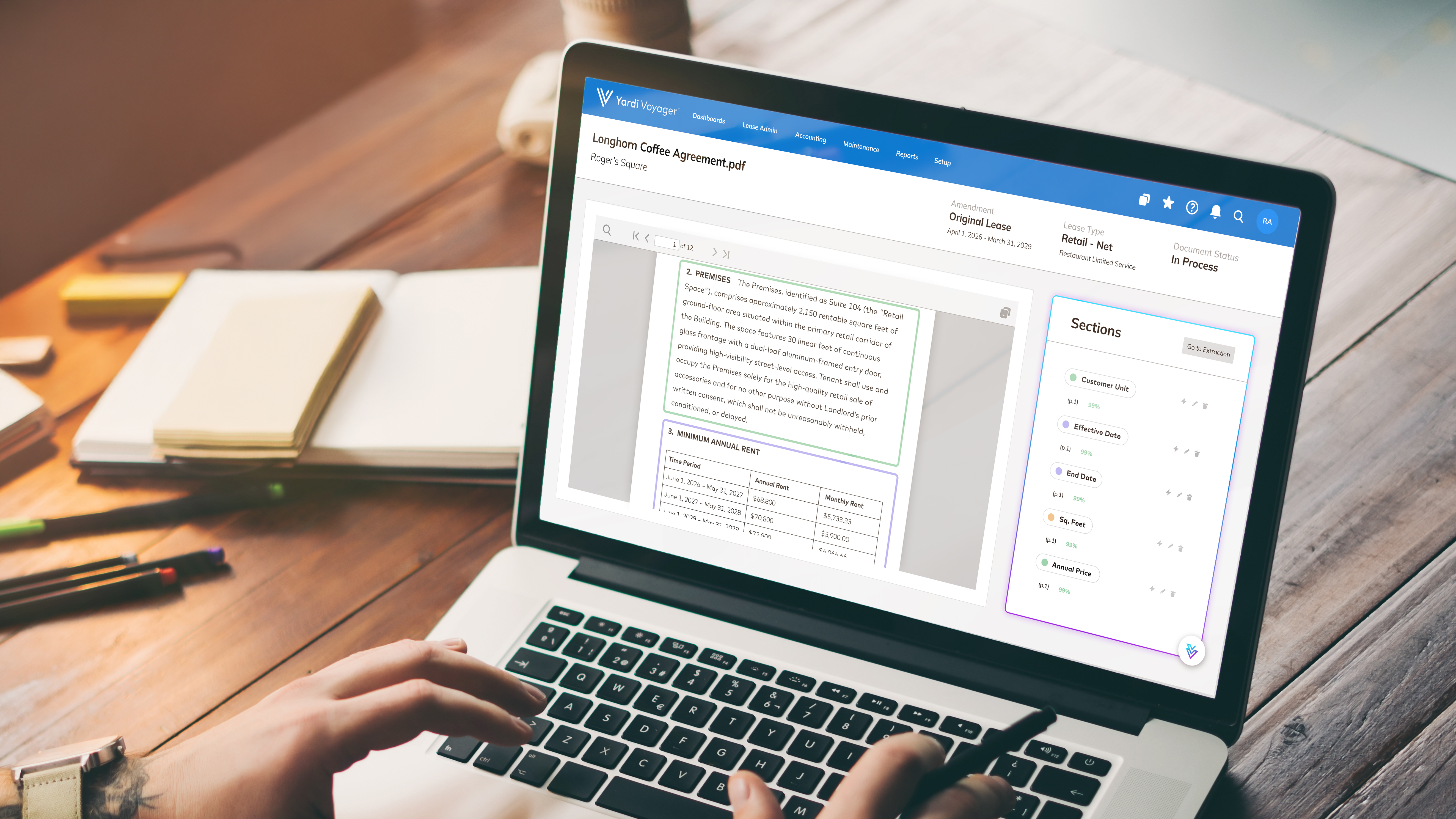
Yardi Smart Lease, part of Yardi Virtuoso, connects the lease document and the Voyager general ledger into a single record so approved terms apply directly to the GL without a manual re-keying step in between. See how Smart Lease works.
For portfolios already running on Voyager, that means the version control problem has a structural fix rather than a process workaround. Learn how Virtuoso Enterprise for Commercial puts this into practice across the full accounting workflow or get a Virtuoso demo to see it against your portfolio.