

 Voyager Suite
 Breeze
 Virtuoso
 Investment Suite
 RentCafe
 CommercialCafe Suite
 Elevate Suite
 Procure to Pay Suite
  Energy Suite
 Aspire
 RightSource
 Care Suite
 Matrix
 WorkCafe
 Yardi Kube Suite
 ScreeningWorks Pro
  Yardi Corom



















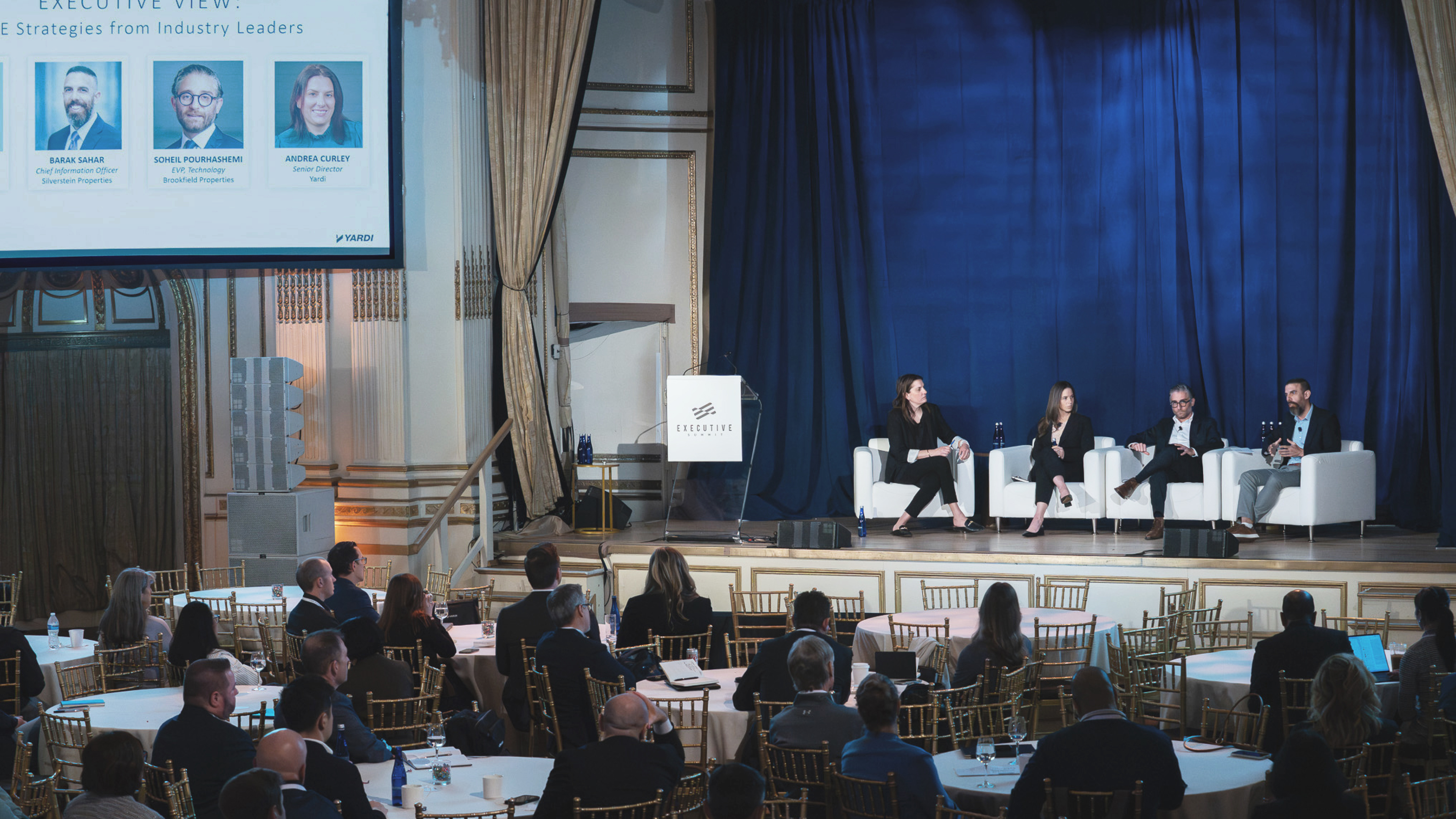
No two quarters in commercial real estate look the same right now, and neither does AI adoption. At the Yardi Executive Summit in New York, we brought together Pamela Larin, Soheil Pourhashemi and Barak Sahar to talk through what that means for operators at every scale.
Larin is CFO at Arden Logistics Parks, a vertically integrated owner of small-bay industrial with 10 million square feet across 12 markets. Pourhashemi is executive vice president at Brookfield, where the real estate platform spans nearly $300 billion in assets under management, 500 million square feet and 80,000 multifamily units. Sahar is CIO at Silverstein Properties, leading technology strategy across one of New York’s most recognizable portfolios, including the World Trade Center buildings.
Three very different firms with three perspectives on the same question: How do you run a commercial real estate business right now?
Key takeaways
- Tenant and asset diversity buys optionality when the market shifts
- Firms of every size are building portfolios designed to absorb disruption rather than avoid it
- Tenant experience is a crucial retention strategy
- AI adoption looks different across firm sizes, but the underlying playbook is to start small, govern early and treat literacy as a long game
- The firms getting the most from AI are the ones that built data infrastructure first
Diversification as a disruption hedge
Every panelist made the same point from a different angle: When the market gets noisy, scale and diversity buy you options.
For Arden, that means tenant variety. With more than 1,000 tenants spread across roughly 5,000 square foot suites, no single bankruptcy reshapes the portfolio. “Tenant diversity has really been a boon to us,” Larin said. Small-bay industrial is supply-constrained and increasingly hard to build in markets that won’t approve new development, but it’s the kind of asset that holds up when conditions shift.
Brookfield plays the same game at a different scale. With assets across nearly every category, the firm can reallocate capital between sectors as conditions change. Office vacancy in New York has tightened, and trophy assets in gateway cities are seeing strong demand. Other markets tell a different story. When federal agency layoffs hit Washington, Brookfield’s D.C. portfolio felt it. Their response was reallocation, not retreat.
Sahar took the longest view. “If we would have had the same discussion in 2019, no one would have predicted COVID, no one would have predicted AI,” he said. That understanding shapes Silverstein’s strategy: Class A buildings are running near full occupancy, the firm is developing Two World Trade Center with American Express as the anchor tenant, and a deliberate push into multifamily, including commercial-to-residential conversions, is broadening the pipeline.
Why tenant experience has become the lease
Tenant expectations keep climbing across asset classes, and the panelists see tenant experience as the deciding factor in retention.
Brookfield treats the office as a curated environment, not a lease. Activation, food and beverage programming, arts, showers and lockers all promote the same goal. “When somebody goes into an office building, it’s not just an office building,” Pourhashemi said. “It’s the curation of retail at the bottom.”
Silverstein launched its Inspire brand before the pandemic and has built a dedicated team around the concept. The Inspire app pulls together commercial and residential touchpoints, including conference room booking, fitness classes and amenity access, in one place. “We understand that this is what will be our main differentiator,” Sahar said.
Industrial works differently. Arden’s tenants don’t want a yoga studio. They want a clean, well-lit park where their business operates. Arden focuses on deferred maintenance, security, lighting and onsite presence, then uses Yardi Lease Manager to track which improvements are paying off.
How CRE leaders are evaluating technology
The role of technology has shifted, and every panelist felt it. “There was a time when IT held the keys to the kingdom,” Pourhashemi said. The on-premises era required IT to touch everything, the cloud brought more flexibility and SaaS pulled the business closer to vendors. AI has moved everyone closer still, to the point where, as Sahar put it, “every person in the organization can potentially create their own application.”
That shift changed how Silverstein thinks about where IT adds value. Enterprise platforms stay with IT, where contracting, integration and user experience matter. Smaller standalone tools can sit with the business, and anything that touches data or other systems still routes through IT.
Then AI arrived and compressed the timeline on all of it. Pourhashemi described Brookfield’s early experience: “The AI FOMO was so real. At one point we may have had 10 or 12 POCs that were trying to do the same thing.” The firm now runs a more disciplined process, with a dedicated team that helps the business sort signal from noise.
The AI adoption playbook across three firms
Of all the topics discussed, AI dominated and the three firms offered a useful range of approaches. Silverstein built the most structured rollout. Sahar described a three-phase program designed around the recognition that not everyone enters the AI conversation from the same place.
Phase one was training using an outside consultant that ran company-wide sessions on tools like ChatGPT, Claude and Gemini, calibrated for both advanced users and skeptical ones. The second phase was adoption through gamification: a 30-day holiday challenge where employees logged in daily to work through small AI exercises, bite-sized enough that hesitant users could engage without feeling overwhelmed. Phase three, currently underway, names AI champions in every department. Each champion works with their team to find the highest-value use cases. “Now users are asking me, ‘How can we get there?'” Sahar said. The change management has flipped and the business is pulling instead of being pushed.
Brookfield took a different route. Enterprise agreements with Anthropic and OpenAI gave the firm private instances of frontier models, and licenses opened broadly across the organization. A value creation office meets monthly to share use cases, and weekly news tips keep employees current. Pourhashemi sees AI in two camps: a productivity layer for the whole business, and a focused R&D effort aimed at what makes Brookfield different in its investment decisions.
Arden embeds AI into day-to-day work rather than treating it as a separate initiative. Property managers record their on-site meetings so AI can handle the writeup. Financial teams use AI for Excel work that was manual just a few months ago. “It’s woven into everything versus it being a big and scary new tool,” Larin said.
A common thread runs through all three: start small, be clear about security and treat AI literacy as a long game. Sahar’s team runs an AI governance committee that reviews use cases alongside the security team. The goal isn’t to slow adoption, but to make sure the foundation holds.
What it all means
New pressures on commercial real estate are happening now and so are the tools for navigating them. The firms represented at this summit are all looking to diversify to absorb disruption, invest in tenant experience to drive retention and build AI infrastructure.
For CRE operators looking to compete at any scale, the issue is how quickly a foundation can be put in place.
Interested in how Yardi supports enterprise CRE operations, from portfolio management to AI-ready data infrastructure? Check out Yardi Commercial Suite and Yardi Virtuoso.