Voyager Suite
 Breeze
 Virtuoso
 Investment Suite
 RentCafe
 CommercialCafe Suite
 Elevate Suite
 Procure to Pay Suite
 Energy Suite
 Aspire
 RightSource
 Care Suite
 Matrix
 WorkCafe
 Yardi Kube Suite
 ScreeningWorks Pro
 Yardi Corom


We hope you’ve enjoyed this year’s Changemakers series to date, a series full of inspiring interviews with leaders across the senior living industry. As sponsor for the fifth consecutive year, we’ve enjoyed sharing the interviews and highlighting how each honoree is building a better tomorrow.
Today’s featured Changemaker is Jodi Guffee, owner and chief operating officer at Radiant Senior Living, one of our amazing senior living clients! Read on for a preview of Guffee’s interview, then head to the Changemakers site to read her full conversation with SHN.
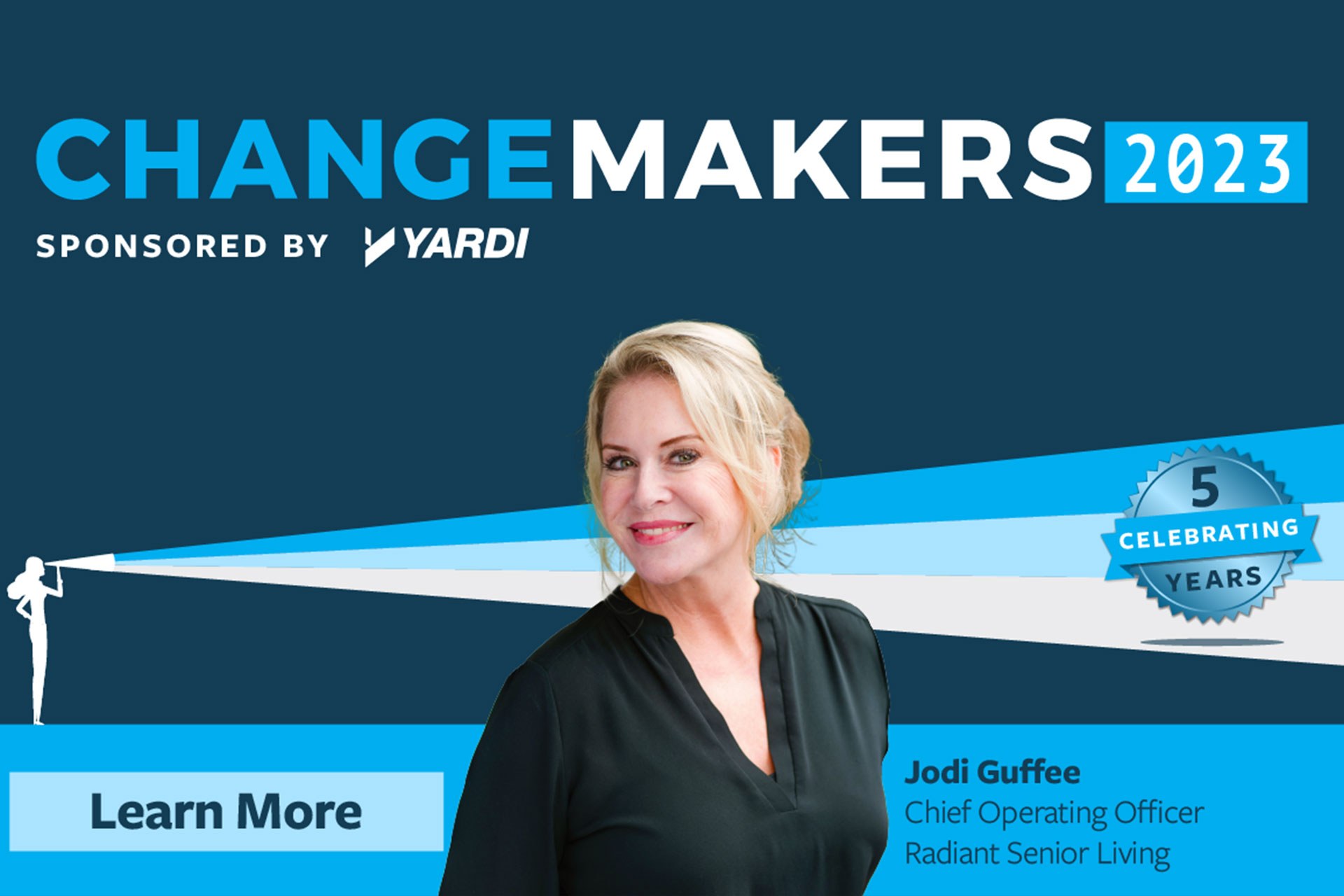
Yardi client Jodi Guffee named 2023 Changemaker
With over 20 years of experience leading Radiant Senior Living, Jodi Guffee has spearheaded initiatives that have changed the organization’s operations for the better. While she’s faced challenges throughout her career, it hasn’t stopped her from pushing boundaries in order to make Radiant — and the industry as a whole — a better place.
In her interview with SHN, Guffee shares what her journey has been like over the years — and reveals more about her initiatives at Radiant and what’s inspired them. She also shares her perspective on the senior living industry today (and her outlook on where it’s headed).
SHN: As you look across the rest of the senior living industry, do you think that it’s changing fast enough to keep up with the times?
Guffee: No. That’s a short answer, I know. There are several layers to that. Probably one of the biggest ones is funding: funding for staffing and funding for a generation that’s going to have a hard time paying for what we have to charge. We have a huge middle market segment that needs to be served, and we have models that are unaffordable for the most part.
There are some genius people out there really doing some cutting-edge stuff that I’m really looking into. I think it’s fantastic, but I don’t think that there are enough companies that can pivot quickly enough for us to be able to serve this baby boomer “silver tsunami.” We just don’t have the people to take care of them, and the people who are going to need our services may or may not be able to afford them. Where are we going to see some government subsidies for lower-income, reimbursement rates?
Our home offices are in Oregon. We have a very lucrative reimbursement rate for memory care, but not for assisted living. They aren’t very different [residents], but we have an extremely good reimbursement rate for memory care. We’re also pioneers here in Oregon. There are very few states that have good reimbursement for the private sector to be able to take some state or federal funding for residents that are low income because it’s not affordable.
SHN: Can you talk about a time when you tried to execute a change and things didn’t go according to plan? How did you pivot, and what did you learn as a leader?
Guffee: Gosh, there are so many. I’ll say that the ability to turn and pivot and see through different lenses is probably the key. [For example], when we were at the beginning of COVID and then in the middle of COVID and then coming out of it, we see the statistics are scary.
We lost 40% of our women in the workforce. In our setting, that’s a lot of the people. They had to either stay home to take care of children who were online schooling, or they couldn’t afford childcare, so it was more affordable for them to stay home.
That was and still is a very scary time in that everybody has a staffing shortage. What are we going to do about that? It kept me up at night for a long time. We were trying so many different things and being flexible, and things just weren’t working. We weren’t getting people back into the workforce.
Our entire industry, as you well know, took a major dip in our census. How are we going to pay for those good workers, too? Subsequently, we’re starting to rebound now. When I look back at it, there are a few things that I would have done differently — like real flexible schedules, bringing childcare into the community, and job sharing. Two people might have four kids in total and could have partnered them up for childcare.
It’s still a challenge. It’s starting to trickle back in. It’s not all the same workers, though, because as I mentioned we’re trying to find that new generation of people and inspire them. Some of the workforce we lost are coming back, but not all of them. It’s been frustrating, but what I think we’ve cracked the code on is that you have to meet people at their need.
We bring a resident into our communities and they have a very detailed care plan — from the fact that they like their coffee black at 8 AM to they need a shower assist. What we’ve started to do is recognize every single one of our employees or potential employees needs to also have their own “care plan.” We need to know very individually who these people are and how we meet them at their place of need.
We call this their “FORD,” which stands for their family, occupation, recreation, and their dreams. Once we’ve identified this in the first week, we’ve got this down to a policy and procedure and a QA that we follow implicitly.
At the end of week one, we task our department heads and others to find out at least two things about a new employee’s FORD. Then we get all together around that and we say, “This is what we really know about Sarah. She has two kids, she’s a single mom. These are her needs. She would love to take her kids to do some thing or other.” Then we come up with a personalized gift around that FORD and we send it to the home.
We don’t just give it to the employee, we send it to the home where their family will see how vested our company is in their mom or dad or whomever. Then it brings their family into our family. Then when mom has to work late or has to work a double shift or can’t make it home for dinner, there’s more grace in understanding why that’s happening and that we do care about her as a person.
Read Jodi Guffee’s interview with SHN
For more insights from Jodi Guffee, read her entire Changemakers interview. Have questions about how we help clients like Radiant succeed with our single-point software, designed uniquely for senior living? Reach out to connect with our team!