Voyager Suite
 Breeze
 Virtuoso
 Investment Suite
 RentCafe
 CommercialCafe Suite
 Elevate Suite
 Procure to Pay Suite
  Energy Suite
 Aspire
 RightSource
 Care Suite
 Matrix
 WorkCafe
 Yardi Kube Suite
 ScreeningWorks Pro
  Yardi Corom




















If you have not yet given in to the temptation to splurge on in-flight Wi-Fi, you are not alone. USA Today offers a relatively dismal assessment of the current state of the business. The low-lights include only a seven percent sign-up rate in 2011, and a tech bottleneck that severely limits bandwidth. The biggest barrier is convincing passengers to shell out up to $15 per flight, give or take, for the same subpar Wi-Fi service they get for free in the terminal.
However, change is in the air. Qualcomm is looking to rewrite the rules with its proposed in-flight 4G service, currently code-named ‘Next Gen-AG.’ That’s bad news for current in-flight 3G leader Gogo and rival Row44, but good news for passengers who want a robust connection at 30,000 feet. Qualcomm’s plan calls for about 150 cell towers to serve the nation’s skies, utilizing 500MHz of spectrum in the 14GHz band. What exactly does that get you? All the online services you currently enjoy on terra firma, while in the air.
The new cell towers connect directly with the planes (mobile devices do not have enough oomph to reach down for service from cruising altitude), which means each tower will distribute capacity among hundreds of planes at any given moment. At 300Gbps there is more than enough to go around. This would allow airlines to offer on-demand entertainment to each seat, as well as parcel out bandwidth to paying passengers via Wi-Fi.
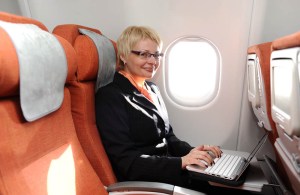 Next Gen A-G is far from imminent. Qualcomm is currently in the petitioning process, asking the FCC to clear that huge parcel of spectrum. Once the spectrum is cleared, it goes up for auction. Row44, which provides in-flight Wi-Fi for Southwest flights, is opposing Qualcomm’s proposal on various grounds, chiefly a lack of need and potential interference with adjacent bands.
The broadband network provider is being aggressive with its plans. Most importantly, Qualcomm has the support of American Airlines, Virgin American, and Delta Airlines, this according to filings with the FCC. With a full-court press officially on, expect the petitioning timetable to move quickly. On Jan. 30, the FCC responded with its first draft of several technical questions, which Qualcomm answered the very next day.
One important question remains: will passengers care enough about the extra bandwidth to pay for it? Aside from the cost barrier, there is a psychological one. For many travelers, airplanes offer a convenient opportunity to unplug and find refuge from the office. But 4G service promises access to a host of cloud-based goodies: movies, TV episodes and webisodes, music, gaming, and more.
What do you think – have you used any of the current in-flight Wi-Fi services? Do you want to stay plugged in (for work or entertainment) while you are in the air, or would you miss the luxury of hanging out a “Gone Fishin’” sign while you fly?