Voyager Suite
 Breeze
 Virtuoso
 Investment Suite
 RentCafe
 CommercialCafe Suite
 Elevate Suite
 Procure to Pay Suite
  Energy Suite
 Aspire
 RightSource
 Care Suite
 Matrix
 WorkCafe
 Yardi Kube Suite
 ScreeningWorks Pro
  Yardi Corom



















Every two years, Tokyo hosts its own Motor Show. This year’s gathering was filled with fun and futuristic designs. Some have Wi-Fi capability, others are developed to drive autonomously, and some concepts come with augmented reality technology. Cars are not what they used to be.
This is the case for the Mitsubishi eX concept car, a pure electric SUV with an intriguing design the company claims has a range of 248 miles (400km) on a single charge. The Japanese carmaker mounted underneath the body a battery pack they called “high performance” and “high-capacity.” The battery feeds power to two electric motors, which comprise the concept’s Twin Motor AWD (all-wheel drive). Moreover, it has semi-autonomous functions including an self-parking feature and highway driving assistant. Yet, probably the most attractive feature is the windshield that turns into a display. You’d think such an addition might seem a distraction, but actually it’s quite the opposite. Augmented reality can add web-surfing information and entertainment value to a car, but it can also improve safety.
The augmented reality windshield has the special mission to keep the driver’s eyes glued on the road ahead displaying information normally shown on the screen mounted on the dash into the driver’s forward field of vision. Furthermore, a car capable of sensing its surroundings could alert the driver via the windshield about the unseen pedestrian in a blind spot, it could warn of potential collisions 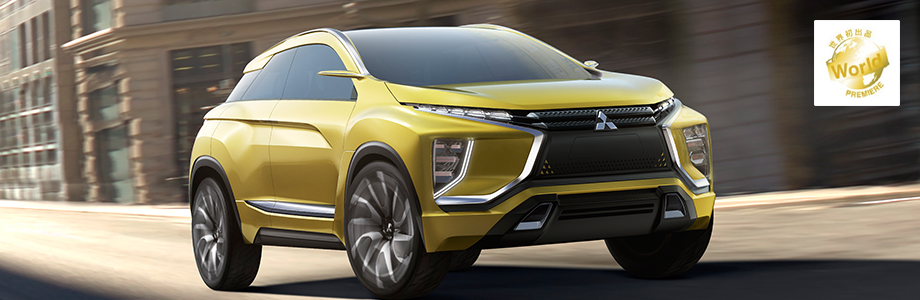 with other vehicles, direct lane changes and even illuminate objects in the dark by outlining them on the windshield.
The AR windshield is fitted with the Caution Tracking feature which employs driver assistance technology and includes navigation route guidance, vehicle-to-vehicle distance alerts, lane departure warning, and traffic sign alerts to display guidance and warnings on information outside the driver’s field of view, such as vehicles and pedestrian s approaching, but hidden from the driver. This information is gathered by the onboard high-definition camera-based road sign recognition system. Additionally, the side-view and rear-view mirrors have been replaced with high-definition cameras and screens, reducing the amount of eye movement the driver has to make, while providing a wider and clearer image than the a conventional car mirror.
The Mitsubishi eX holds in the center dash the Information Display (ID), which deals with less critical infotainment presentation. The ID has its own artificial intelligence (AI) which, when paired with the cloud by the way of a smartphone, it can make recommendations for the driver based upon their hobbies interests, as determined by the cloud information.
The crossover comes with one funny feature too—the rubber-coated fascia components, specifically on the underside and the sides where contact is possible with people or obstacles. Mitsubishi eX – where the conventional befriends the future.