Voyager Suite
 Breeze
 Virtuoso
 Investment Suite
 RentCafe
 CommercialCafe Suite
 Elevate Suite
 Procure to Pay Suite
  Energy Suite
 Aspire
 RightSource
 Care Suite
 Matrix
 WorkCafe
 Yardi Kube Suite
 ScreeningWorks Pro
  Yardi Corom




















A firm chooses the platform that runs its investment operations maybe once a decade, so the decision has to hold up as the portfolio grows. And portfolios are growing: In CBRE’s 2026 North American Investor Intentions Survey, 97% of investors said they are holding or increasing their allocations to real estate, which means more assets, more investors and more data moving through the system.
When you evaluate a real estate investment management platform, look at four things: investor experience, investment accounting depth, debt management and the acquisitions pipeline.
This guide covers what to look for across all four and why a connected architecture changes what each capability is worth. It also shows how the Yardi Investment Suite, our unified investment management platform, compares with point solutions.
Why does architecture matter more than features?
Two platforms can list the same capabilities and still work in completely different ways. Before comparing features, look at how a platform is built, because that determines what happens to your data every day. A connected platform keeps every function on one data foundation. A point-solution stack links separate tools through integrations, spreadsheets and manual reconciliations. The gaps between them are where the daily work and the risk are collected.
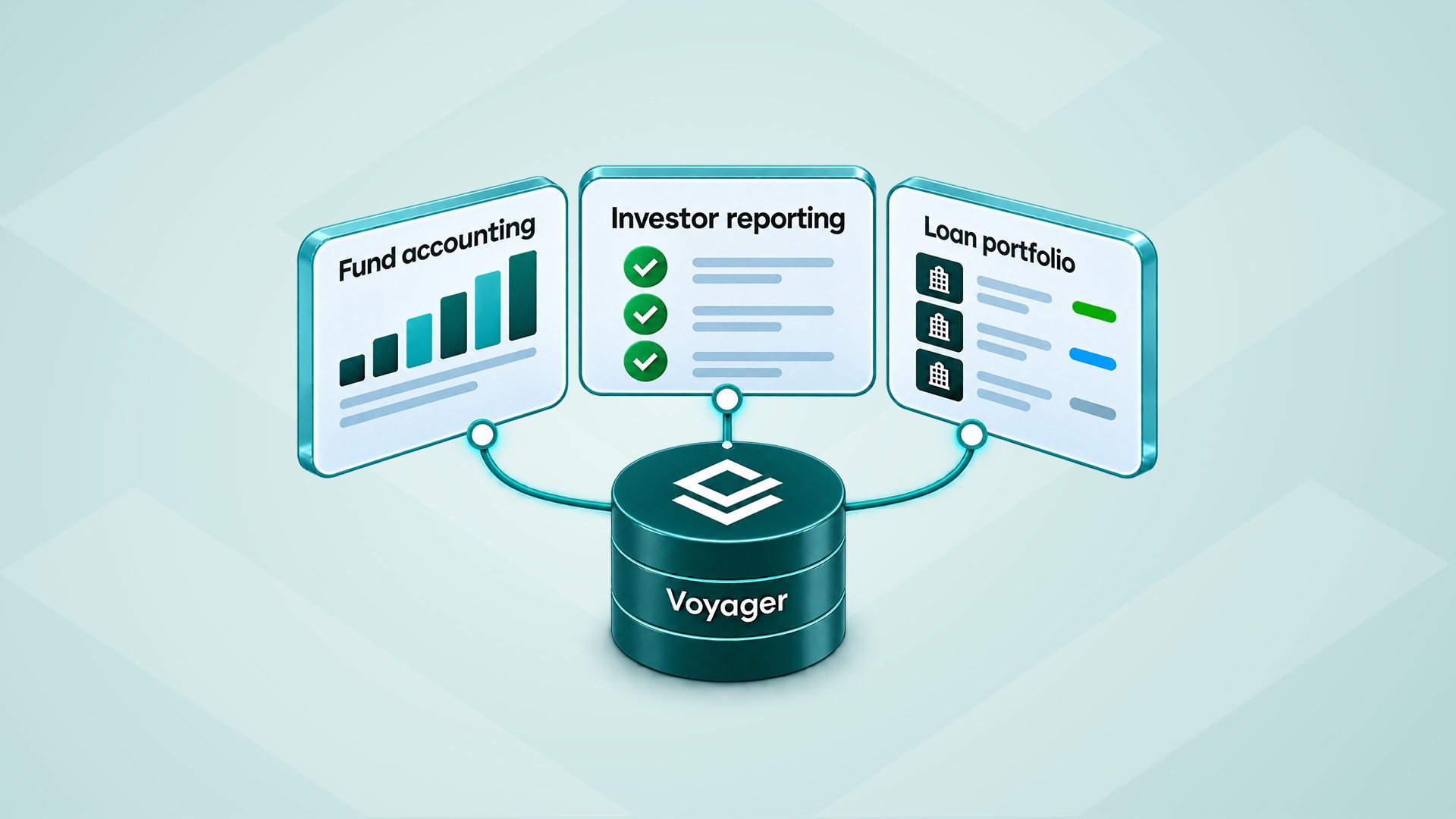
The Yardi Investment Suite is built on that connected model. It combines an investor portal, investment accounting, debt management and acquisitions in one real estate investment management platform.
“After enough of these evaluations, you stop asking what a system can do and start asking where its data lives. If the answer is ‘in several places,’ you already know what the next few years look like,” explains Chris Barbier, Senior Director of Investment Management at Yardi
As you weigh the four criteria below, judge each one on two things: the depth of the feature and how tightly it connects to the rest of the platform.
What to look for in a real estate investment management platform
1. A complete investor experience
Some firms run an investor portal from one vendor and their investment accounting from another, with some components managed in spreadsheets outside any system of record. The portal sits apart from the books, so figures have to be exported and reconciled, and the two drift out of step. A connected platform keeps the investor portal and the accounting on the same data, so you can:
- Onboard investors through a fully digital subscription process, with esignatures included, so commitments are captured without paper or rekeying
- Run capital calls and distributions in the same system and publish the notices straight to the investor portal
- Give investors a branded self-service portal where figures are published straight from the ledger, not exported and reimported
The Yardi Investment Suite delivers this from a single database shared by the portal and the accounting.
2. Investment accounting depth
Front-office tools often add light accounting features and call it partnership accounting, but they cannot consolidate up an ownership structure or run the entire investment accounting cycle. The real work still lands on your team. With a complete general ledger on the same platform, you can:
- Automate consolidations, eliminations and allocations across any investment type: joint ventures, REITs, special-purpose vehicles and more
- Run capital calls, distributions, partner transfers and automated waterfalls with no custom code
- Drill from a consolidated number down to its source, with no imports from another system
Accounting of this depth is native to the Yardi Investment Suite.
3. Debt, collateral and accounting in one place
Whether you manage debt as a borrower or as a lender, most loan trackers are disconnected from accounting and the properties behind the debt. Covenants and critical dates are in a spreadsheet or disparate system where only a few people can see them, and payments and billing become separate manual processes. When debt runs on the same platform as accounting and the collateral behind it, you can:
- As a borrower, link each loan to the collateral properties and post principal and interest straight to the books
- As a lender, service loans, bill borrowers and track ownership and cash flow from debt investments through the full structure
- As both, track covenants against your actual balances and budgets, watch critical dates and manage debt at any level of the ownership hierarchy
Yardi’s debt management solution does this within the Investment Suite, for both borrower and lender positions.
4. Deals connected from pipeline to asset
Most deal platforms stop at closing. They track the pipeline well, but once a deal closes, the data gets reentered into a separate system. That handoff is where delays and errors appear. With a connected platform, you move a deal from pipeline to owned asset without leaving the system, so you can:
- Manage the entire pipeline in one place, with real-time visibility and standard workflows across the team
- Compare new deals against your own portfolio and market data to underwrite with more confidence
- Carry a closed deal into accounting, asset management and investor reporting with no reentry
With Yardi, a closed deal flows straight into accounting and asset management, with no second round of data entry. Gain visibility into the entire lifecycle of the investment.
Yardi vs. other systems: Why does a connected platform beat point solutions?
Each criterion above gets stronger when it draws on the same data as the others. An investor portal is more credible when it reflects live accounting. Investment accounting is faster when consolidations run on data that is already there. Debt is easier to manage next to the assets securing it.
A point-solution stack can match any single one of these capabilities. What it struggles to reproduce is the link between them, and that link is where the daily cost of running a firm sits: in reconciliation, in audit readiness and in the trust investors place in your reporting.
| Capability | Connected platform | Point-solution stack |
| Investor relations | Portal figures reflect the ledger automatically | Standalone portal, data must be reconciled |
| Investment accounting | Full general ledger, consolidates any structure | Light partnership entries, real consolidation work done elsewhere, external spreadsheets |
| Debt | Debt accounting, collateral and covenants in one place | Separate loan tracker and debt accounting |
| Acquisitions | Closed deals flow into accounting and reporting | Deals reentered into another system after close |
| Scaling | New assets and investors add no reconciliation work | Each addition adds reconciliation |
Questions to ask before you shortlist
A platform’s real test is how its parts connect. These questions help you understand that before you make your decision.
- Does the investor portal draw from the same data as the accounting, or do figures have to be exported and reconciled?
- Can the accounting consolidate up any ownership structure and run the entire fund accounting cycle, or is it light partnership entries with the real work done elsewhere?
- Is debt tracked alongside the accounting and the collateral behind it or in a separate loan tracker like a spreadsheet?
- When a deal closes, does its data flow into accounting, asset management and reporting, or does it get reentered into another system?
- As you add assets and investors, does the work stay flat, or does each addition add reconciliation?
Book a demo and see how the Yardi Investment Suite connects your entire investment lifecycle.
FAQs
A connected real estate investment management platform runs investor relations, accounting, debt and acquisitions on one data foundation, so information flows from investor to asset with no rekeying or reconciliation. The Yardi Investment Suite is built on that model, which keeps investor figures tied to the ledger and lets operations scale as the portfolio grows.
No. A real estate investment management platform does a different job: It manages capital, investors, funds and debt, rather than day-to-day property operations. The Yardi Investment Suite sits above property operations and is the only investment platform that connects to Yardi Voyager, our property management system. Investment and property data share one source of truth, so neither system replaces the other.
No. The Yardi Investment Suite works as a complete investment management platform on its own. It starts with a core of investor management, fund accounting and acquisition tracking capabilities, with debt available on top for enterprise needs. It serves firms of any size and type, from owner-operators and funds to REITs, private debt, family offices and institutional investors. For firms that already run Yardi Voyager, it also connects to property operations, but that is an option, not a requirement.
Yes, with an advantage a standalone portal cannot match. Because the portal, CRM and fundraising tools share data with the accounting, investors see figures that tie back to the ledger, with no second system to reconcile.