

 Voyager Suite
 Breeze
 Virtuoso
 Investment Suite
 RentCafe
 CommercialCafe Suite
 Elevate Suite
 Procure to Pay Suite
  Energy Suite
 Aspire
 RightSource
 Care Suite
 Matrix
 WorkCafe
 Yardi Kube Suite
 ScreeningWorks Pro
  Yardi Corom



















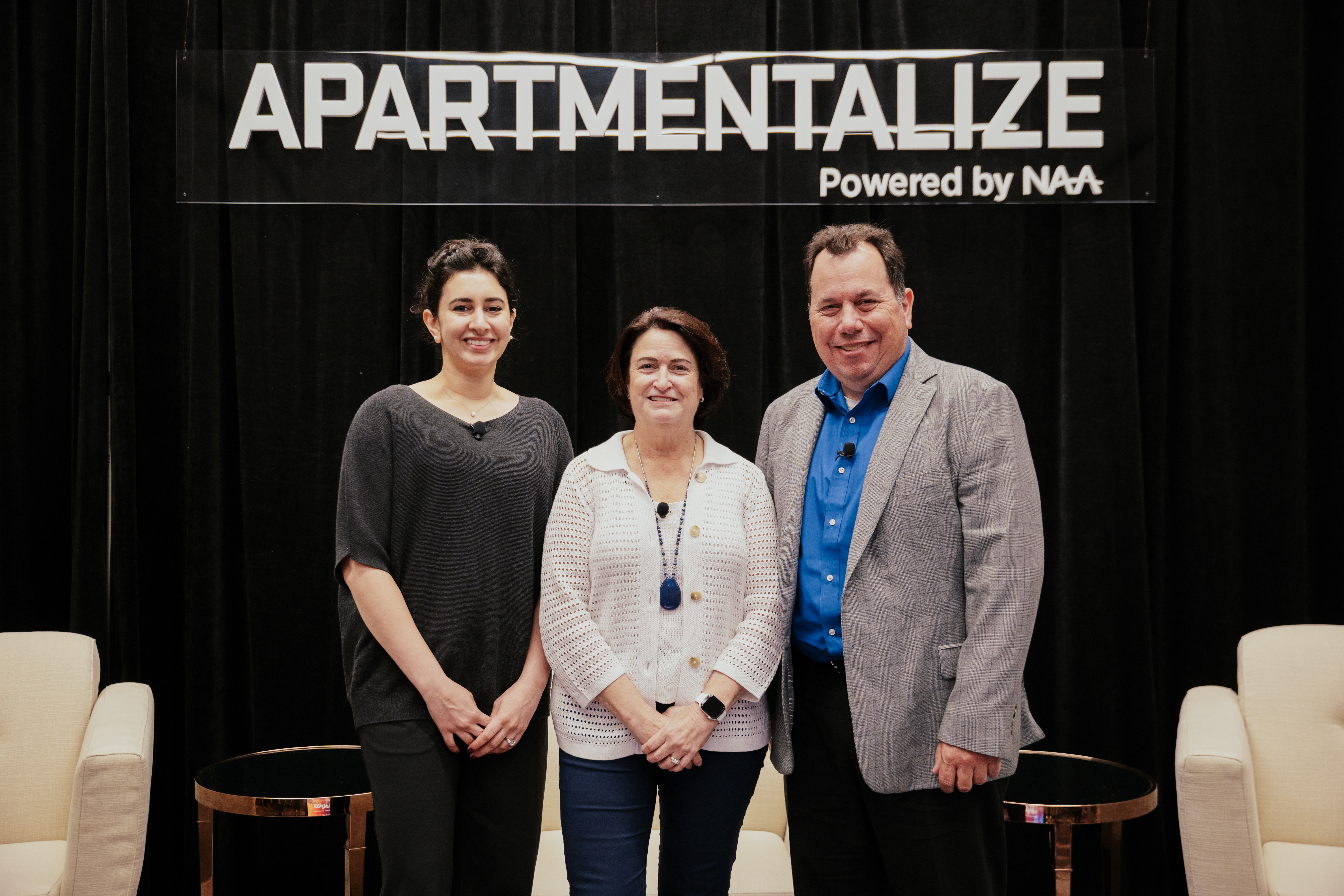
At the 2026 NAA Apartmentalize conference in New Orleans, Cindy Fisher, president of KETTLER, joined Yardi industry principals of applied AI Joe Consolo and Shivani Kumar for a packed session titled “Agents of Change: How AI is redefining rental housing performance.” The session looked at KETTLER’s real-world experience deploying agentic AI in multifamily and gave attendees a practical framework for doing the same.
What agentic AI actually in multifamily looks like
Joe opened with how AI focused on resident and prospect interactions has driven the conversation for years. The next evolution is agentic AI, software agents that automate business processes end to end.
“What if you could save 20% of your labor dollars by automating repetitive tasks and workflows through AI?” Joe asked the audience. “Think about how hard you work to get a $10 or $20 per unit savings. This is exponential change.”
The potential savings are only part of the story. The bigger opportunity is what teams can do with the time they get back. The session’s message was consistent that AI agents join the workflow as an added role. They don’t replace employees.
3 keys to deploying AI successfully
Before turning to KETTLER’s use cases, Joe outlined three priorities for any successful AI deployment: security, data access and change management.
The first priority is security, which includes three key elements. These are storing data in a secure cloud environment, maintaining user permissions and access controls, and using enterprise-grade licensing for large language models (LLMs). On that last point, Joe noted that only about 5% of the audience indicated they were already using enterprise licenses. Without an enterprise license, your data may be used to train public models.
The second priority is data access. Agentic AI needs to understand the context of your data to make informed decisions and take action. “It needs to understand the difference between a unit and a vendor, or a property and a vendor,” Joe said. Consistent, context-aware data access through approaches like Model Context Protocol helps minimize errors and improve reliability over time. This is also where a connected platform pays dividends. Clean, consolidated data gives AI agents what they need to perform accurately and consistently.
The third requirement is change management. “This is something a lot of people overlook when it comes to implementing AI,” Joe said. Concerns about job security are real, and when teams feel uncertain, resistance often follows. Involve employees early, align initiatives to business drivers and measure progress along the principles that have driven successful change. With agentic AI multifamily, these actions are important.
KETTLER’s approach to agentic AI in multifamily
Cindy took the stage with a clear message about what deploying AI agents takes.
“This is a two-year journey that I’ve been on with KETTLER to figure out what we’re going to do,” she said. “We didn’t start with ‘Let me bring in AI.’ I started with, ‘Where are we today?’”
That meant auditing their existing technology stack, identifying where consolidation was possible and mapping every major workflow. KETTLER gathered their teams to surface the friction points for different groups within their company, including onsite, accounting, central office and leadership.
“You’ve got to know your workflows. You have to do your homework,” Cindy said. “We had to step back, look at those workflows and ask our users, all our site teams, where’s the biggest friction? What are those things that could be better?”
That process became the foundation for every AI use case KETTLER has deployed since.
Real results from real deployments
Invoice entry
KETTLER’s first use case was AI-powered invoice processing. All invoices now flow into a centralized services function, where an AI engine handles data entry and coding.
The results included invoice processing time dropping 86%, falling from seven days to one. More importantly, KETTLER was able to scale its portfolio without adding headcount to the central office.
“With the growth we’ve been experiencing, I was going to have to start hiring people,” Cindy said. “We eliminated that need, and we’ve been able to grow and scale from there without having to add people.”
Invoice approvals
The second phase brought AI agents into the approval workflow. Rather than routing every invoice to a team member, KETTLER configured business rules to let predictable invoices flow through automatically. These included utilities, recurring service contracts and similar line items where approval is essentially guaranteed.
“We believe we’re going to get 40-50% of our invoices approved automatically,” Cindy said. At roughly two minutes per approval step, that adds up to more than 6,500 hours saved per 100,000 invoices processed.
She was candid about a lesson learned early in the rollout. Her team flagged that invoices were getting stuck in exceptions because they were over budget. The instinct was to fix the budgets. Cindy’s question cut to the heart of the issue: Would the invoice get paid regardless? If yes, budget variance was the wrong control.
“You have to think through those levels,” she said. “Don’t over-control, because if you stop everything over budget, you’re going to stop your whole process, and it’s not going to do anything.”
Lease audit
KETTLER is now testing an AI agent that audits lease data against what is in the system. The goal is to catch discrepancies at the front end before they create downstream issues in billing and month-end close.
“If we can just make sure what’s on the lease is in the system, that’s going to help with GPR and clean up the data on the front end,” Cindy said. The agent does not change the approval workflow. Leases still go through the same human review, but the automated check reduces errors and protects revenue before issues have a chance to compound.
Governance, security & the program management office
One of the most substantive portions of the session was Shivani’s conversation with Cindy about the operational infrastructure KETTLER built to support its AI strategy.
KETTLER launched a formal program management office (PMO) in December, along with a governance board that brings together leadership from across the organization, including its development and investment teams. The PMO maps the roadmap, prioritizes initiatives and holds the organization accountable to a measured execution plan.
Security was not just a checkbox. Cindy described the contract negotiation process with Anthropic as a three-month effort, involving conversations with Yardi and KETTLER’s infrastructure partner to understand what controls needed to be in place and how to document them for owners and clients.
“No data leakage. The access to data is still permissioned so that the right people are getting access to the right data,” she said. “We picked enterprise licensing because that had the best controls.” She noted that cybersecurity audit questionnaires have grown significantly as a result of AI. What used to be five questions is now five pages.
KETTLER’s broader rollout will start with a beta group of roughly 20 users, each with a defined use case, mandatory training and a requirement to report outcomes. That measured approach reflects a principle Cindy returned to throughout the session — deploy carefully, monitor closely and hold the gains.
From dashboards to insights to action
The session closed with a live example of what AI-native intelligence looks like in practice. During a recent executive meeting, a financial statement on a particular asset looked off. Rather than pulling in her team to investigate, Cindy asked Virtuoso Connectors, Yardi’s MCP Tools connected to Claude, for a budget-versus-actual variance analysis.
“In two minutes, it came back and said ‘There’s nothing wrong, you just have something coded wrong. Your revenue for this commercial space is sitting in residential. If you consolidate it, it would be fine,’” Cindy said. “Take that example and think how quickly we could get people from dashboards to insights to action. That is the ultimate goal.”
Results still need to be validated. The AI surfaces the finding, and people confirm it. But the shift in speed is real.
“I couldn’t stop myself,” she said. “I kept asking questions. It is exciting.”
What operators should take away
The session’s closing message made it clear that this is not a technology initiative you can simply hand off to IT. It requires top-down strategy, well-documented processes from the people doing the work, strong governance around security and a technology partner capable of bridging business requirements with technical execution.
“You don’t boil the ocean on this,” Cindy said. “You have to do your work. You have to think about what you’re doing.”
Start with your highest-friction workflows. Define the current state. Measure it. Deploy carefully and monitor closely. The results compound from there.
Ready to explore what agentic AI in multifamily can do for your portfolio? Connect with our team to learn about Virtuoso Enterprise.