Voyager Suite
 Breeze
 Virtuoso
 Investment Suite
 RentCafe
 CommercialCafe Suite
 Elevate Suite
 Procure to Pay Suite
  Energy Suite
 Aspire
 RightSource
 Care Suite
 Matrix
 WorkCafe
 Yardi Kube Suite
 ScreeningWorks Pro
  Yardi Corom



















Living in a futuristic utopia might be closer to reality than we realize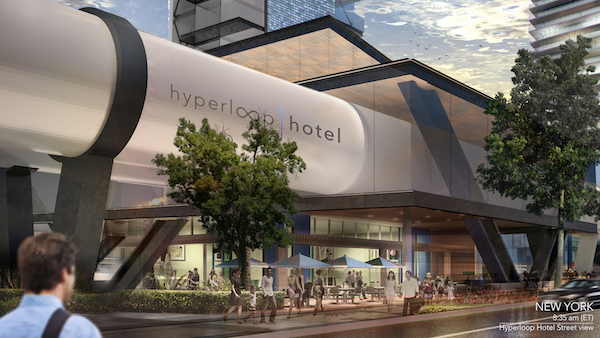 . Brandan Siebrecht, a graduate architecture student at the University of Nevada, Las Vegas, revealed an ingenious hotel design that combines transport with accommodation. The concept aims to transform Elon Musk’s innovative Hyperloop One into a high-speed transit hotel.
The Hyperloop Hotel shoots guests through tubes from city to city in a blink of an eye, all while never leaving their pod-like rooms. The concept enables travelers to manage everything from reservation, check-in and check-out from a device or a smartphone app. Basically, this futuristic transit system involves using magnets to levitate pods inside an airless tube, creating conditions in which the floating pods shuttle at near supersonic speeds. Guests would feel almost no sense of motion.
The hotel concept uses sustainable, modular design in the form of shipping containers, all outfitted for luxury. Featuring customizable layout and design, each capsule includes an office, bedroom, bathroom and a living room. When arriving at destination, the shipping container “suite” simply docks to a modular hotel.
13 U.S. destinations
Siebrecht’s proposal includes the following travel stations across the U.S.: Austin, Texas; Boston; Chicago; Denver; Las Vegas; Los Angeles; Nashville, Tenn.; New York; Portland, Ore.; San Francisco; Santa Fe, N.M.; Seattle; Washington, D.C.
An award-winning hotel concept 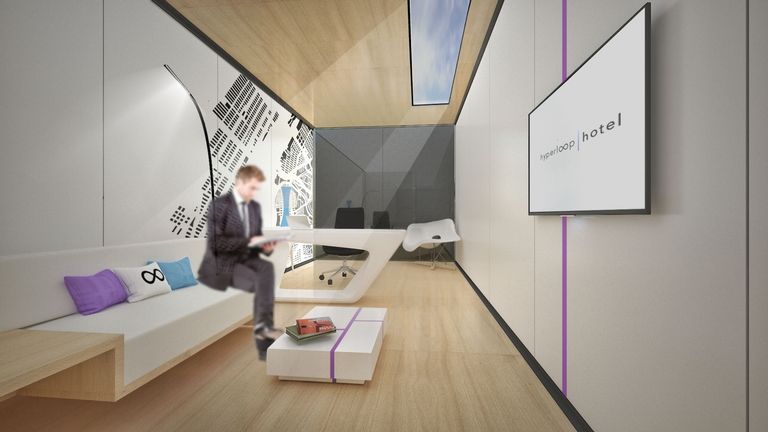
The Hyperloop Hotel is this year’s student winner of the Radical Innovation Awards, a competition for imaginative hotel designs, because it combines the comfort of a hotel with the convenience of speedy transportation, all in one. A jury of seven hotel investors, developers and architects selected Siebrecht’s idea out of over 65 submissions from 24 countries. The Radical Innovation team rewarded him $10,000 to develop the concept further.
Costs and feasibility
Siebrecht estimates each hotel will cost $10 million to build. So the whole project is currently evaluated at $130 million. Prices are estimated at a flat rate of $1,200, a sum that allows guests to access the entire network of cities. Individual night rates have not been calculated yet.
Since the technology a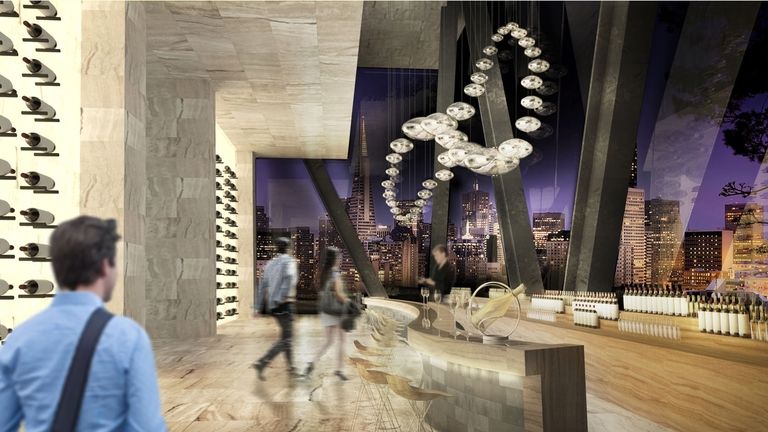 nd infrastructure to pull off this transport-accommodation hybrid don’t currently exist, there are no concrete plans to build the first Hyperloop Hotel. However, traveling to multiple cities without ever stepping foot outside could become a reality sometime during the next decade.
Inspired by Hyperloop One
Siebrecht’s brainchild picks up on billionaire tech entrepreneur Elon Musk’s Hyperloop transportation system—known as Hyperloop One—and takes it a step forward. A functional test track for Hyperloop One is being developed north of Las Vegas, in the Nevada desert. The system is energy-efficient, autonomous, and quicker than a plane. Tests have shown that one could travel between Los Angeles and San Francisco in approximately 34 minutes.
As this is an unconventional system, everything needs to be invented from the ground up. So the project is still conceptual and has experienced delays. Hyperloop One’s goal is to deliver a fully operational system by 2020. Since there’s not so much time left, you could start saving money to afford traveling IN your hotel room at light speeds.
Images courtesy of Brandan Siebrecht via Pinterest.