


 Voyager Suite
 Breeze
 Virtuoso
 Investment Suite
 RentCafe Suite
 REACH by RentCafe
 CommercialCafe Suite
 Elevate Suite
 Procure to Pay Suite
  Energy Suite
 Aspire
 RightSource
 Care Suite
 Matrix
 Yardi Kube Suite
 ScreeningWorks Pro
  Yardi Corom

















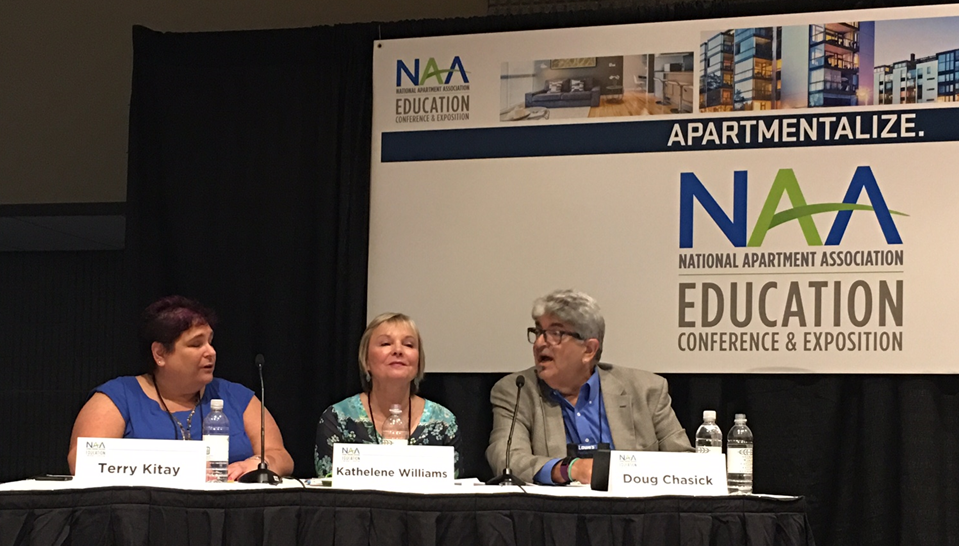
This week’s NAA Education Conference & Exposition kicked off with a special session on Fair Housing, The New Five: Fair Housing Issues You Didn’t Know About.
Panelists Doug Chasick, President, The Fair Housing Institute; Theresa Kitay, Attorney, Law Firm of Theresa L. Kitay; and Kathelene Williams, Partner, Williams & Edelstein, P.C. led the discussion.
The team compiled a list of five hot topics in Fair Housing that can be confusing due to recent changes and ambiguities. The forum discussed best practices to help housing professionals avoid liability.
Chasick opened with a piece of general advice before diving in: let common sense comes to the rescue when gray areas arise. “Take off your Fair Housing hat and put on your ‘Do I want to be the next slide in their presentation’ hat,” he laughs.
“We can’t forget the, ‘Be a decent person’ hat,” adds Kitay.
Below are the panelists’ recommended best practices:
- Occupancy Policies – Many properties rely on a two occupants per bedroom standard. The panel suggests reconsidering that standard, as it can lead to disparate impact claims from families with children. Consider two people per bedroom, plus one per unit as a base.
Additional considerations might include items listed in the Keaton Memo, special circumstances such as the age of kids (e.g. exclude infants from occupancy rules), the size of rooms, and extra finished rooms like libraries or lofts that can safely serve as a sleeping quarters.
When it comes to evictions or rejecting an application based on past troubles, victims of domestic violence may also require additional occupancy consideration. See statement HUD 16-159, issued Oct 24, 2016 for additional details.
- Immigration Status vs. National Origin – Immigration status is not a protected category in Fair Housing in most states. National origin, however, is a federally protected category.
Housing providers may question applicants about their legal status if they can assure that the question is consistently asked of all applicants without exception, ever. Otherwise, Williams recommends “not prioritizing” the question.
Conversely, housing providers should avoid questioning applicants about their national origin.
Federally assisted housing providers should consult federal guidelines regarding language proficiency as well.
- Criminal History – Rigid criminal history policies such as “no felonies” or “no arrests,” will place housing providers at risk.
“Have a reasonable look back period,” suggests Chasick. “And adjust it based on the type or severity of crime.” Misdemeanors may have a shorter look back period than felonies, for example.
“There is a felony, and then there is a felony,” adds Kitay. “Have a way for applicants to provide additional mitigating info, especially if that’s the only thing in the policy that may be holding them back. It doesn’t have to change your mind but there are things worth considering.”
- Harassment – Any harassment claim involving residents, staff, or vendors must be taken seriously. The panelists recommend three basic steps: conduct investigation, document, and discipline as needed.
- Assist Animals – Chasick notes an increase in discrimination claims regarding people with disabilities and their service animals. This is due to a rise in websites that claim to provide prescriptions for a service animal or emotional support animal. These sites often sell kits that include an embellished vest, leash, and certificate for a companion pet to act as a service animal.
“It’s a scam,” says Chasick. “Many times, the residents don’t know they are scams.”
Kitay recommends requesting additional documentation from a doctor if in doubt of a certificate’s legitimacy.