Voyager Suite
 Breeze
 Virtuoso
 Investment Suite
 RentCafe
 CommercialCafe Suite
 Elevate Suite
 Procure to Pay Suite
 Energy Suite
 Aspire
 RightSource
 Care Suite
 Matrix
 WorkCafe
 Yardi Kube Suite
 ScreeningWorks Pro
 Yardi Corom



Key takeaways
- Yardi is the top-rated property management software in our evaluation, standing out for its ability to support every portfolio size and asset class on a single platform. With Yardi Virtuoso AI natively woven throughout the Yardi Voyager platform, $0 ACH fees for tenants, unlimited live support and a native upgrade path that eliminates the need for system migrations as organizations grow, Yardi offers a combination of capabilities that few direct competitors match.
- AppFolio addresses the needs of mid-market property management firms focused on workflow automation, while Entrata and MRI Software offer capabilities tailored to enterprise multifamily and commercial portfolios, respectively.
- Free-for-landlord tools (TurboTenant, Innago) cover core needs for portfolios under 50 units but require re-platforming as you grow – operators expecting to scale should factor that transition cost into their platform decision.
- The most common triggers for switching platforms: inadequate live support, inflexible reporting, hidden transaction fees and scalability ceilings that force a full migration rather than an in-platform upgrade.
The best property management software is the one built for your portfolio size, your asset class and the accounting depth your operation requires, consolidating rent collection, leasing, maintenance and reporting in a single platform.
To identify the best property management software solutions for 2027, we evaluated each platform based on the factors that matter most to today’s property managers, including accounting capabilities, governance, controls, audit ability, leasing and maintenance tools, user experience, AI and automation, reporting, pricing transparency, customer support and long-term scalability.
How the top PM platforms compare at a glance
The table below summarizes key decision factors across all property management (PM) platforms.
A side-by-side comparison of leading property management platforms across pricing, support, upgrade path and included AI automation.
Competitor information reflects publicly available sources as of October 2026.
Top 10 property management software solutions
Yardi stands out as a top-rated property management software in our evaluation, combining a unified platform with AI-powered capabilities that simplify operations at every stage. Built for everyone from small portfolios to enterprise organizations, Yardi scales with your business, eliminating the need to switch platforms as your needs evolve.
AppFolio and Entrata are options for professional property managers, while Innago covers the basics for independent landlords managing smaller portfolios.
Explore our detailed reviews of the 10 best property management software platforms below to determine which solution best aligns with your portfolio, operational needs and long-term growth strategy.
1. Yardi
Best for: Residential, commercial and mixed-use operators across all portfolio sizes: from growing independents to global enterprises requiring a unified platform with Yardi’s Virtuoso native AI ecosystem spanning every workflow.
Overview
Backed by more than 40 years of innovation and shaped by the real-world needs of property managers, Yardi has become one of the industry’s leading property management software platforms. Designed to be intuitive for everyday users yet powerful enough for large portfolios, Yardi helps operators streamline every aspect of property management from a single, unified platform.
Built-in Virtuoso AI enhances every workflow by automating routine tasks, delivering actionable insights and helping teams work faster with greater accuracy. The result is smoother operations, better decision-making and more time to focus on growing the business.
Yardi offers two primary entry points into its property management ecosystem, each providing access to the solutions and services that best fit your business model, portfolio type and operational needs.
Both software solutions share the same underlying database. Yardi Breeze is designed for small, midsize and growing operators managing up to 2,000 units or up to 5 million square feet of commercial space. Yardi Voyager is built to scale for enterprise organizations managing multi-entity or mixed-asset portfolios.
Yardi Virtuoso is the AI layer that spans the entire ecosystem. It includes native AI agents built into core products, a platform-wide AI assistant, Premium Agents with quantifiable ROI (Smart Approval, Lease Audit Analyst, Vendor Payment Terms Specialist, Month-End Close Coordinator), a no-code agent builder and marketplace (Virtuoso Composer) and Connectors that give executives natural-language access to live portfolio data through their preferred LLM (large language model).
Key features
- Accounting: Full general ledger with multi-entity, multi-currency and consolidation reporting. Non-modular architecture eliminates periodic posting and AR/AP month-end reconciliation between modules. Audit trails, investor-level financial packages and budgeting and forecasting built in.
- Leasing and marketing: End-to-end lead-to-lease workflows, digital applications, automated screening, online lease execution. Chat IQ enables agentic leasing across email, phone, text and chat, handling prospect inquiries and scheduling autonomously. RentCafe property websites, ILS (internet listing site) syndication and CRM tools support prospect engagement and resident communication across the platform.
- Maintenance and facilities: Maintenance IQ provides work order management, inspections, unit turns, preventive maintenance scheduling and inventory management (50,000+ maintenance professionals, 3.1 million units). Facility Manager covers commercial facilities. Both are fully integrated, with no data transfers or separate systems.
- Resident and tenant engagement: RentCafe resident and tenant portals, Chat IQ for 24/7 AI-powered communication, CRM IQ for relationship management and a call center service for after-hours support.
- Asset and investment management: Portfolio analytics, investment accounting, acquisition management, debt management and performance dashboards, from underwriting through asset disposition in a single connected workflow.
- Procurement and energy: Procure-to-pay with automated invoice processing, vendor management via VendorCafe, utility billing and energy management, all built into the platform.
- AI and automation (Virtuoso): Native AI agents built into core workflows: Chat IQ for 24/7 resident and prospect engagement, Smart Lease for AI-first lease abstraction, Smart AP for machine-learning invoice coding (free at the Breeze tier). The platform-wide AI assistant handles common queries without escalation. Connectors give executives natural-language access to live portfolio data. Virtuoso Composer enables custom no-code agent creation.
- Compliance: LIHTC (low-income housing tax credit), Section 8, HOME, HUD reporting, tax credit allocation and REAC (Real Estate Assessment Center) submission support for affordable housing operators.
- Learning: Yardi Aspire LMS with AI-powered course generation for staff training and onboarding.
- Support: Unlimited live chat support from 8:30 a.m. to 6:30 p.m. CT, Monday through Friday, included in Breeze pricing with no ticket queue, no tier restriction. Voyager includes a dedicated account manager, Virtuoso AI assistant and live technician escalation.
Pricing
- Residential: from $1/unit/month, $100/month minimum
- Commercial: from $2/unit/month, $200/month minimum
- Mixed: $200/month minimum
No onboarding fees. No ACH payment charges under a designated amount. Transparent pricing.
Things to consider
- Yardi is a complete system covering accounting, leasing, maintenance, reporting and more run natively. For operators migrating from tools like QuickBooks, Yardi’s built-in GL covers AR, AP and financial reporting alongside property operations, eliminating the need for a separate accounting program. Organizations migrating from QuickBooks should expect a natural learning curve.
- Voyager implementation timelines are longer than lighter-weight tools and require dedicated internal resources to complete successfully.
- Monthly minimums ($100 for Breeze residential, $400 for Breeze Premier) can make the effective per-unit cost higher for smaller portfolios.
Trusted by nearly 80% of the NMHC Top 50 multifamily owners and powering over 10 million multifamily units as of 2026, Yardi is one of the industry’s most widely adopted property management platforms. Its unified architecture enables organizations to grow from their first properties to complex enterprise portfolios without changing systems or migrating data.
HK Multifamily Management experienced that scalability firsthand. As the company expanded across multiple states, its manual processes became a barrier to growth. After implementing the full Yardi platform, the impact was immediate.
“The level of automation and flexibility allowed us to operate consistently across multiple states while maintaining control and performance. That’s when we fully committed to a technology-first approach. […] We were able to replace 40 hours of manual labor with our technology stack”, according to Ajay Banga, CEO, HK Multifamily Management .
The same operational benefits extend to smaller portfolios. Steve Daddeo, vice president of Development at Commercial Services Realty, says his team relies on Yardi for tenant screening, rent collection, lease drafting and resident communications while bringing a 200-unit community online.
“One of the biggest benefits of Yardi Breeze is that it updates the leases according to any changes in local state rules and regulations. That saves us time and legal fees”, said Steve Daddeo, vice president of Development, Commercial Services Realty.
Verdict
For property managers seeking a unified, future-ready operating platform, Yardi stands apart by combining a client-first property management platform with a native AI platform embedded directly into the workflows operators use every day. Yardi delivers intelligence across leasing, accounting, maintenance, operations and portfolio management from a single source of truth.
2. AppFolio Property Manager
Best for: Growing property management firms managing residential, student housing and mixed-use portfolios that prioritize streamlined leasing and day-to-day operations.
Overview
AppFolio combines AI-powered automation with a centralized, mobile-first platform to streamline leasing, maintenance and resident communications. It helps operators improve day-to-day operational efficiency rather than managing highly complex accounting structures or enterprise-level compliance requirements.
Key features
- Leasing and marketing: AI-assisted listing creation, automated lead-to-lease workflows, online applications with integrated screening.
- Maintenance: Smart bill entry, mobile inspections, work order management and unit turn tracking.
- Accounting: Native general ledger, CAM (common area maintenance) tracking and reconciliation, owner and vendor portals, corporate accounting.
- AI automation: Realm-X Performers (agentic AI) on Plus and Max plans. Basic AI tools, including Realm-X Assistant in Core.
- Portals: Resident, owner and vendor portals with a unified communications inbox.
Pricing
- Core: $1.49/unit/month
- Plus: $3.20/unit/month
- Max: $5/unit/month
Things to consider
- Custom reporting and workflow customization have limitations across accounting and maintenance. Confirm that out-of-the-box reports meet your owner and investor expectations before committing.
- Commercial capabilities are more limited than in dedicated commercial platforms, requiring, for example, workarounds to complex common area maintenance (CAM) and triple-net (NNN) charges. Organizations managing complex commercial portfolios should confirm whether lease administration and accounting functionality meets their requirements.
- Support varies by subscription tier. Organizations that require dedicated customer support should confirm service levels before purchasing.
Verdict
AppFolio is designed for residential and mixed-use property management firms seeking a straightforward platform for day-to-day operations. However, organizations requiring more advanced or configurable accounting capabilities, enterprise-scale workflows or support for larger and more complex portfolios may benefit from platforms offering greater configurability.
3. Entrata
Best for: Mid-market to enterprise multifamily operators, including student, military and affordable housing portfolios, seeking a unified platform with a strong focus on leasing and resident engagement.
Overview
Entrata provides a platform for leasing, maintenance, accounting, resident communications and reporting. It is particularly well suited to multifamily operators that prioritize streamlined lead-to-lease workflows and a centralized experience for on-site teams.
Its AI offering, ELI+, supports tasks such as content generation for resident communications, maintenance work order translation and reputation management. The Homebody resident services suite combines renters insurance, deposit alternatives, rent reporting and other resident services within the Homebody RXP app, alongside online payments, maintenance requests and amenity reservations.
Key features
- Leasing: Automated lead management, digital leasing workflows and SiteTablet for real-time on-site leasing.
- Accounting: Native general ledger, owner reporting and budget management.
- AI capabilities: ELI Essentials native in base plan, with ELI+ modules available at added cost for AI-assisted resident communications, content generation and maintenance support.
- Resident services: Homebody suite, including renters insurance, deposit alternatives and rent reporting, delivered through the Homebody RXP resident experience app.
- Compliance: Supports multifamily, student, military and affordable housing operations.
Pricing
Custom, quote-based pricing. Entrata does not publicly disclose pricing.
Things to consider
- Implementation: Organizations migrating from other property management systems should allow time to validate billing configurations and workflows during implementation.
- Document management: Some features, like bulk updates or custom reporting, may not be immediately intuitive and can require training or some trial and error to use effectively.
- Performance: Occasional page load delays can occur when working with large portfolios or data-intensive workflows.
Verdict
Entrata is a capable platform for multifamily operators focused on leasing, resident engagement and day-to-day operations. Organizations with complex accounting requirements, mixed-use portfolios or long-term growth plans should carefully evaluate whether its architecture, compliance capabilities and scalability align with their operational needs.
4. MRI Software
Best for: Institutional owners, large property management firms and organizations managing complex commercial and mixed-use portfolios with advanced lease administration requirements.
Overview
MRI Software is best known for its commercial real estate capabilities, particularly in retail, office and industrial portfolios with complex lease structures, service charge reconciliation and multi-entity ownership. Its open, API-driven architecture allows organizations to integrate MRI with a wide range of third-party systems, making it a common consideration for enterprise operators with established technology ecosystems.
MRI also supports global operations across North America, Europe, Australia and other international markets, making it suitable for organizations managing cross-border portfolios.
Key features
- Commercial lease administration: Advanced lease management, complex rent schedules, CAM and service charge reconciliation.
- Accounting: Multi-entity, multi-currency general ledger, consolidation reporting and investment management.
- Integrations: Open API ecosystem through MRI Partner Connect and MRI Information Exchange (MIX).
- AI capabilities: Data extraction and more via MRI Agora Artificial Intelligence.
- Global operations: Support for organizations managing international real estate portfolios.
Pricing
Custom, quote-based enterprise pricing. MRI does not publicly disclose pricing.
Things to consider
- Enterprise implementation: MRI typically requires a longer implementation and onboarding process than platforms designed for smaller portfolios.
- Learning curve: The platform’s breadth and flexibility can require more training for end users.
- Open architecture: While highly flexible, organizations are often responsible for selecting, integrating and maintaining more of their technology ecosystem than with unified platform approaches.
Verdict
MRI Software is a strong choice for organizations with sophisticated commercial real estate operations and complex lease administration requirements. Its flexible integration model and global capabilities make it particularly well suited to institutional operators with established technology ecosystems.
5. RealPage OneSite
Best for: Large multifamily and affordable housing portfolios where LIHTC, HUD and Section 8 compliance are primary operational requirements.
Overview
RealPage OneSite is the core property management platform within the RealPage ecosystem, designed for multifamily, student and affordable housing operators. Its compliance capabilities support LIHTC, HUD, Section 8, HOME and other affordable housing programs, making it a strong option for organizations that require robust regulatory reporting and compliance workflows.
Key features
- Compliance: Support for LIHTC, HUD, Section 8, HOME and tax credit compliance, reporting and certifications.
- Accounting: Full accounting suite including AP/AR, budgeting and financial reporting.
- Leasing: Lead-to-lease workflows, online applications and integrated tenant screening.
- Analytics: Portfolio-level reporting and benchmarking.
- Integrations: Native connections with RealPage revenue management, LRO (lease rent options) pricing and other RealPage services.
- AI capabilities: Lumina AI Workforce embedded in OneSite (June 2025). Agents span leasing, operations, facilities, finance and resident engagement.
Pricing
Custom, quote-based pricing. RealPage does not publicly disclose pricing.
Things to consider
- Support responsiveness can vary, with issue resolution taking longer for more complex enterprise requests.
- Implementation requires careful planning. Enterprise deployments typically involve dedicated internal resources and a structured implementation process.
- The core OneSite interface has a more traditional feel, while the newer “New Experience” interface continues to evolve through its rollout.
Verdict
RealPage OneSite is a strong option for enterprise multifamily and affordable housing organizations with demanding compliance requirements. Buyers should evaluate whether its implementation approach, support model and broader platform capabilities align with their operational priorities and long-term technology strategy.
6. Buildium
Best for: Third-party residential property management firms, HOA managers and student housing operators seeking a straightforward platform with predictable pricing and core property management functionality.
Overview
Buildium, part of the RealPage portfolio, is designed primarily for residential property managers and HOAs. Its straightforward onboarding and tiered pricing make it an accessible option for smaller portfolios, while its accounting, owner reporting and HOA tools cover the day-to-day needs of many residential operators.
Key features
- Leasing and marketing: Online applications, tenant screening and vacancy syndication to major listing sites.
- Accounting: Native general ledger, trust accounting and owner reporting.
- Maintenance: Work order management, vendor assignment and an optional maintenance contact center.
- Portals: Resident and owner portals with online payments and document access.
- HOA management: Violation tracking, board communications and architectural review workflows.
- AI capabilities: Lumina AI writing tools available on all price tiers. Full Lumina AI Workforce (Maintenance Agent, Leasing Agent, Resident Experience Agent, Business Operations Agent) on Premium plan.
Pricing
- Essential: Starting at $62/month
- Growth: Starting at $192/month
- Premium: Starting at $400/month, including API access and Buildium Marketplace
Things to consider
- Support experience may vary. Customer support responsiveness has changed in recent years.
- Scalability is best suited to residential portfolios. Organizations expecting significant growth or increasing operational complexity should evaluate long-term platform flexibility.
- Advanced reporting is limited. Custom reports often require exporting data for additional analysis.
- Integration options are narrower than some enterprise platforms. Organizations with extensive technology ecosystems should evaluate integration requirements carefully.
Verdict
Buildium is a solid choice for residential property management firms and HOA managers seeking an affordable, easy-to-use platform for everyday operations.
7. DoorLoop
Best for: Independent property managers, growing firms and self-managing owners seeking an easy-to-use platform for residential, commercial and mixed-use portfolios.
Overview
DoorLoop emphasizes simplicity, fast implementation and a modern user experience. Its QuickBooks integration appeals to operators that already manage accounting outside their property management software, while its streamlined setup makes it well suited to smaller portfolios looking to get up and running quickly.
As portfolios grow, organizations with more complex accounting, reporting or operational requirements should evaluate whether the platform provides the depth and scalability needed for long-term growth.
Key features
- Leasing: Online applications, tenant screening and built-in CRM for prospect management.
- Accounting: QuickBooks Online integration, native general ledger, CAM reconciliation and financial reporting.
- Maintenance: Work order management, vendor tracking and mobile maintenance requests.
- Portals: Tenant and owner portals with online payments and automated reminders.
- Marketing: Property website templates for vacancy marketing.
- AI capabilities: AI Assistant and AI Inspections available as add-ons on Pro and Premium plans.
Pricing
- DoorLoop One: $2.50/unit/month or $1.50/unit/month above 100 units
- DoorLoop Connect: $4/unit/month
- DoorLoop Multiply: $5/unit/month
Transaction fees apply to online rent payments and tenant screening. Some advanced features are available only on Pro and Premium plans.
Things to consider
- Financial management is best suited to smaller portfolios. Organizations with complex ownership structures or advanced reporting needs may require more robust accounting capabilities.
- Operators who outgrow DoorLoop migrate to a different platform. There is no native upgrade path equivalent to Yardi’s same-database Breeze-to-Voyager transition.
- Feature availability varies by plan. Many advanced capabilities require a Pro or Premium subscription, increasing the effective cost for some organizations.
Verdict
DoorLoop is a solid option for independent owners and smaller property management firms seeking a modern, easy-to-use platform.
8. Rent Manager
Best for: Independent residential and small commercial property management firms seeking comprehensive accounting, maintenance tools and accessible phone support without enterprise-level complexity.
Overview
Rent Manager is a mature property management platform designed for residential and small commercial portfolios. It delivers the core capabilities most property managers need (including a full general ledger, tenant and owner portals, work order management and vacancy marketing) while offering both cloud-hosted and on-premise deployment, a deployment model that has become increasingly uncommon among property management platforms.
One of Rent Manager’s distinguishing strengths is its accessible phone and email support, an important consideration for organizations that value direct assistance. The platform has also expanded its automation capabilities through the Orion AI suite, which helps streamline administrative tasks and reporting.
Key features
- Accounting: Full general ledger, trust accounting, owner statements and financial reporting.
- Maintenance: Work order management, vendor tracking and property inspections.
- Portals: Tenant and owner portals with online rent collection.
- Deployment: Cloud-hosted or on-premise deployment.
- Support: Phone and email support.
- AI capabilities: Orion AI for invoice and receipt processing, check scanning, writing assistance and report summaries.
Pricing
Custom, quote-based pricing. Rent Manager does not publicly disclose pricing.
Things to consider
- User experience: The interface reflects a more traditional enterprise software design and may require additional training for new users.
- Long-term scalability: Rent Manager is a good fit for professional property managers handling complex portfolios. If you’re running small operations or you’re making the transition from a simpler system, a lengthy onboarding period is customary.
Verdict
Rent Manager is a dependable choice for independent property management firms seeking strong accounting capabilities, flexible deployment options and responsive customer support. It is particularly well suited to organizations that value stability and core functionality over a modern interface or a broader enterprise ecosystem.
9. TurboTenant
Best for: Independent landlords managing fewer than 50 units who want to replace paper-based processes with a free, easy-to-use property management platform.
Overview
TurboTenant is a landlord-focused platform that offers core property management tools without a monthly software subscription. The platform is funded primarily through tenant-paid application and screening fees and covers the essentials of self-managing rental properties, including online rent collection, maintenance requests, lease management and tenant screening. It is designed for independent landlords rather than professional property management firms or organizations with complex accounting needs.
Key features
- Online rent collection
- Tenant screening and online applications
- Maintenance request tracking
- Lease management and esignatures
- Vacancy listing syndication
- AI capabilities: AI Lease Audit, Maintenance AI and AI property descriptions available (not a full automation suite).
Pricing
The core landlord plan is free. Tenants pay for applications, screening and certain optional services. Paid Essentials and Pro plans add features such as unlimited lease agreements, faster rent payouts, lower screening fees and phone support.
Things to consider
- Limited scalability: The platform is designed for independent landlords rather than third-party property management firms or larger portfolios.
- Free-plan support may be limited, with assistance sometimes taking longer to reach and escalations not always resolved as quickly as urgent situations require.
- Growth path: Landlords expecting significant portfolio growth should consider whether the platform will continue to meet their operational needs over time.
Verdict
TurboTenant is a strong entry-level solution for independent landlords who want to digitize everyday property management without paying a monthly software subscription. As portfolios grow and operational complexity increases, many landlords eventually require more advanced accounting, reporting and workflow capabilities than entry-level platforms are designed to provide.
10. Innago
Best for: Independent landlords and small residential property management firms seeking a free, easy-to-use platform for core property management tasks.
Overview
Innago is a free property management platform designed for independent landlords and smaller residential portfolios. Rather than charging a monthly subscription, the platform generates revenue through tenant-paid transaction fees while providing essential tools for rent collection, lease management, tenant screening and maintenance tracking. It is best suited to straightforward residential operations rather than professional property management firms with more complex accounting or reporting requirements.
Key features
- Online rent collection
- Lease management and e-signatures
- Tenant screening
- Maintenance request tracking
- Basic financial reporting
- AI capabilities: AI automation not advertised as of this review.
Pricing
The core landlord platform is free. Revenue is generated primarily through tenant-paid transaction fees.
Things to consider
- Basic accounting: Financial capabilities are limited and are not intended to replace a full general ledger or advanced owner reporting.
- Limited scalability: The platform is designed for small residential portfolios and does not offer the depth required by larger or more complex operations.
- Feature depth: Organizations managing properties on behalf of third-party owners or requiring advanced workflows may outgrow the platform as their business expands.
Verdict
Innago is a practical entry-level solution for independent landlords who want to digitize everyday property management without paying a monthly software subscription. As portfolios grow or operational requirements become more sophisticated, many operators will require more advanced accounting, reporting and automation capabilities than entry-level platforms are designed to provide.
Five questions to ask before signing with any platform
- Does the platform publish its pricing? Undisclosed pricing makes total cost of ownership comparisons difficult and creates room for surprises at renewal.
- Are ACH fees included or charged per transaction? For operators collecting rent across large unit counts, per-transaction ACH fees materially increase monthly costs.
- Is live support available in the base plan or gated to a higher tier? Poor support is a common source of dissatisfaction among property management software users and it can push customers to look at alternatives.
- What does the upgrade path look like if your portfolio doubles? Platforms without a native upgrade path require a full migration when you outgrow them, with associated cost and operational disruption.
- How is implementation structured, and what does it cost? Enterprise platforms vary significantly in implementation transparency. Request a structured timeline and cost estimate before signing.
How to choose the right property management software
Choosing the right property management software starts with your portfolio’s size, property types and day-to-day needs. Look beyond the starting price to compare accounting capabilities, leasing tools, support and the features you’ll need as you grow. The options below help narrow your shortlist, whether you manage a handful of rentals or a complex portfolio.
Independent landlords managing fewer than 50 units
TurboTenant and Innago offer free landlord plans with online rent collection, maintenance tracking and basic lease management. Yardi Breeze, starting at $1/unit/month, is an alternative for landlords who expect to scale beyond 50 units and want to avoid re-platforming later.
Growing operators managing 50–500 units
Yardi Breeze offers professional-grade accounting, published pricing starting at $1/unit/month, $0 ACH fees under a designated amount, live chat support and a native upgrade path. Buildium, starting at $62/month, is an alternative for residential-focused portfolios and HOAs. DoorLoop, starting at $2.50/unit per month, suits organizations that prefer QuickBooks integration.
Mid-market operators managing 500–2,000 units
Yardi Breeze Premier offers advanced accounting, CAM reconciliation, job costing and commercial lease management. Virtuoso AI adds automation for invoice processing and resident communications on the Voyager platform. AppFolio offers Realm-X AI tools for residential operators prioritizing leasing workflows.
Enterprise operators managing 1,000+ units
Yardi Voyager supports residential, commercial and affordable housing portfolios with integrated accounting, compliance capabilities and Virtuoso AI. MRI Software offers complex commercial lease administration with an open API architecture. RealPage OneSite provides Lumina AI Workforce for affordable housing compliance. Entrata offers ELI+ AI for multifamily leasing and resident engagement.
Use this table to identify the strongest fit for your operation before booking demos.
FAQ
What is the best property management software for small landlords?
If you’re managing a small rental portfolio, the best property management software should make your day easier—not more complicated. Look for a platform that’s easy to use, affordable and capable of growing with your business so you won’t need to replace it as your portfolio expands.
Yardi Breeze combines accounting, online leasing, rent collection, maintenance management and owner reporting in one platform. Pricing starts at $1 per unit per month ($100/month minimum), with $0 ACH fees (under a designated amount) and live chat support during business hours.
As your portfolio grows, you can move to Yardi Breeze Premier or Yardi Voyager without migrating to a new system, helping you avoid the time, cost and disruption of switching platforms later.
If you only manage a handful of properties and don’t expect to grow, free platforms such as TurboTenant and Innago can cover the basics. However, landlords planning to expand their portfolios may benefit from choosing a platform that can scale with them from the beginning.
How much does property management software cost?
Property management software ranges from free for basic landlord tools to custom enterprise pricing for large portfolios.
When comparing software, look beyond the monthly subscription and evaluate the total cost of ownership, including:
• Implementation and onboarding fees
• ACH and payment processing fees
• Customer support
• AI and automation features
• Integration costs
• Future upgrade or migration costs
While some platforms advertise a low starting price, additional modules, transaction fees and implementation costs can significantly increase the total investment over time.
Do property management platforms charge ACH fees for rent collection?
Many property management platforms charge landlords ACH processing fees or pass payment costs through to property managers.
Yardi Breeze includes $0 ACH fees for paying rent (under a designated amount). Before selecting any platform, confirm whether payment processing, transaction fees or other payment-related costs apply.
Which property management software offers the best customer support?
Customer support varies considerably between property management platforms.
Yardi Breeze includes live chat support during business hours. DoorLoop offers chat, phone and Zoom support. Enterprise platforms typically provide dedicated account management based on service level.
When evaluating software, ask about:
• Live phone or chat availability
• Response times
• Support hours
• Dedicated account managers
• Additional support fees
• Reliable customer support can become just as important as product features when managing time-sensitive leasing, accounting or maintenance issues.
What are the most common complaints about property management software?
Property managers most commonly report:
• Limited accounting and reporting flexibility
• Too many clicks to complete routine tasks
• Hidden fees and payment processing charges
• Slow customer support
• Disconnected systems requiring multiple integrations
• Difficult software migrations as portfolios grow
• Limited automation for repetitive administrative work
Platforms built on a unified architecture can address many of these issues by consolidating accounting, leasing, maintenance, reporting and resident communications in one place. Yardi offers published pricing, $0 ACH fees and Virtuoso AI for automating tasks such as invoice processing and lease abstraction on the Voyager platform.
I manage multiple properties. Which property management software is best?
For property managers overseeing multiple residential, commercial or mixed-use properties, the best software combines accounting, leasing, maintenance, reporting and resident communications in a single platform.
Yardi Voyager is designed for operators managing larger or more complex portfolios. It centralizes:
• Property accounting and financial reporting
• Leasing and resident management
• Maintenance and work order management
• Online payments and resident services
• Business intelligence and portfolio analytics
• AI-powered workflow automation through Virtuoso
Voyager supports multiple asset classes on a unified platform. The latest version includes redesigned role-based dashboards for on-site teams and executive users.
Can property management software scale as my portfolio grows?
Not all property management platforms are designed to scale without disruption.
Many entry-level solutions require organizations to migrate to a different platform once portfolios become larger or operational requirements become more complex. Data migration, staff retraining and system reconfiguration can add significant cost and risk.
Yardi Breeze, Yardi Breeze Premier and Yardi Voyager are part of the same technology ecosystem, allowing operators to move between tiers without replacing their property management software or migrating data.
How we evaluated property management software
Our 2027 property management software review was built around the practical demands of today’s property managers.
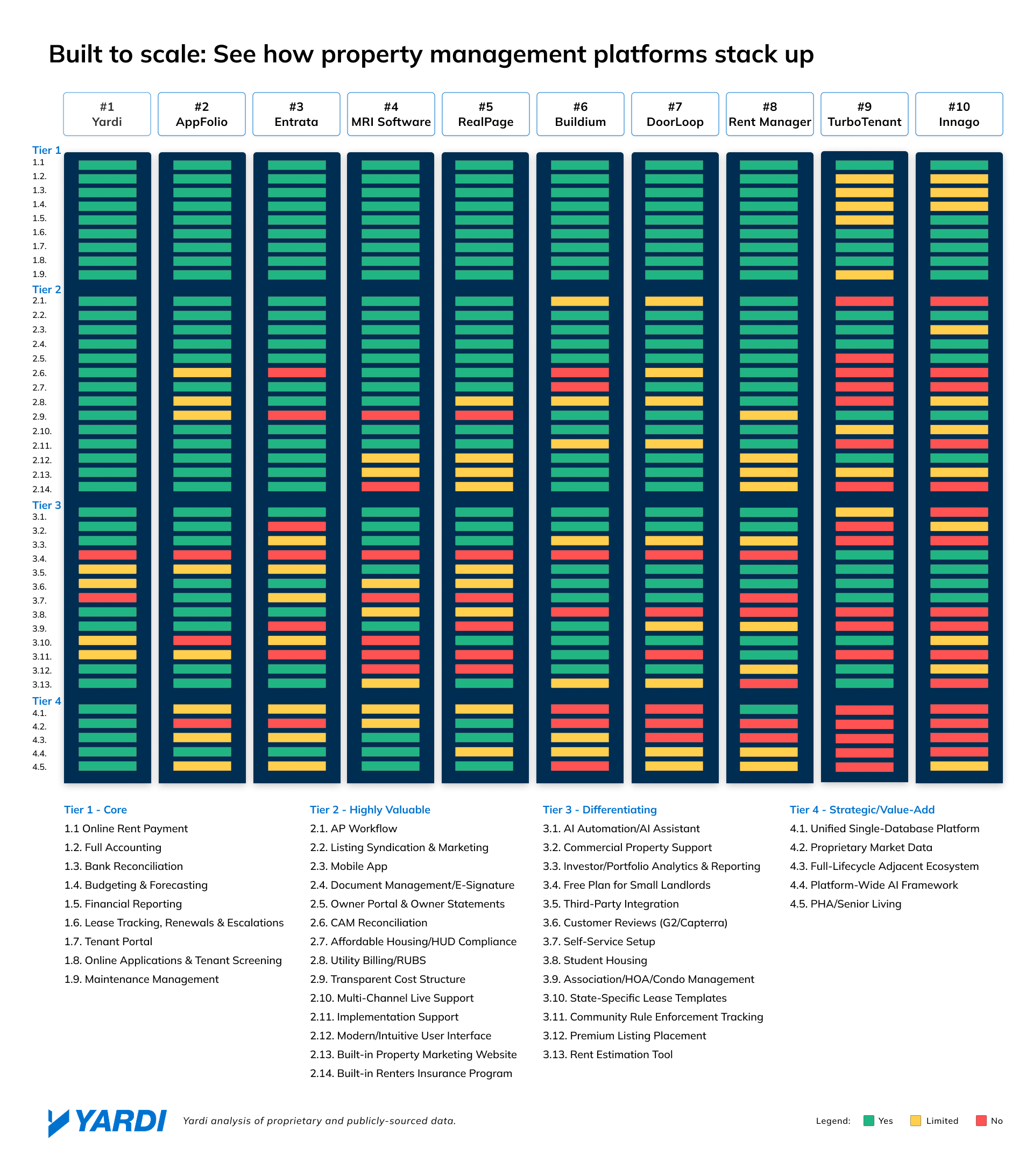
This comparison reviews 10 property management software platforms across 41 features, organized into four tiers based on how critical each capability is to day-to-day property operations. The goal is to give property managers and owners a structured, transparent way to compare platforms against the workflows that drive their businesses.
Platforms included. Yardi, AppFolio, Entrata, MRI Software, RealPage OneSite, Buildium, DoorLoop, Rent Manager, TurboTenant and Innago. These platforms were selected to represent the full market spectrum, from enterprise systems managing mixed-use portfolios with tens of thousands of units to free tools designed for landlords with fewer than 10 doors.
Feature taxonomy. Every feature was placed into one of four tiers based on how broadly the capability is needed across portfolio types and sizes:
- Tier 1 – Core: Covers the nine capabilities nearly every property manager needs, regardless of portfolio size: rent collection, general ledger accounting, bank reconciliation, budgeting and forecasting, financial reporting, lease tracking and renewals, tenant portals, online applications and screening and maintenance work order management.
- Tier 2 – Highly valuable: Covers 14 capabilities expected in modern mid-market and enterprise systems: vendor management and AP workflows, listing syndication and marketing, mobile apps, document management and e-signature, owner portals and statements, CAM reconciliation for commercial properties, affordable housing and HUD compliance, utility billing including RUBS (ratio utility billing system), published pricing and a transparent cost structure, multichannel live support, dedicated onboarding and implementation support, a modern and intuitive user interface, a built-in property marketing website and a built-in renters insurance program.
- Tier 3 – Differentiating: Covers 13 capabilities that distinguish platforms serving different market segments: AI automation and assistants, commercial property support for office, retail and industrial assets, investor and portfolio analytics, free plans for small landlords, third-party accounting integrations, customer review sentiment on G2 and Capterra, self-service setup, student housing with by-the-bed leasing, association and HOA management, state-specific lease templates, violation tracking and community rule enforcement, rental listing boost tools and rent estimate and comp analysis tools.
- Tier 4 – Strategic/value-add: Covers five architectural and ecosystem-level differentiators. These are structural advantages rather than individual features: unified single-database architecture, proprietary market data, full-lifecycle ecosystem breadth, a platform-wide AI framework and specialized regulated housing depth across public housing, senior living and LIHTC.
How features were scored. Each platform received one of three ratings for each feature:
- Yes: The platform offers the capability natively or through a tightly integrated first-party module.
- Limited: The platform provides partial support, offers the capability only through a third-party integration or restricts it to certain plans or property types.
- No: The capability is not available.
How the ranking was calculated. We created a weighted score across each tier, where ‘Yes’ received 1 point, ‘Limited’ equals 0.75 and ‘No’ received 0. We then weighed each tier’s score, where Tier 1 received 1, Tier 2 got 0.75, Tier 3 received 0.5 and Tier 4 equaled 0.25 for the final score. A platform’s weighted score is the sum of its ratings across all 41 features. The maximum possible score is 27.25.
The difference between ‘Yes’ and ‘Limited’ reflects the practical difference between a capability that is available natively and one that requires a workaround, third-party add-on or plan upgrade. Partial availability deserves recognition, but it does not provide the same operational value as native support.
AI and automation evaluation. AI capabilities were evaluated using the same Yes/Limited/No framework applied to every other feature, across two separate rows: AI Automation/AI Assistant (whether the platform offers any native AI functionality) and Platform-Wide AI Framework (whether that AI is a branded, cross-product capability embedded across the operating stack rather than a single-function tool or third-party integration). This distinction matters because most platforms now market AI features, but the depth and integration of those capabilities varies significantly. Scoring both dimensions separately surfaces that difference in a way a single “has AI” checkbox would not.
Portfolio-type recommendations. Beyond the overall ranking, this comparison names a best-fit platform for seven portfolio types: small residential, mid-market multifamily, enterprise multifamily, commercial, affordable housing, student housing and mixed-use. These recommendations are derived directly from the feature matrix, specifically from the Tier 2 vertical features, Tier 3 segment differentiators and Tier 4 architectural capabilities that determine which platform can operate a given portfolio type natively rather than through workarounds. A platform can only be named best fit for a portfolio type if it scores Yes on every feature critical to that segment.
Customer review sentiment. This criterion was scored using aggregate ratings from G2 and Capterra:
- Yes: Generally positive overall sentiment, with an average rating of 4.0 or higher
- Limited: Mixed sentiment relative to category peers, with an average rating of 3.0 to 3.9
- No: Predominantly negative sentiment, with an average rating below 3.0
This criterion captures the market perception that feature availability alone does not reflect.
Sourcing rules. Every feature claim was sourced exclusively from each vendor’s website, including product pages, feature pages and published documentation. No third-party review site, analyst report or blog post was used to determine whether a feature is available.
The one stated exception is customer review sentiment, which is drawn from G2 and Capterra aggregate ratings and clearly noted wherever it appears. This sourcing rule exists to ensure every capability claim is verifiable against the vendor’s own published materials.
Currency. Feature data reflects each vendor’s published capabilities as of October 2026. Property management software changes frequently. If you notice an error or a feature has been added since this review, please contact us so we can update the article accordingly.
Feature data reflects each vendor’s published capabilities as of October 2026. The best software depends on portfolio size, asset class, operational complexity and long-term growth plans.
This analysis draws primarily on each vendor’s publicly available product documentation, feature pages and published pricing, supplemented by aggregate customer review ratings from G2 and Capterra as noted in the methodology. Because every property management operation is different, the best software ultimately depends on portfolio size, asset class, operational complexity and long-term growth plans.