

 Voyager Suite
 Breeze
 Virtuoso
 Investment Suite
 RentCafe
 CommercialCafe Suite
 Elevate Suite
 Procure to Pay Suite
  Energy Suite
 Aspire
 RightSource
 Care Suite
 Matrix
 WorkCafe
 Yardi Kube Suite
 ScreeningWorks Pro
  Yardi Corom


















Most operators need the same core functions covered regardless of asset class: lead nurturing and leasing, resident retention, accounting and financial reporting, maintenance and portfolio visibility. As a portfolio grows, so does the number of tools competing to cover them.
Problems start when those tools do not share data. Records sit in disconnected systems, repetitive tasks absorb staff hours that should go to residents and assets, and portfolio-level visibility arrives after the decision has already been made.
These are all operational needs that property management software tackles head-on.
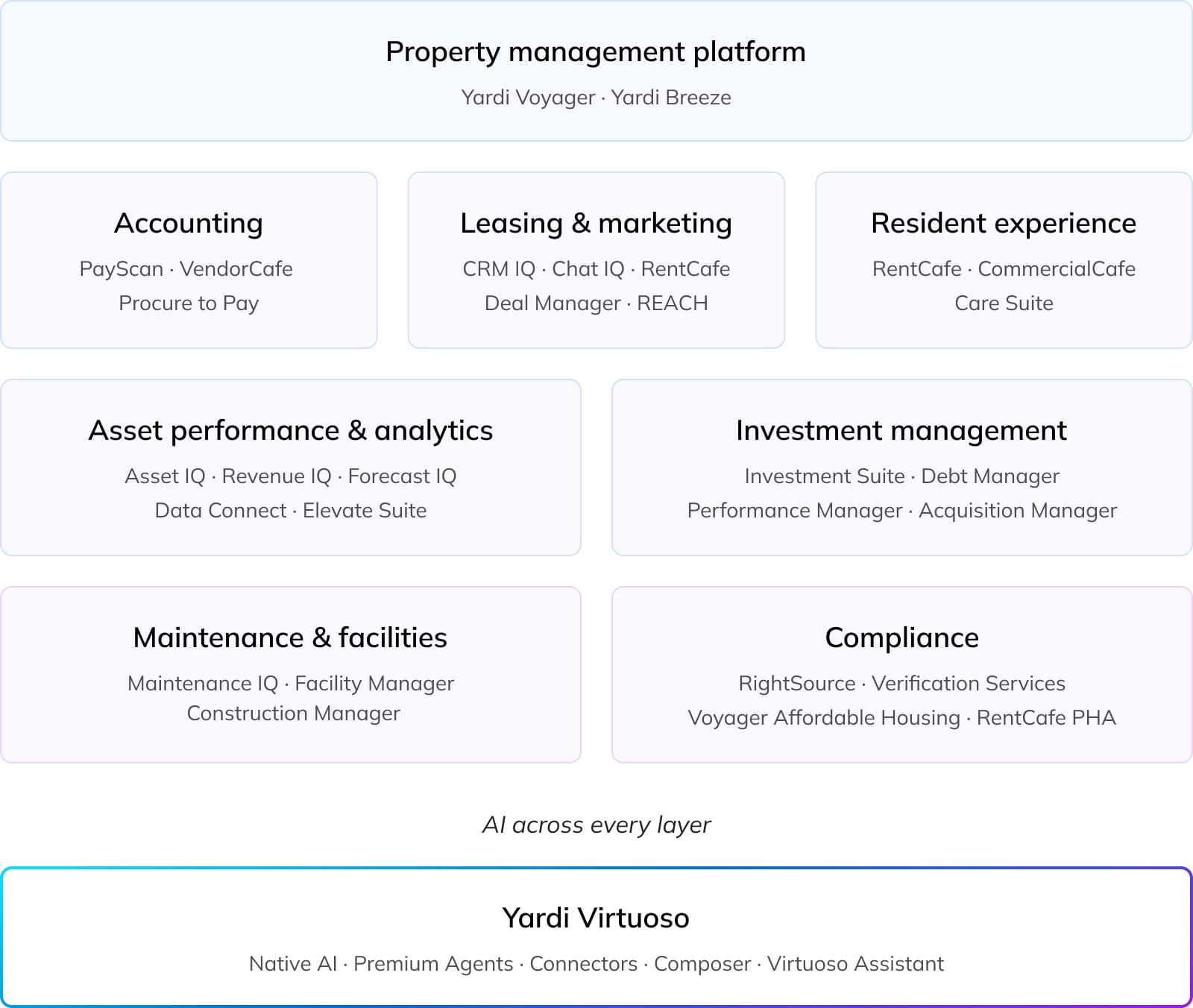
As an all-in-one, end-to-end property management platform with AI natively woven into the system, Yardi meets each of those needs inside one database which is what makes portfolio performance and NOI visible and manageable in one place.
Property management tech stack decision matrix: need, category and Yardi solution
| Operational need | Solution category | Yardi offering | Typical fit |
|---|---|---|---|
| Core platform and single database | Property management platform | Yardi Voyager or Yardi Breeze | Every portfolio |
| AI across every workflow | AI platform and embedded agents | Virtuoso Enterprise, native agents in each product, plus Chat IQ, Smart AP, Smart Approval, Smart Lease, Virtuoso Support, Virtuoso Connectors and the no-code Composer | Spans every category below |
| Property accounting and accounts payable | Real estate accounting and procure to pay | Voyager accounting, Yardi PayScan, Yardi Smart AP, Yardi Smart Approval, Yardi VendorCafe | Any portfolio with invoice volume |
| Residential leasing and marketing | CRM, ILS marketing and screening | Yardi CRM IQ, Yardi Chat IQ, Yardi RentCafe, ScreeningWorks Pro, REACH by RentCafe | Multifamily |
| Commercial leasing | Deal and lease management | Yardi Deal Manager, Yardi Smart Lease, Yardi Marketing Manager | Office, industrial, retail |
| Resident and tenant service | Self-service portals | RentCafe, CommercialCafe, Yardi Care Suite | Residential, commercial, senior living |
| Maintenance and facilities | Work order and facilities management | Yardi Maintenance IQ, Yardi Facility Manager, Yardi Construction Manager | All asset types |
| Analytics and forecasting | Business intelligence, forecasting and revenue management | Yardi Asset IQ, Yardi Revenue IQ, Yardi Forecast IQ, Yardi Data Connect, Yardi Elevate Suite | Portfolios reporting to owners or investors |
| Program compliance | Regulatory compliance and certification | Voyager Affordable Housing, RentCafe Affordable Housing, RightSource, Verification Services, Voyager PHA | Affordable housing and public housing |
| Investment and debt management | Investment, debt and asset management | Yardi Investment Manager, Investment Accounting, Debt Manager, Performance Manager, Acquisition Manager | Owners, funds and joint ventures |
Your property management platform: the foundation everything else runs on
Your property management platform is the place where data, lease terms, financial transactions, resident records, work orders and reporting all live. Every other tool in your stack depends on this one. When it’s fragmented, the rest of your stack compensates for it, often not ideally.
The need here is to have a single operational database that manages all your portfolio, whether you’re handling residential, commercial, affordable, senior living or mixed-use properties – in one vertical or several. Yardi supports all of these verticals in a single data structure and is configurable from platform foundation through operations, analytics and AI.
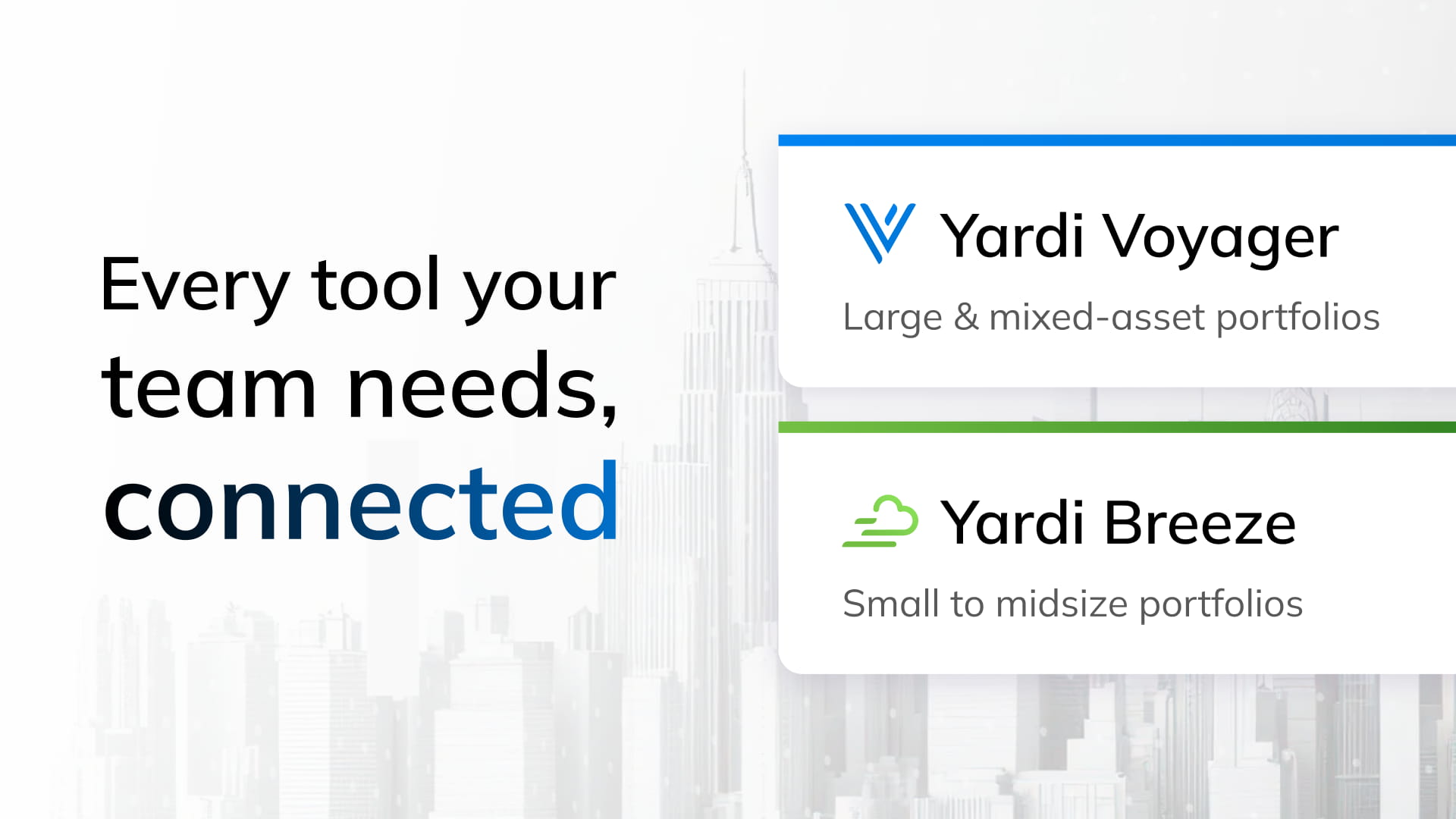
Yardi Voyager for multi-asset or large portfolios
Yardi Voyager supports property management across multiple asset classes through a suite of connected solutions, from operators running a single vertical to enterprise portfolios running several at once:
- Voyager Residential for multifamily
- Voyager Commercial for office, industrial and retail properties
- Voyager Affordable Housing for regulated housing programs
- Voyager Senior Housing for senior living
- Voyager PHA for public housing authorities
These solutions share the same data architecture, allowing single as well as mixed-asset portfolios to operate within one connected system rather than stitching together separate platforms. One database means no reconciliation between systems, one reporting layer across the whole portfolio and one interface for staff to learn rather than several.
Yardi Breeze for small and midsize portfolios
Yardi Breeze is designed for small and midsize portfolios across residential, commercial, self storage, manufactured housing and associations. Breeze gets core operations running quickly from accounting to leasing, maintenance and reporting – all in one place, so you can stay on top of operations, occupancy and expense trends as they happen.
The efficiencies you gain with an all-in-one, intuitive property management system like Yardi create the foundation for growth. And when you grow, the system adds capabilities, in the same database, regardless of portfolio type or size.
How one operator scaled on a connected Yardi platform
For HK Multifamily Management, growth across multiple states created a need for more consistent processes and better visibility across the portfolio. The company uses a connected Yardi platform to manage operations throughout the property management lifecycle. “The level of automation and flexibility allowed us to operate consistently across multiple states while maintaining control and performance,” said Ajay Banga, CEO of HK Multifamily Management.
Before making that transition, many of the company’s daily processes were manual and reactive. Teams met weekly to make leasing decisions, adjusted pricing by hand, processed physical rent deposits and managed maintenance through paper-based systems. Reporting was time-consuming because there was no unified view of performance across assets. As the portfolio expanded, those processes became increasingly difficult to sustain. “That’s when we fully committed to a technology-first approach,” added Banga.
Centralized data and standardized workflows also gave HK Multifamily Management the foundation to move into third-party property management. “We decided that Yardi’s system is so scalable, why not expand into third-party management?” Banga said. The company is now growing that business nationwide, focusing on larger multifamily properties where it can apply the same consistent, performance-focused approach on behalf of outside owners.
8 major capabilities of property management software
Here are eight of the most important capabilities you can and should expect from a modern property management system.
1. Property accounting and accounts payable: purpose-built for real estate complexity
Property accounting requires unit-level ledgers, owner distributions, CAM (common area maintenance) reconciliations, trust accounting and regulatory reporting, often simultaneously and at a speed general accounting software wasn’t built for.
Common friction points: month-end close that drags, reconciliation errors from manual entry, invoice backlogs and inconsistent reporting across ownership structures.
Voyager’s accounting engine handles all of this within the same platform as operations: every lease event, work order charge and payment posts directly to the general ledger without a sync or import.
For invoice processing, Yardi PayScan and the broader Yardi Procure to Pay Suite automate the AP workflow. Smart AP uses AI-powered optical character recognition (OCR) to instantly key invoices, extract line-item data and match them to purchase orders or contracts — automatically coding transactions to the correct GL without manual entry.
Building on this, Yardi Smart Approval uses dual AI agents to automatically review and approve qualifying invoices against your GL rules, vendor thresholds and budget criteria, so your team only handles true exceptions.
KETTLER, a multifamily operator, reported an 86% decrease in invoice processing time and eliminated 48 hours of human processing time per month after deploying Smart AP.
Yardi VendorCafe handles the vendor side: a self-service portal for invoice submission, insurance certificate updates and vendor record management, reducing the back-and-forth that slows AP teams down.
Leasing and marketing: the tools that help you seal the deal
Leasing challenges vary by asset type, and so do the tools needed to address them.
In multifamily, the challenge is volume and speed. Prospect inquiries arrive around the clock, follow-ups can slip when teams are stretched and a missed inquiry during peak leasing season can translate into a longer vacancy.
Yardi software has native AI built into the system, which allows it to cover the renter journey end to end: ILS marketing and tour scheduling, inbound inquiry handling, screening, application, lease execution and reporting.
- CRM IQ: tracks every prospect and resident interaction from first inquiry through renewal, across phone, email, text and chat
- Chat IQ: AI leasing assistant that responds around the clock using verified Yardi data, and screens every outgoing message against fair housing language rules before it sends
- RentCafe: applicant and resident portal for lead acquisition, online applications, lease signing and payments
- ScreeningWorks Pro: credit, criminal and eviction checks run inside the leasing workflow
At the top of the funnel, REACH by RentCafe is a specialized digital marketing agency for real estate offering search engine optimization (SEO), pay-per-click (PPC) advertising management and localized website design for your properties.
In commercial, the problem is cycle length and deal complexity. A lease takes months, involves multiple decision-makers and requires managing deal terms, space configuration and legal review at the same time.
- Deal Manager: tracks deals from prospect to signed lease, with visibility into every stage across the portfolio.
- Smart Lease: AI lease abstraction built directly into Yardi Voyager Commercial. It scans executed leases, detects key sections and populates structured fields for your team to review and approve. A built-in conversational assistant lets you ask plain-language questions about a lease while you’re in it, so you can check a notice period or rent term without scrolling through the document.
Marketing Manager handles commercial property marketing and listings.
3. Resident and tenant experience: the service layer that drives retention
Retention is generally cheaper than replacement. A vacant unit costs more than a renewal concession, and a lost commercial tenant costs more than a lease renewal negotiation.
- For residential use: RentCafe provides a self-service portal for rent payments, maintenance requests, lease renewals and community communication, reducing management office call volume and giving residents on-demand access.
- For commercial tenants: CommercialCafe is a portal and native mobile app for lease payments, maintenance requests and retail sales data entry. For a full tenant experience platform, WorkCafe for Buildings eliminates data silos and manual syncing for good. Built directly inside Yardi Voyager, it keeps every guest check-in, amenity booking and service request accurate, on-brand and connected across your entire portfolio.
- For senior living: the Care Suite brings clinical care management into the same platform as housing operations, so care teams and property teams work from the same resident record.
4. Maintenance and facilities: a workflow that can’t afford gaps
Beyond the portals, service quality during tenancy is what drives renewals. Maintenance is where operational efficiency and resident retention cross paths: a work order that takes too long, gets misrouted or goes unlogged damages both.
The need is a workflow that captures every request, routes it to the right technician and gives supervisors visibility into backlogs — all without manual chasing. Yardi covers three distinct layers of maintenance and facilities work:
- Maintenance IQ: logs, diagnoses and routes work orders so nothing falls between request and repair and supports mobile-first inspections at move-in, move-out and routine reviews.
- Facility Manager: for commercial portfolios with complex requirements: preventive maintenance scheduling, work order management and vendor coordination.
- Construction Manager: tracks capital improvement projects from budget through completion, giving asset managers visibility into timelines and spend.
5. Asset performance and analytics: turning operational data into decisions
Property management generates enormous amounts of data. The problem is rarely a lack of it, but that the data lives in different places, reports run slowly and the link between day-to-day decisions and long-term asset value isn’t visible quickly enough.
Yardi’s business performance tools consolidate that data into one reporting layer, with different products serving residential and commercial portfolios.
For residential portfolios:
- Asset IQ: operational data plus market benchmarks. It surfaces occupancy trends, revenue performance and peer comparisons at the property and portfolio level.
- Revenue IQ: uses demand signals and market data to generate rent pricing recommendations by unit, floor plan and lease term, which your team reviews and approves.
- Forecast IQ: financial forecasting and budgeting and projects NOI and cash flow based on current leasing trends.
- Data Connect: the reporting layer for custom dashboards and business intelligence (BI) tool integration.
For commercial portfolios: the Yardi Elevate Suite for Commercial covers budgeting, leasing performance, forecasting and facilities analysis in one place.
6. Compliance built into everyday workflows
Compliance requirements in real estate vary by asset type and the penalties for getting them wrong — regulatory, financial or both — are rarely forgiving.
With Yardi, fair housing safeguards are built in across the leasing workflow regardless of property type. The audit trail is built into the process. Chat IQ reviews every outgoing message before it sends it and ScreeningWorks Pro applies consistent, documented criteria to every applicant. Compliance with the Fair Housing Act and applicable state and local law remains the operator’s responsibility.
For affordable housing and public housing programs, the compliance stack includes:
- Voyager Affordable Housing: U.S. Department of Housing and Urban Development (HUD) and Tax Credit accounting, income certifications and regulatory reporting, within the same platform as operations.
- RentCafe Affordable Housing: applicant portal with program-specific income documentation and certification workflows built in.
- RightSource: Yardi’s compliance review service. Experts review certification files and flag deficiencies before they become audit findings.
- Verification Services: automates income and asset verification, reducing the documentation burden on staff and applicants.
- Voyager PHA and RentCafe PHA: Housing Choice Voucher administration, inspections and HUD reporting for public housing authorities.
7. Investment management: from fund-level decisions to property-level data
If you manage the investment side of the portfolio, or you’re an asset owner who needs visibility from the fund level down to property operations, the need is a connected view across the full lifecycle: acquisition analysis, debt tracking, investor reporting and performance measurement.
The Yardi investment stack covers the real estate investment lifecycle within the same data structure as property operations.
- Investment Manager: fund and deal management, investor communications and distribution calculations.
- Investment Accounting: accounting for funds, joint ventures and separate accounts, with the same general ledger integration as property accounting.
- Debt Manager: loan terms, maturity dates, covenants and compliance across the portfolio’s debt stack.
- Performance Manager: NOI and return attribution, benchmarking and investor-level reporting.
- Acquisition Manager: deal underwriting and pipeline management.
8. Native AI to scale your leasing, resident services and operational efforts
AI in property management is not a separate category. It’s the layer that makes every other category faster and more consistent. Virtuoso Enterprise is the native AI infrastructure built into the Yardi ecosystem. Rather than passing your property data to a disjointed third-party app, Virtuoso works inside the Yardi accounting ledger and database you already use.
AI appears in each category as follows:
- Leasing: Chat IQ handles prospect communication, follow-up and fair housing review around the clock.
- Accounting: Smart AP automates invoice data capture and GL coding and Yardi Smart Approval routes and approves qualifying invoices automatically — only exceptions reach your team.
- Commercial lease management: Smart Lease extracts critical data from executed leases into structured Voyager fields.
- Staff support: Virtuoso Support gives every team member instant, in-app answers to workflow questions without leaving their current screen. Your team can type normal, plain-language questions into the system such as “How do I change a charge code setup?” or “Where do I run this variance report?” and the AI extracts the exact step-by-step navigation directly from Yardi’s internal help guides.
- Data access: Virtuoso Connectors bring live Yardi data securely into the external AI tools your team already uses for analysis and strategic work.
What distinguishes AI built into a connected platform from standalone tools is the data underneath it. Virtuoso agents answer from your actual property data – real pricing, real availability, real policies – and every action runs inside your existing Yardi environment with the same governance and encryption that applies to the rest of your operations.
How to choose the right Yardi solution for your portfolio
Yardi provides an end-to-end property management ecosystem built to support the full real estate lifecycle. AI is natively woven throughout the platform to improve efficiency, accuracy and productivity.
Choosing the right Yardi solution for your portfolio starts with three questions: What types of properties do you manage? How large and varied is your portfolio? What workflows does your team need to support?
Start with your property type
Yardi Breeze supports residential and commercial portfolios in the U.S. Depending on the configuration, it can also support affordable housing, self storage, manufactured housing and condos or associations.
Yardi Voyager is designed for organizations seeking a comprehensive platform for property management, accounting and real estate operations. It is particularly relevant for mixed portfolios because multiple asset types can be managed within the same system and data structure.
Consider portfolio size and structure
Portfolio size is a useful starting point. Breeze is designed for small and midsize portfolios, while Voyager supports organizations managing larger, multi-entity or mixed-asset portfolios.
Size alone should not determine the choice. A larger portfolio may still be suited to Breeze if its required workflows align with the platform. A smaller organization may choose Voyager because it manages multiple entities or asset types, or needs a broader range of operational and reporting capabilities.
Match the platform to your everyday workflows
The clearest distinction often comes from how teams work and the level of visibility and control they need.
| Workflow area | Yardi Breeze | Yardi Voyager |
|---|---|---|
| Core operations | Supports marketing and leasing, rent collection, maintenance, accounting, reporting and resident or tenant self-service | Connects property management, accounting, leasing, maintenance and communications across portfolio-wide operations |
| Leasing | Supports applicant screening, online applications and leasing workflows. Available capabilities can also include CRM-based follow-up and automated task creation | Supports prospect and application management, renewals, unit transfers, electronic lease execution and automated move-in and move-out accounting |
| Resident and tenant service | Allows residents or tenants to pay rent, sign leases and submit maintenance requests online | Supports text, email and bulk communications with prospects and residents |
| Maintenance | Connects online maintenance requests with the property team’s workflow | Provides maintenance task management and work order tracking within the broader residential workflow |
| Accounting and approvals | Includes built-in accounting, rent collection, vendor and owner payments and owner reporting. Available capabilities include invoice approvals, job costing, custom account trees and batch processing | Centralizes accounts receivable, accounts payable and general ledger tasks. Configurable proposal and approval workflows support multi-step processes |
| Reporting and visibility | Supports operational and owner reporting. Additional capabilities can include reporting attributes for grouping properties and filtering results | Provides standard analytics, custom Yardi Spreadsheet Reporting and financial analytics, along with saved filtered searches |
| Team coordination and control | Includes calendars, reminders, communication tools and available two-way texting and security controls | Provides predefined and customizable dashboards for community managers, leasing agents, maintenance teams and accounting staff |
A practical way to decide
Breeze may be the better fit if your team needs:
- A streamlined system for everyday property management
- Built-in accounting, leasing, payments, maintenance and reporting
- Resident or tenant self-service
- Additional workflow flexibility as the portfolio grows
Voyager may be the better fit if your organization needs:
- Portfolio-wide financial and operational controls
- Centralized oversight across multiple asset types or entities
- Role-based dashboards and configurable workflows
- Broader reporting, analytics and approval capabilities
The right choice depends on the combination of property type, scale and workflow requirements. Evaluating all three provides a more reliable answer than using unit count alone.
Ready to find the right Yardi solution for your portfolio? Request a personalized demo to see the most relevant workflows in action and get a recommendation based on your property types, portfolio structure and business goals.
Frequently asked questions
A property management tech stack is the full set of software an operator uses to run property operations, typically a core platform, accounting tools, leasing and marketing software, a resident or tenant portal, maintenance management and reporting. It may be a single connected platform like Yardi Voyager or a combination of integrated products.
Breeze covers core property management for small and midsize portfolios, with accounting, leasing, payments, maintenance and reporting in one place. Voyager supports large or complex portfolios that need multiple property types, multi-entity structures, configurable workflows and deeper analytics. Because both share the same underlying data structure, capability is added as a portfolio grows rather than replaced.
Yes. Breeze and Voyager sit on the same scalable continuum, so operators can add capability as the portfolio grows without moving to a different platform or rebuilding their data. This matters most for operators expanding into new asset types or taking on third-party management, where reporting requirements change faster than unit count.
Voyager Affordable Housing manages HUD and tax credit requirements, income certifications and regulatory reporting. Verification Services automates income and asset verification. RentCafe Affordable Housing handles the applicant portal with program-specific documentation workflows built in. RightSource provides expert review of certification files before deficiencies become audit findings.
Asset IQ surfaces portfolio performance data and peer benchmarks at the property and portfolio level. Revenue IQ uses demand signals and market data to generate rent pricing recommendations by unit and floor plan for your team to review. Forecast IQ projects NOI and cash flow. Data Connect provides the reporting layer for custom dashboards and BI tool integration. For commercial portfolios, the Yardi Elevate Suite for Commercial covers equivalent budgeting and forecasting functions.
Yes. Yardi Voyager is a single database that supports multifamily, commercial, affordable housing, senior living, manufactured housing and mixed-use portfolios simultaneously. You can run all asset types out of one Voyager instance with one general ledger, one reporting layer and no cross-system reconciliation.
For most operators, yes. Yardi Voyager includes a full general ledger and real estate accounting engine, so lease events, work order charges and payments post directly to the GL without a separate accounting system. Organizations with an existing corporate enterprise resource planning (ERP) typically keep it for entity-level consolidation and connect it to Yardi rather than duplicating property-level accounting.
Four signals indicate fragmentation: the same data is entered in more than one system, portfolio reporting requires exporting to spreadsheets, month-end close depends on reconciling between platforms, and answering an owner question takes more than one system to complete. Any one of these points to a stack that is compensating for a gap in the core platform.