

 Voyager Suite
 Breeze
 Virtuoso
 Investment Suite
 RentCafe
 CommercialCafe Suite
 Elevate Suite
 Procure to Pay Suite
  Energy Suite
 Aspire
 RightSource
 Care Suite
 Matrix
 WorkCafe
 Yardi Kube Suite
 ScreeningWorks Pro
  Yardi Corom



















Does your property management operation need AI? As much as we’d love to be everywhere at once, no team can respond to every inquiry, follow up consistently with 40 prospects when leasing season peaks, catch a Fair Housing issue in an outgoing message before it sends and flag the renewal that’s three weeks out while a maintenance backlog builds. That’s where AI earns its keep: covering the volume, the hours and especially the mundane, repetitive tasks a good team shouldn’t.
What is AI in property management?
AI in property management refers to software that handles high-volume communication and administrative work, like lead qualification, tenant screening, lease data extraction and maintenance coordination. It does this by syncing with your existing systems and routing each request to the right workflow. It delivers 24/7 virtual leasing support, maintenance triage and reporting, while your team stays in charge of the decisions.
There are two terms that often get lumped together when we talk about AI solutions in property management: automation and AI. But knowing the difference between them is vital when deciding what makes sense for your business.
Automation is the first line of defense, handling predictable, high-volume tasks and eliminating the repetitive manual work that drains leasing teams and introduces human error. AI is the next step. It learns from your data, handles complex work, understands intent, personalizes responses and makes judgment calls in nuanced conversations. That’s why the most effective leasing operations don’t choose one over the other, instead they layer both.
- Automation is software that performs a defined task the same reliable way every time. Think of sending a scheduled follow-up email, logging a maintenance request the moment it comes in, or routing a work order to the right technician. Automation executes directly, and that dependability is precisely its strength.
- AI goes a step further. It reads context and adapts its response, and it grows more accurate as it sees more examples. A simple illustration: in revenue management, AI studies patterns in demand, such as how interest shifts by season, by floor plan, or by the length of a lease, and it suggests a rent for each unit. As new leasing results come in, those suggestions sharpen.
The table below shows how automation and AI differ in practice — and why property management operations work best when they layer both:
| Automation | AI | Example in practice | |
|---|---|---|---|
| How it works | Executes a defined task the same reliable way every time | Reads context, adapts its response and learns from your data and feedback | Routing a work order vs. drafting the right reply to a lease inquiry |
| Best for | Scheduled follow-up emails, work order routing, maintenance log entries | Lead nurturing, rent pricing suggestions, Fair Housing compliance review | AI flags a renewal at risk, automation sends the follow-up |
| Improves over time? | No — dependability is the strength | Yes — accuracy sharpens as it sees more examples from your portfolio | Maintenance triage categorization improves as the system processes more resolved work orders |
| Who decides? | Task executes automatically | A person reviews and approves the recommendation | Revenue manager reviews the AI rent suggestion before it applies |
Crucially in this AI example, an agent or a revenue manager still reviews and approves the recommendation. The software behind the screen informs the decision, but the person in front of the screen makes it.
That distinction — software that suggests versus a person who decides — sits at the heart of every good AI tool in property management. Which raises the question leaders ask next.
Does AI run the property on its own?
No, and it shouldn’t. The honest, healthy model is straightforward: AI handles the repetitive load and drafts the work, while your people review, approve and own the relationship. A prospect touring an apartment, a resident weighing a renewal and a family navigating a maintenance issue are all moments that call for human judgment and warmth. The value of AI is that it clears away the routine work surrounding those moments, so your team has the time and attention to handle them well.
At McLean, Virginia-based KETTLER, agentic AI handles invoice processing by matching each invoice to the appropriate purchase order or contract and routing it through the approval workflow. Automating these steps gives the team more time to focus on leasing, customer service and asset quality. “They’re really managing their financials as opposed to having to do all these tasks to get there, making the results more consistent and accurate as well,” said Cynthia Fisher, president of KETTLER.
In other words, the goal is a reliable assistant working alongside experienced professionals. That’s a comfortable model to adopt because it changes the texture of the workday without changing who is accountable. But it only works if you can trust what the software produces.
How does AI learn — and can you trust what it produces?
Trust isn’t something a tool can claim. It has to be earned through how the system is built. Three ideas explain how well-designed AI earns it:
- It learns from patterns. The software studies your past data to recognize what tends to happen and what tends to work, so its suggestions reflect your properties rather than generic assumptions.
- It stays grounded in data. Good systems answer only from your verified property information, so they don’t invent prices, availability or policies. If the system doesn’t know something, it says so or routes the question to a person, rather than guessing.
- It improves with feedback. Every corrected answer and completed task teaches it to do better next time. The more your team works alongside it, the more dependable it becomes.
Together, those three qualities describe technology that’s transparent about its reasoning, faithful to your real information and always accountable to a person. That’s the standard worth holding any AI tool to.
Quick take: AI is a dependable assistant for routine work. Trustworthy systems show their reasoning, stick to your real data and keep a person in the approval seat.
Once you’re comfortable with what AI is and how it earns trust, the natural next question is where it belongs in the day-to-day work of leasing and managing a community.
Where does AI fit in the leasing and resident journey?
The easiest way to understand where AI fits and how it can streamline the process is to walk the renter journey from first inquiry to renewal. The consistent theme is that AI shows up in the gaps, the moments when a team is stretched too thin to be everywhere at once.
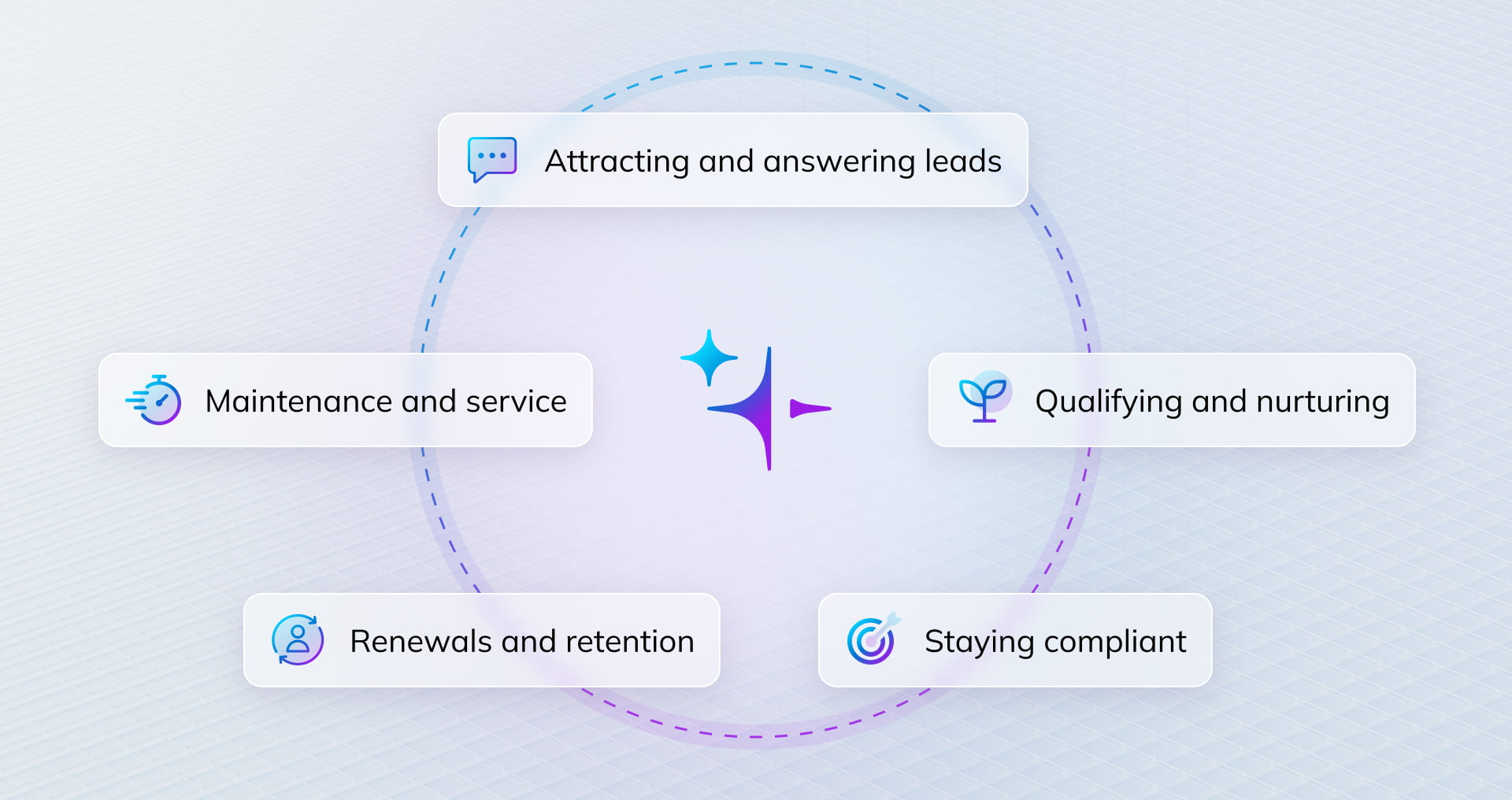
- Attracting and answering leads. Prospects rarely reach out only during business hours. A question about pet policy or November availability might arrive at 9 p.m. on a Saturday. AI responds to those questions the moment they land, so no inquiry sits waiting overnight or over a weekend. Your leasing team then steps into the conversations that need a human touch, arriving with context instead of starting cold.
- Qualifying and nurturing. Not every lead is ready to lease today, and following up consistently with dozens of prospects is exactly the kind of task that slips when a team gets busy. AI keeps interested prospects moving forward with steady, relevant follow-up, freeing agents to focus on tours and building rapport with the people closest to signing.
- Staying compliant. Fair Housing compliance is nonnegotiable, and it’s easier to protect when it’s built into the workflow rather than checked afterward. AI can review messages for Fair Housing alignment before they send, giving teams a dependable safety check instead of an after-the-fact audit.
- Renewals and retention. Renewals are one of the easiest things to let slip, and a lapsed renewal is expensive. AI flags who is coming up for renewal and drafts the outreach. Your team personalizes the offer and tends to the relationship that ultimately keeps someone in their home.
- Maintenance and service. A service request that goes unlogged or misrouted becomes a frustrated resident. AI helps log, diagnose and route work orders so requests don’t slip through the cracks and the right person gets them quickly.
Where Yardi AI makes a difference: Virtuoso changes the game in property management
Every workflow and stage above helps teams get organized to tackle different needs along the renter journey. These stages also represent many instances where a team might get stretched too thin, overwhelmed by repetitive inquiries, reminders, follow-up questions or renewals.
Virtuoso is what makes those moments manageable as portfolios grow or seasonality brings increased demand. From native agents (meaning intelligence that’s always on and built into core products and existing workflows) to Premium Agents and Connectors, our Virtuoso AI automates tasks, analyzes data and surfaces insights so that all daily tasks that can be automated are taken care of, freeing up time for teams to focus on strategy and growth.
Because it operates within the secure environment of your existing data, your teams can safely review, analyze and interact with information while maintaining the controls your organization requires. All of it runs on a governed foundation — encryption by default and built-in compliance readiness. That foundation is what makes the AI usable: It’s only as reliable as the data and the guardrails underneath it.
Virtuoso is organized across five main pillars:
| Pillar | Main action | Main feature |
|---|---|---|
| Native AI Agents | Natively woven in | AI that lives in every Yardi product |
| Virtuoso Assistant Includes: Yardi Chat IQ, Yardi CRM IQ, Yardi Maintenance IQ, Yardi Smart Lease |
Help & actions | Help, action & insights inside Voyager |
| Virtuoso Premium Agents Includes: Smart Approval Agent, Lease Audit Agent and Month-End Close Agent |
Actions & automation | Yardi-built, ROI-backed, ready to deploy |
| Virtuoso Composer | Design & build | The no-code tool for building custom agents tailored to your specific workflows |
| Virtuoso Connectors | Ask & analyze | Connects your live Yardi data to the large language model (LLM) of your choice |
Instead of a leasing tool in one login, a maintenance system in another and an accounting platform in a third — each holding a piece of the picture nobody else can see — Yardi weaves AI into every core workflow, so every tool draws from the same trusted data and works in concert.
“Virtuoso is AI at Yardi. It’s not one product or a feature you turn on. It’s how AI shows up across everything clients use, natively woven into the tools their teams already work in. We didn’t add AI on top of what we had. We did a foundational reset and built it throughout, so day-to-day operations just get faster and smarter,” says Turner Levison, director of marketing, Yardi.
“It starts with AI already woven into every product, so it’s just there in the work. From there, tools that help people get answers and take action right where they are. Then agents we’ve built to automate the workflows that take the most manual time, the ones where the ROI is clearest. Then the freedom to build your own. And for teams that already live in outside AI tools, they can bring those straight to their Yardi data. All of it sits on one connected, unified platform. That’s the real story. The AI is only as strong as the data under it, and here everything runs on the same foundation.”
The main products are all natively built into Yardi workflows and are always on. To the end user, it’s just part of how the product works, not a separate AI layer:
- CRM IQ is the central hub for customer intelligence. It unites your data, your teams and your AI tools in one system, so leasing conversations stay consistent from a prospect’s first inquiry all the way through to renewal. Nothing gets lost in the handoff between people or channels.
- Chat IQ is the AI leasing assistant built specifically for multifamily. It runs on four agentic workflows mapped to the four chapters of the renter lifecycle, and each workflow contains specialized agents that handle specific skills, activating at the right moment depending on who is reaching out and why. Importantly, Chat IQ runs inside Yardi, not alongside it. Conversations, prospect details and tour schedules sync directly with your existing workflows, with no double entry and no disruption. Every message is reviewed for compliance before it sends, and every interaction is logged and auditable, so you always have a clear record of what was said and why.
- Maintenance IQ is the maintenance layer of Yardi Virtuoso, helping teams manage and diagnose work orders, so service requests are handled reliably and nothing gets lost between the request and the repair.
- Smart Lease is Yardi’s AI-powered lease abstraction tool for commercial real estate, built directly into Yardi Voyager Commercial. It scans lease documents, detects key sections and populates structured fields. Your team reviews and approves the extracted data before finalizing it in Voyager. It includes a conversational assistant. You can ask the Smart Lease AI assistant a question while reviewing a lease, and it returns plain-language answers. This is useful for checking things like notice periods or rent terms without going through the document manually.
The tools at a glance:
| Product | Role in the suite | Key function |
|---|---|---|
| Virtuoso | AI & automation platform foundation | AI agents, automation workflows and data governance with encryption across the entire Yardi ecosystem |
| CRM IQ | Customer intelligence hub | Unified prospect and resident data enabling consistent leasing conversations from inquiry through renewal |
| Maintenance IQ | Service request management layer | Work order triage, diagnosis and routing to ensure no service request is lost from intake to repair |
| Smart Lease | AI-powered lease abstraction solution | Lease abstraction with AI that keeps people in control — extracts key information and improves with your portfolio over time |
Does this mean handing operations over to software?
It does not, and this is worth saying plainly. The point of this approach is to make team members’ lives easier, not to take over for them. The tools take on the weight of the repetitive work. Your people stay firmly in charge of the decisions and the relationships.
“You want the property teams in those moments that matter,” said Paul Yount, industry principal at Yardi. “When somebody comes in for their tour or when a resident walks in the door, that’s where you want them, not sending out emails and text messages and phone calls, chasing down the rent. If the technology can do that for them, then they can go do more high value, more rewarding tasks.”
Quick take: One connected, governed platform — Virtuoso — built so your data stays trusted and your team stays in control.
What results are teams seeing from Yardi AI?
The results most teams notice first show up in how leasing agents spend their days: fewer hours chasing leads, more time on tours, relationship building and closing, meaning they’re doing work that actually moves the needle. AI reduces repetitive questions so internal teams can focus on higher-value work, delivers instant, 24/7 help without wait times and scales with your portfolio as on-site teams grow.
“Virtuoso is designed to complement human support, not replace it,” said Akshai Rao, president, Yardi. “It combines the speed of AI with the reliability of human insight through dynamic escalation to Yardi experts when appropriate.”
A good way to picture all of this working is Virtuoso Assistant, which is part of the Virtuoso AI platform. It’s embedded directly in the Yardi suite and gives your team contextual, in-app guidance, helping people resolve routine questions, navigate workflows and find the right documentation without leaving the screen they’re already working in. In practice, that shortens training time for new staff and takes pressure off your internal support team. And when a question is beyond what the AI can help with, it hands the conversation off to Yardi’s existing client support organization, so no one hits a dead end.
Early usage points to steady engagement:
- Hundreds of clients and tens of thousands of users are live and actively using it.
- In July 2026, Virtuoso Assistant handled 36,000 client chats with a 93% resolution rate.
The same efficiency shows up on the invoice and approval side:
- Between 40% and 50% of invoices are approved automatically
- Each approval step is 2-6 minutes shorter
- Over 6,500 hours saved per 100,000 invoices processed
“Virtuoso Assistant is a valuable tool that assists site teams by efficiently addressing knowledge-based queries, particularly those related to CRM navigation, accessing support documentation and clarifying simple workflows,” says Shawaun Alexander, senior vice president, Bozzuto. “Its integration directly into core applications like RentCafe CRM IQ encourages adoption, drives consistency and eases the burden on internal support.”
Quick take: Virtuoso Assistant gives teams instant, in-app help with strong satisfaction and real time savings, and it hands off to a human whenever that’s the better answer.
How to get started with AI in property management
Adoption tends to go best when it’s treated as a series of small, measurable steps rather than one large leap. A calm, staged path looks like this:
- Audit your current bottlenecks. Before choosing any tool, get honest about where the friction is: slow lead response, missed work orders, inconsistent follow-up. The clearest wins come from fixing a problem you can already name.
- Choose the right AI-integrated software for the goal you care about most. Favor tools that live inside the systems you already use, so your team isn’t juggling logins or re-entering data.
- Track your current numbers for a while so you can compare honestly later. A baseline is what turns “it feels faster” into a result you can stand behind.
- Keep people in the approval seat and gather their feedback as you go. The team using the tool day to day will tell you quickly what’s working and what needs adjusting.
- Expand where it’s clearly earning its keep. Once one workflow is delivering, extend the approach to the next, at whatever pace suits your organization.
Quick take: Measure against your own baseline and grow adoption where it’s genuinely helping.
Why AI works best as a team tool
AI in property management is most valuable as a dependable teammate. It takes on the low-value, repetitive and sometimes uncomfortable tasks, which frees your leasing and service teams to focus on the work that is genuinely rewarding: building relationships, solving real problems and giving residents a better experience. That’s the whole promise, and it’s a modest, trustworthy one: steady help you can rely on, so your people can do their best work.
If you’re curious what this looks like for your own portfolio, you can explore Yardi Virtuoso at yardi.com/virtuoso.
Frequently asked questions
Is AI in property management reliable enough to trust with resident communication?
Yes, when it’s built the right way. Dependable systems stay grounded in your verified property data and review messages for compliance before they send, so they don’t invent prices or policies. A person still oversees the process, and every interaction can be logged and reviewed.
Will AI replace my leasing team?
No. The practical model has AI handling repetitive tasks while your team owns decisions, relationships and the moments that need a human touch. The goal is to free up your people’s time, not to replace them.
How is AI different from the automation property managers already use?
Automation performs a fixed task the same way every time, like sending a scheduled email or routing a work order. AI reads context, adapts its response and grows more accurate as it learns from your data and feedback.
How long does it take to see results from AI in property management?
It varies by portfolio size and how the tools are rolled out. Setting a baseline before you start is the best way to measure your own results fairly over the first several months.
Do AI property management tools work with the software I already use?
The most useful ones are built directly into your existing platform rather than bolted on as a separate system. That means data syncs automatically and your team avoids double entry.
What is Yardi Virtuoso, and how does it use AI?
Yardi Virtuoso is the AI platform that connects Yardi’s AI tools and automation under one governed, trusted foundation. It includes AI agents that handle routine tasks, AI built directly into Yardi products and secure connectors that bring your Yardi data into trusted AI tools. Everything runs on a foundation of automatic encryption and built-in compliance readiness, so your data stays protected and your team stays in control.
Quick glossary
- AI: Software that learns from data to adapt its responses and suggest useful next steps.
- Automation: Software that performs a set task reliably the same way every time.
- Machine learning: The part of AI that improves its accuracy as it sees more examples.
- Agent: A focused AI helper built to handle one specific job within a larger workflow.
AI in property management automates lead qualification, tour scheduling, maintenance triage and renewal outreach, while your team keeps the decisions.