Voyager Suite
 Breeze
 Virtuoso
 Investment Suite
 RentCafe
 CommercialCafe Suite
 Elevate Suite
 Procure to Pay Suite
  Energy Suite
 Aspire
 RightSource
 Care Suite
 Matrix
 WorkCafe
 Yardi Kube Suite
 ScreeningWorks Pro
  Yardi Corom




















Most real estate investment firms build their technology stack the same way: one problem at a time. A property management system comes first, then an investor portal follows, then a debt tracker, with spreadsheets filling every gap in between. The cost of this setup hides in plain sight because no one tracks it as a single number.
For a while, this works fine. Then the portfolio grows, and every new property, investor or loan means more data moving between more systems. The process that used to take a late evening starts consuming days, then weeks, and the true cost stays buried across budgets that nobody totals.
Key takeaway
Running investment operations across disconnected systems creates hidden costs in reconciliation time, unnecessary headcount and compounding errors. A connected platform like Yardi Investment Suite can help you focus on strategy instead of constant, tedious data verification.
A stack nobody designed
Nobody plans to run their investment operations across multiple systems. Each tool makes sense when you adopt it. The problem is that now you have a multisystem stack that’s consuming your teams’ time through endless reconciliation cycles and rekeyed data.
The same pattern plays out across firms of all sizes. The accounting team exports financial data from the property management system and opens spreadsheets to calculate waterfalls. The capital markets team maintains a separate tracker for loan terms and covenants. The IR team pulls it all together, compiles PDF reports and capital notices, and publishes them on the standalone investor portal.
As one multifamily investment manager put it, “There’s no connection between anything. Our investor portal, our third-party property management instance and our corporate GL all sit in separate places.”
Nobody questions it because it has always functioned. But when you total the hours different teams spend each quarter moving data between systems and checking numbers, the figure is larger than you expect in time, headcount and direct cost alike.
Where the money goes with siloed systems
In conversations with hundreds of real estate investment firms, we’ve seen the same five cost categories surface repeatedly, often in organizations that believe their current setup is working well enough.
1. Time lost on reconciliation
Every time data moves from one system to another, someone has to check whether the numbers still match. One firm estimated that its annual distribution processes took over 40 hours per deal. Another noted that its annual reporting cycle took up to a week. For firms actively scaling assets under management, this is the bottleneck that turns growth into a liability: every new asset multiplies the reconciliation burden rather than the returns.
2. Unnecessary headcount
Several firms have described hiring additional staff specifically to manage the manual processes created by siloed systems. One brought on new team members solely to validate calculations for a manual debt management workflow. The salary cost rarely gets linked to the technology gap that created the need.
3. Error risk
When waterfall calculations, covenant tracking and reporting live in independent systems maintained by different people, discrepancies add up. One firm described having three different schedules that do not agree with each other.
These errors surface at the worst possible moment: during an audit or a distribution cycle. In a market where LPs expect faster, more transparent reporting, even a single miscalculated distribution can erode confidence that took years to build, putting future capital commitments at risk.
4. Cumulative licensing fees
Firms rarely total what they pay across all platforms they use. Investor portal subscriptions alone can run tens of thousands of dollars per year. Add up the cost of a debt tracking solution, property management tool and general ledger system, and the combined annual spend usually exceeds that of a unified platform.
5. Cost of delayed decisions
Perhaps the highest cost is inaction itself. Many firms recognize the limitations of their stack long before they act on them. Implementation bandwidth, budget cycles and the perceived difficulty of switching keep them where they are.
I have watched firms defer this decision for years, only to find the migration substantially more complex with every quarter of accumulated gaps. One firm said that they need to address the manual entry challenges before the structure grows too much.
What changes with a connected platform
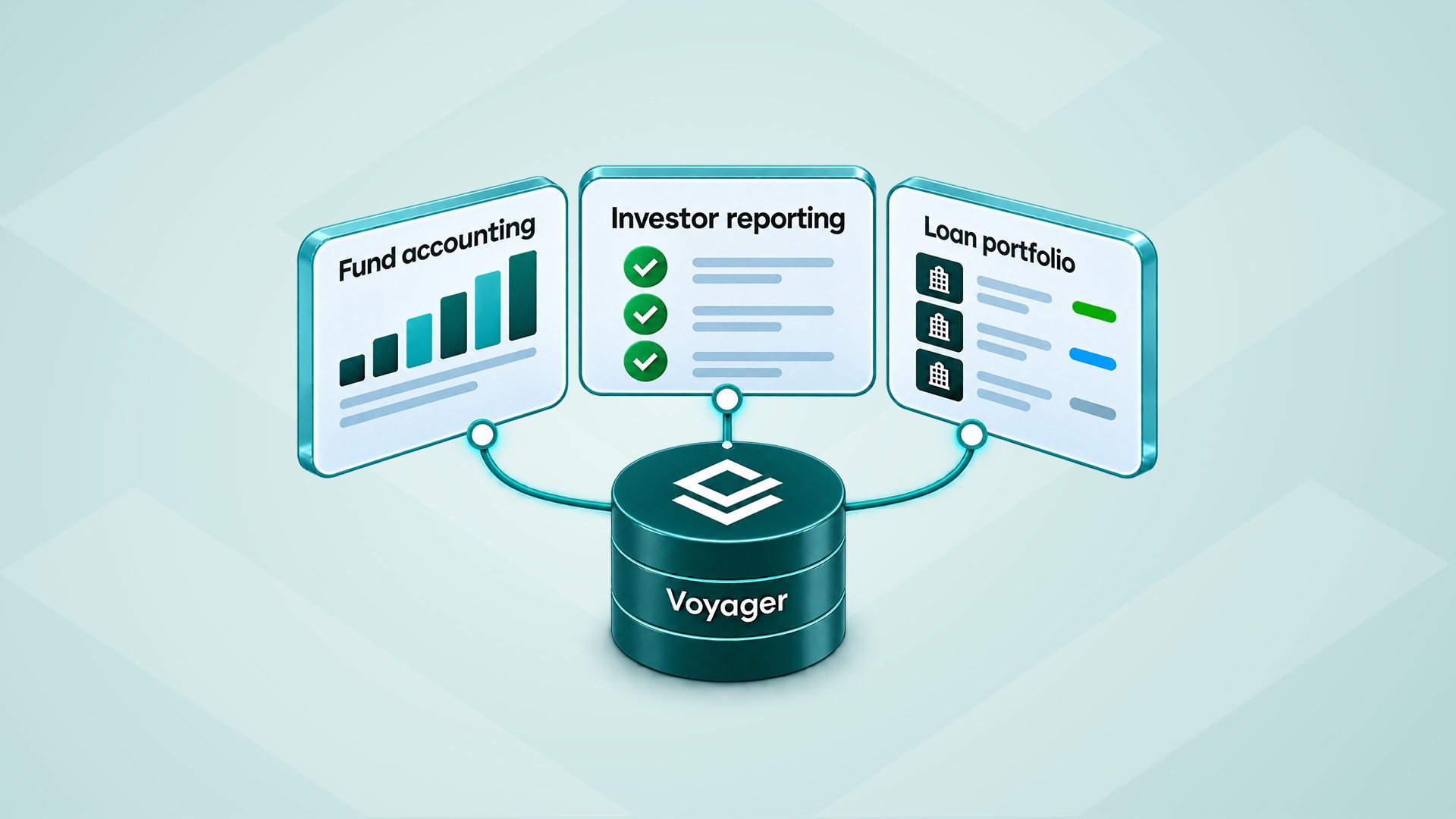
The industry is beginning to recognize that the answer to system fragmentation is not better integrations between disconnected tools, but a fundamentally different architecture. When property management, accounting and investor relations share a single database, reconciliation disappears for good. Data enters once and flows through every function that depends on it. This foundation is also what makes AI practical: models can only deliver reliable insights when they draw from one consistent, clean data source.
Yardi Investment Suite was built on this principle, connecting every stage of the investment lifecycle to the same foundation that runs property operations. In practice, reconciliation and error risk disappear when waterfalls, covenants and reporting all draw from the same data source. Automated workflows replace manual bridging between systems, so teams can scale processes without adding headcount. A client of ours, MG Properties, cut their quarterly distribution process from seven weeks to less than two weeks after adopting Yardi Investment Suite.
The firms that make this move earlier avoid the compounding data debt that makes later migrations more difficult and more expensive. For firms already on Voyager, the connection is immediate because the investment layer reads directly from existing property management and accounting data. For firms evaluating a new platform, the suite consolidates from day one rather than requiring a new set of disconnected tools to be assembled over time.
Start with the math
Before evaluating any connected platform, do the exercise of adding up what your current stack actually costs. Start with licensing fees, then add estimated staff hours spent on manual processes each period-end, as well as any roles hired specifically to bridge system gaps. Your spreadsheets may not carry a licensing fee, but factor in the hours your team spends assembling and reconciling data in them and how much time can just one error cost. The total may surprise you when measured against the expense and the advantages of a connected platform.
Want to see how your current stack compares to a connected platform? Let’s have a conversation.