Voyager Suite
 Breeze
 Virtuoso
 Investment Suite
 RentCafe Suite
 REACH by RentCafe
 CommercialCafe Suite
 Elevate Suite
 Procure to Pay Suite
  Energy Suite
 Aspire
 RightSource
 Care Suite
 Matrix
 Yardi Kube Suite
 ScreeningWorks Pro
  Yardi Corom

















No owner wants to wake up to surprise expenses or costly lawsuits. You can avoid both by staying on top of your property’s accessibility compliance standards.
Across the nation, well-intentioned multifamily professionals are facing citations and fines for noncompliance. Many are surprised to discover that employing licensed architects and contractors does not automatically mean that their properties are compliant.
Mark English, President at E&A Team, Inc., has specialized in accessibility compliance inspections for more than 22 years with operations in all 50 states. He has witnessed beautiful new construction with notable accessibility violations. Often times, it’s an issue of communication rather than competence.
“A lot of developers are very cloak-and-dagger about where they’re going to get their money because they don’t want everyone to know. So sometimes architects, contractors, and engineers who are asked to build something may not bother to ask the question, ‘What sort of funding do we use?’ That’s a majorly important question!” These experts can’t meet stringent accessibility regulations for specific types of federally funded projects if they don’t know what type of project they’re creating.
On-site staff is often completely unaware that there is a problem until a resident or employee files a complaint. Their complaints are generally followed by lawsuits so it’s better to address issues early.
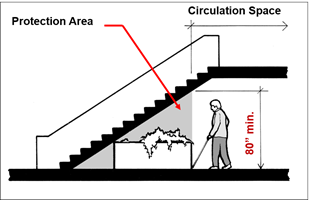
Throughout his career, English has witness two common violations that cause problems on many multifamily properties. The first is a lack of cane detection under stairways. “For the visually impaired, you’re required to have a minimum of 80 inches of vertical clearance along an accessible route. If you have paving or concrete under a set of stairs, that would lead a person with any visual impairment to assume that they can walk right under the stairway. The goal is to have a cane detectible barrier under the stairway so that the person would touch the detection area with their cane before they would hit their head.”
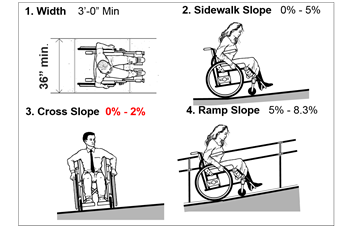
The second would be slope and cross-slope issues, the angle at which a walkway inclines or declines. “If you have a cross-slope from right to left, it can’t exceed two percent,” explains English. “It’s not much to a healthy person but to a person with a mobility-limiting disability or disease, such as debilitating arthritis, a broken limb, someone confined to a wheelchair, etc., it’s a major issue.”
For new construction, English recommends having property blueprints inspected for accessibility compliance before a single shovel is put into the ground. “It’s much easier to fix problems when you’re changing lines on paper than when you’re changing bricks and sticks in mortar,” he says.
Then the building should be inspected before it receives its Certificate of Occupancy. Lastly, federally funded properties should follow-up with accessibility inspections every three to five years; a property that was compliant upon construction may slip into noncompliance as the ground shifts, freezes and thaws, or as tree roots grow up into sidewalks and parking lots and create barriers.
It may sound like a lot of work but on a property with 200 or fewer units, an inspection can typically be completed within four to five hours. The nominal cost of the inspection is also worthwhile compared to the cost of violations.
English explains, “We suggest being pro-active versus reactive with regards to addressing accessibility compliance. It is also wise to consider the high costs in not complying. In 2012, The Department of Justice announced its largest-ever disability-based housing discrimination settlement fund to resolve allegations that one company with 32 properties discriminated on the basis of disability in the design and construction of multifamily housing complexes throughout the United States. Under the settlement, they had to pay $10,250,000 into an accessibility fund to provide retrofits at properties built by them and to increase the stock of accessible housing in the communities where these properties are located. The settlement also required them pay a $250,000 civil penalty. This is the largest civil penalty the Justice Department has obtained in any Fair Housing Act case. ”
Especially in issues of accessibility compliance, ignorance is not bliss. Instead it is often costly mistakes that may result in a dangerous or unhealthy situation for tenants or acts of discrimination. Either of which can have serious consequences. Inspections and proactive procedures can help protect both you and your tenants.
The inspections are a wise investment on their own yet in addition to avoiding surprise costs, staying up-to-date on accessibility requirements can also open the doors to a larger pool of renters. Improving the accessibility standards of your site promotes multi-generational occupancy, bringing a wealth of diversity and stability into your property.