Voyager Suite
 Breeze
 Virtuoso
 Investment Suite
 RentCafe
 CommercialCafe Suite
 Elevate Suite
 Procure to Pay Suite
  Energy Suite
 Aspire
 RightSource
 Care Suite
 Matrix
 WorkCafe
 Yardi Kube Suite
 ScreeningWorks Pro
  Yardi Corom



















Artificial intelligence is moving fast. According to METR research, AI agents’ ability to handle complex tasks has been doubling every three to four months. The complexity of tasks they can handle has expanded from a few seconds of work in 2019 to more than 16 hours of sustained, multistep processing today. For multifamily operators, this pace of change raises a practical question:
How do you build an AI strategy that stays flexible as the technology keeps evolving?
That was the central question Taylor Blades, senior marketing manager at Yardi, explored in a recent webinar produced with Multifamily Executive. The session, “Beyond Automation: Agentic AI for Enterprise Efficiency,” walked through what agentic AI actually means, how it differs from traditional automation and where multifamily operators are already seeing results.
“My goal is to provide some signal in all of the AI noise,” Blades said. “To define what agentic AI means in multifamily and leave you with an actionable playbook to get started.” Here’s some of what she covered.
What makes AI agentic?
Traditional automation follows rules. It routes tasks and often requires human approval at each step before the workflow can continue. Agentic AI works differently. It understands context, chooses next actions, completes multistep workflows without human intervention and escalates to a team member when needed, with full context on why.
Think of the difference this way. Traditional automation responds, but agentic AI acts.
A practical example: a resident gives notice. An agentic workflow can trigger communication to the resident about move-out expectations, prompt maintenance to complete an inspection, pass that information to accounting for deposit accounting and send the resident an update on their deposit funds, all without a staff member handing off each step. That agentic workflow crosses leasing, operations, maintenance and accounting. AI point solutions operating in silos cannot do this.
The ideal agentic workflow has five components: trigger, analyze, decide, act and escalate.
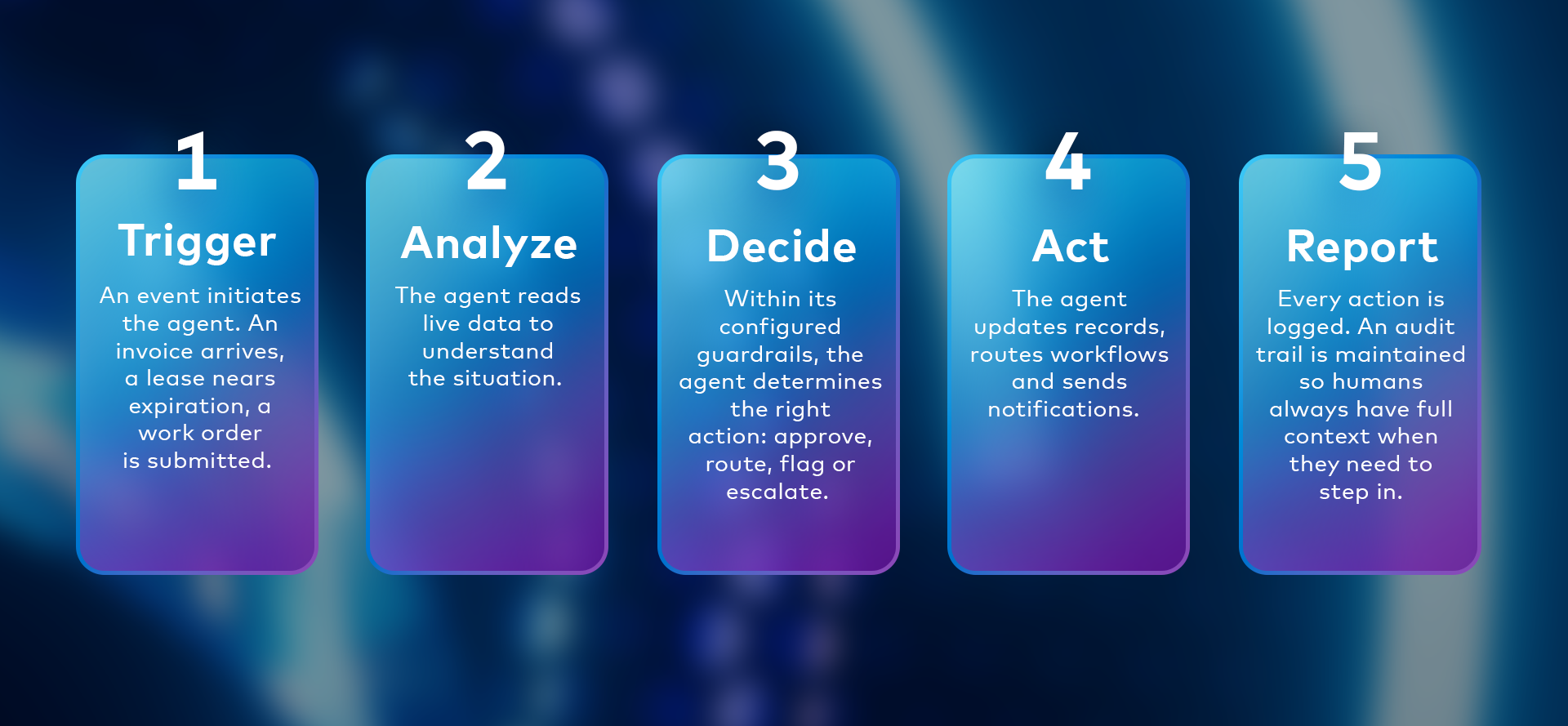
That last step matters more than it might seem. When a team member does need to step in, they need full context.
Where multifamily stands on AI adoption
Real estate was slower than most industries to adopt the first wave of AI. That wave, which peaked around 2021, was largely focused on analytics, forecasting and data science, which favored industries with more standardized, digital-native workflows.
Multifamily is different. It is asset-heavy, operationally complex and fundamentally human-centered. But those same characteristics make it a strong fit for agentic AI, which is built for complex, multistep workflows that require judgment and context, not just pattern recognition.
“With agentic AI, those complex workflows, the ones that require human touch, that’s really where agentic AI thrives,” Blades said. “I think we’re poised to be much further up the scale in this next wave.”
Operators today are facing pressure with rising renter expectations, labor constraints, shrinking NOI and fragmented workflows. Agentic AI addresses each of these, not by replacing people, but by removing repetitive, manual work that prevents teams from focusing on higher-value interactions and connecting traditionally siloed workflows.
AI that communicates with renters
Many operators have already put AI to work on customer communication, answering availability questions, scheduling tours and responding to basic service requests. But those are entry points, not endpoints. The real opportunity is extending AI across the entire renter journey, from first inquiry through renewal.
That’s what Yardi Chat IQ is built for. Part of Yardi’s AI platform, Virtuoso Enterprise, Chat IQ covers chat, email, text and voice natively across the full renter lifecycle. Here are three capabilities that separate effective renter-facing AI from tools that fall short.
Context is everything
Most AI tools treat every conversation as the first one. A resident who called about a maintenance issue three days ago and then follows up through chat should not have to start from scratch. Chat IQ carries full context across every channel, remembering up to 30 prior interactions and applying that history to every response. The experience feels continuous regardless of how or when a resident reaches out.
This matters for trust. When residents feel heard and understood, they are more likely to renew. When they have to repeat themselves, they lose confidence in the property and its team.
“The conversation history shouldn’t just live in the on-site team’s head or with one AI that doesn’t communicate with another,” Blades said. “It should follow through every interaction that happens with that same customer.”
Because Chat IQ runs inside Virtuoso Enterprise rather than alongside it, every conversation logs in CRM IQ in real time and every response pulls from live property data. There is no manual syncing and no risk of the AI working from stale information.
The handoff moment
When a team member does need to step in, the transition should be invisible to the resident. That means the team member already knows what was discussed, what the resident needs and what has already been tried before they say a word. The best operators design handoffs the customer does not notice.
“If a prospect has already shared how many bedrooms they’re looking for or when their move-in date is and then they get transferred to a human who asks the same questions, they’re instantly annoyed,” Blades said. “That moment has erased everything AI has done right up until that point.”
Chat IQ makes the handoff work by surfacing the full conversation transcript, intent score, urgency classification and AI-generated reasoning directly in CRM IQ. Leasing teams step in with complete context, not a blank screen and a frustrated resident.
Personalized follow-up
Not every prospect needs the same message. A renter who is six months from a move-in date needs a different cadence than someone ready to sign today. Rather than sending the same template to everyone, Chat IQ reasons through each conversation individually, reading interest level, target move-in date and prior interaction history to send the right message at the right time, much like a skilled leasing agent would.
Response timing varies so interactions feel natural rather than automated, and every message is reviewed for Fair Housing compliance before it sends. Teams see the strategy and reasoning behind each follow-up in CRM IQ, so the AI never operates as a black box.
AI that supports the enterprise
The other side of agentic AI in multifamily is enterprise-facing: using intelligent workflows to reduce repetitive, manual work for staff. Two Virtuoso Premium Agent case studies from the webinar illustrate what this looks like in practice.
Month-end close: exception monitoring
A property management firm with more than 150,000 units implemented agentic AI to handle exception monitoring as the first step in improving its month-end close process. The challenge was manual exception identification across hundreds of properties, a process that required frequent retraining and produced inconsistent results.
The organization had already standardized its process: four specific reports, reviewed at set intervals each month, to surface exceptions. That standardization was the key that made AI implementation possible. The agent took over that review step, surfacing exceptions for the team rather than having staff hunt for them manually.
“That is key when you want AI to jump in and handle something,” Blades noted. “A standardized process in place is something AI can easily take over.”
The result: a 90% decrease in exception identification time across all report types and eight hours of human processing time eliminated per property across approximately 750 properties.
Invoice coding & approval
The second case study addressed invoice processing using the Smart Approval Agent. The challenge: invoices from vendors went through manual coding, manual review and manual approval, with guidelines enforced inconsistently.
Procure to Pay uses dual AI agents to read and code digital invoices, then approve or flag them based on rules derived from historical approval and rejection data. One AI agent makes the approval decision; a second reviews it to confirm or challenge the first. Both agents must meet a confidence threshold set by the user before an invoice is auto-approved. Every decision includes a detailed audit history, so there is never any mystery about why an invoice was approved or escalated.
Early results show more than 6,500 hours saved per 100,000 invoices, approximately two minutes saved per approval step and 40-60% of invoices approved automatically.
Connecting your data to AI
One emerging capability worth understanding is the ability to connect your property management data to large language models through model context protocol (MCP), allowing for dynamic interaction through a context window interface. Rather than pulling static reports and uploading them manually, operators can query live Yardi data through LLMs like Claude, asking questions in plain language and receiving analysis, owner packages or interactive dashboards as output.
The Virtuoso Connector makes this possible for operators licensing Yardi Virtuoso Enterprise. The connector authenticates through Yardi, so data access automatically follows existing user permissions. The result is faster, more accurate insights without the manual reporting work and without the risk of an AI assistant filling in gaps with invented data.
How to get started
To successfully deploy agentic workflows, any operator can follow these four practical steps:
1. Map your application landscape. Identify where you have workflow gaps or data silos.
2. Document your workflows. Look for delays, handoffs and rework. Those are the highest-value targets for agentic AI.
3. Define a measurable impact. Know what you need the AI to accomplish before you turn it on. If it is not delivering, move on.
4. Start small, then finish. Exception monitoring in month-end close is a great example: a focused, contained use case with meaningful results. Build from there.
“The advantage won’t go to the operators who say they’ve implemented AI in every single area of their business,” Blades said. “It’s going to go to the operators who really thought about where AI could fit into their unique operations and evaluated where it was most impactful.”
Ready to see what’s possible?
Virtuoso Enterprise brings together leasing, operations, resident services and back-office workflows in a connected, AI-native platform built for multifamily. Learn more about Virtuoso Enterprise.