Voyager Suite
 Virtuoso
 Investment Suite
 RentCafe Suite
 REACH by RentCafe
 CommercialCafe Suite
 Elevate Suite
 Procure to Pay Suite
 Aspire
 Yardi Kube Suite
 Yardi Corom



Technology in real estate investment is no longer confined to operational support. Across the industry, it is increasingly viewed as a strategic driver of performance, transparency and resilience, shaping everything from investment decisions to occupier experience and investor confidence.
Findings from the Association of Real Estate Funds (AREF) and Yardi industry report reveal that firms are embracing technology not as a replacement for human expertise, but as a critical enabler of smarter decision-making and scalable growth.
However, as ambition grows, the sector continues to face significant challenges in translating digital strategy into operational reality.
A growing strategic priority in real estate investment
For many organisations, technology is now directly linked to business strategy and long-term investment performance.
“We definitely view technology as a strategic enabler, rather than just an operational support function.”
This shift reflects a broader industry evolution. Firms increasingly recognise that technology has the potential to improve operational efficiency, strengthen reporting accuracy, enhance forecasting and support stronger investor outcomes.
According to the research, the top perceived benefits of technology adoption include:
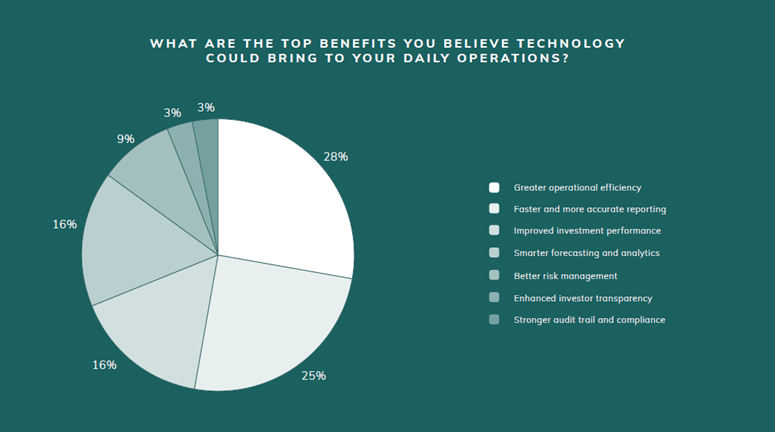
These priorities demonstrate that technology investment is no longer simply about modernising infrastructure. Instead, firms are focusing on how digital tools can help create more agile, data-driven organisations capable of responding to growing market complexity.
The digital maturity gap
Despite this strategic focus, the report highlights a notable disconnect between scale and digital maturity.
Although 64% of surveyed firms manage portfolios exceeding £5 billion, only 28% consider themselves “ahead of the curve” in technology adoption. This suggests that even some of the industry’s largest organisations continue to grapple with fragmented systems, inconsistent processes and operational complexity.
In many cases, digital transformation is progressing incrementally rather than through large-scale reinvention. In addition, firms are prioritising pragmatic improvements that enhance existing workflows and business practices instead of pursuing wholesale transformation programmes.
This measured approach reflects both the sector’s complexity and the practical realities of managing large property portfolios across multiple markets and business units.
Legacy systems remain a major barrier
One of the clearest themes emerging from the report is the ongoing challenge posed by legacy technology. For example, an overwhelming 88% of firms identified legacy systems and a lack of interoperability as the primary barriers to technology adoption.
Many organisations continue to operate multiple disconnected platforms simultaneously, often due to historical acquisitions, regional structures, or independently managed business units. Furthermore, some reported maintaining three to five legacy systems concurrently across different regions.
As one COO noted:
“Legacy systems… switching that into advanced technology will be quite difficult…but the advantages are so much greater than the pain of getting there.”
The challenge is not simply technical – fragmented systems can limit visibility, slow reporting processes and increase reliance on siloed knowledge within teams – all of which can impact operational resilience and scalability.
People & culture remain critical in real estate investment
While technology itself is evolving rapidly, firms repeatedly emphasised that successful adoption ultimately depends on people.
Resistance to change, digital skills gaps and cultural adoption were all identified as ongoing challenges. In addition, leadership teams are increasingly aware that implementing new systems alone is not enough. Organisations also need the right governance structures, processes and employee engagement to ensure long-term success.
This is particularly important as firms seek to balance innovation with operational control. As adoption increases, many organisations are focusing on creating scalable, centralised processes that reduce reliance on individual expertise and improve organisational resilience.
At the same time, technology is helping firms strengthen relationships with occupiers and investors by improving transparency, responsiveness and service delivery.
Emma Long, head of business strategy at Legal & General Real Assets Equity, explained:
“To deliver successful real estate investment strategies across different client mandates, we need to be much closer to our occupiers. Data and technology are a critical part of enabling that – helping us operate more efficiently, improve transparency and ultimately drive better outcomes for investors.”
Technology as an enabler – not a replacement
The report shows that the industry doesn’t view technology as a substitute for human expertise. Instead, firms see digital transformation as a way to support better decisions, streamline operations, and create stronger foundations for future growth.
The organisations making the greatest progress are not necessarily those pursuing the most aggressive transformation agendas. Rather, they are firms that align technology investment closely with business objectives, operational needs, and long-term strategy.
As real estate investment continues to evolve, the ability to connect systems, improve data visibility and embed technology into day-to-day decision-making is likely to become an increasingly important differentiator across the sector.
AI is only as good as the data underneath it. Yardi connects your portfolio, properties, and teams into one source of truth – so AI can finally work for commercial real estate.
One platform. One dataset. Smarter decisions.