


 Voyager Suite
 Virtuoso
 Investment Suite
 RentCafe Suite
 REACH by RentCafe
 CommercialCafe Suite
 Elevate Suite
 Procure to Pay Suite
 Aspire
 Yardi Kube Suite
 Yardi Corom












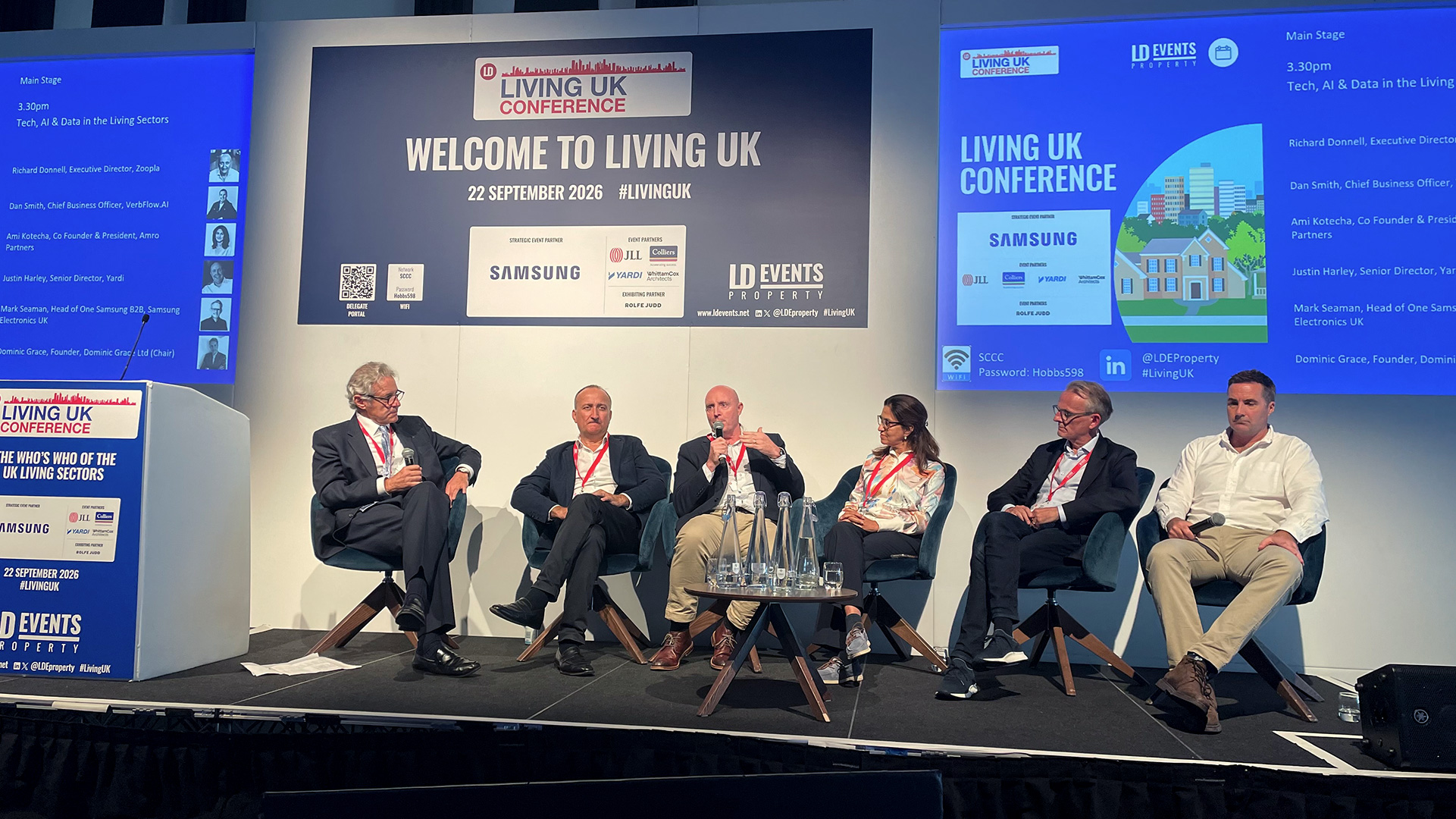
At this year’s LD Events Living UK Conference, a panel discussion moderated by Dominic Grace, principal at Dominic Grace Limited, brought together four of the sector’s leading voices to explore the role of technology, artificial intelligence and data in transforming the living sector.
The panel featured:
- Justin Harley, senior director at Yardi
- Dan Smith, chief business officer at Verbflow.AI
- Ami Kotecha, co-founder and president at Amro Partners
- Mark Seaman, senior director at Samsung
- Richard Donnell, executive director at Zoopla
The session, titled “Tech, AI & Data in the Living Sector”, challenged the panel to look beyond the industry’s growing enthusiasm for AI and instead address the practical, cultural and commercial realities of implementation. Four key themes shaped the discussion:
1. Adoption: A Sector That Moves Slowly
Grace opened the discussion by posing a question that sits at the heart of the sector’s technology challenge – why, given the volume of innovation available, has the living sector been so slow to adopt? Smith offered a candid assessment, reflecting on two distinct phases in Verbflow.AI’s go-to-market experience. The first phase was relatively straightforward – early adopters who recognised the opportunity and moved quickly. The second, he noted, has proven far more demanding, observing that “right now we’re in the phase where everybody wants to check case studies, they want to see the exact ROI, they’re much more in depth in terms of the processes.”
Smith acknowledged the inherent tension in selling a product that automates workflows to the very people whose roles those workflows sustain. He noted that he frequently finds himself pitching to leasing managers whose entire teams sit behind them. His view is that “it’s just going to take time to evolve.”
Harley was direct in his diagnosis. He argued that “what has stopped the industry doing this is the industry itself – “it’s a cultural challenge.” His observation that boardroom culture is the single biggest barrier to technology adoption, not just in real estate, but across industries – which drew broad agreement from the panel.
And the signal that a business lacks genuine data culture? “If you hear people in your business saying things like, ‘we don’t trust the data,’ or, ‘let me just get that spreadsheet’ – you do not have a data culture.”
2. Data: The Foundation That Cannot Be Skipped
Kotecha offered a compelling perspective on why data infrastructure is the non-negotiable precondition for any meaningful AI strategy. As an integrated investor, developer and manager, Amro has taken the deliberate step of building a proprietary intelligence platform “AmroIQ” to mine and contextualise its own data. Her reasoning was clear – “generative AI has made a general-purpose technology available to all of us – and the word general is really important in this because there are so many applications of it.” For Amro, the priority has not been chasing the technology itself, but identifying where its own proprietary data creates the greatest competitive return.
Kotecha was equally measured about the temptation to follow the crowd, cautioning that “there’s a lot of FOMO that’s created – everybody wants to have an AI-enabled product or solve a pain point using AI.” Her counsel was instead to start with a single use-case improvement and treat the current moment as the beginning of a longer transformation. “I think this is not going to be the same company we are today in a few years, and this is the start of that process.”
Seaman reinforced the importance of granular data capture in unlocking real operational value, specifically in the context of energy management. He argued that moving beyond annual, aggregated building data to AI-monitored submetering at unit level is what enables operators to demonstrate genuine savings to boards. The framing matters – once you can quantify savings with actual figures, “it becomes much more of an OpEx conversation.” Therefore, when properly captured and analysed, the data does the persuading.
Richard Donnell of Zoopla offered a counterpoint on data volume. His view was direct – “there is too much data out there.” The priority, he argued, is not more data but better data – particularly in understanding individual consumers, rather than aggregating signals at the market level. Zoopla’s focus has shifted accordingly, from generating high volumes of leads to delivering richer consumer insight to their developer and operator clients. The direction of travel is towards personalisation, and the data strategy must follow.
3. Build vs. Buy: The Case for Integration
The panel gave meaningful attention to the question of interoperability – the degree to which technology systems are open to integration versus closed to it. Smith was candid about the landscape: not all property management systems are built with openness in mind, and those that are not create material obstacles to innovation. His characterisation of closed systems as “walled gardens” (content to guard legacy revenue models at the expense of client outcomes) prompted visible recognition from the room.
The contrast, in Smith’s experience, is clear. “The ones that are performing really well in terms of our integration are the ones that are completely open and are saying, ‘work within it, this is going to benefit the client’.” For operators and investors considering their technology architecture, the message is direct – an open, interoperable stack is not merely a technical preference, it is a commercial and strategic one.
Kotecha’s decision to build proprietary capability rather than rely entirely on external vendors reflects a different expression of the same principle. As a fully vertically integrated business, she explained, the data Amro generates across investment, development and management is uniquely valuable. Furthermore, the build decision stemmed from the conviction that the real competitive advantage lies in how that data is mined and contextualised. As she put it, “it’s a fantastic opportunity for every company to decide for themselves where they’re going to get the most return.”
4. Culture: The Barrier That Technology Cannot Fix
The panel returned repeatedly to the question of culture – not as a soft afterthought, but as the primary constraint on the sector’s ability to realise the value of AI and data investment. Harley was emphatic that the technology is not the problem (it is available), the obstacle is whether the boardroom is open to it. He cited a conversation with a new CEO of an Irish REIT who arrived with a clear mandate: “data is the north star.” The cultural shift that followed in the business (staff taking pride in data accuracy, treating incomplete records as something to be corrected rather than worked around), illustrated what genuine data culture looks like in practice.
Smith acknowledged the human dimension directly, recognising the difficulty of selling workflow automation to teams whose roles those workflows currently sustain. His response was honesty about what the technology can do, paired with patience about the time it takes to shift perceptions.
Donnell’s closing reflection offered a useful grounding. Having spent two decades working in data businesses within the property sector, his view was that the problem of data quality and trust is not new – and that the answer lies less in more sophisticated tools and more in a fundamental commitment to getting the basics right.
The shift the sector needs isn’t technological, but behavioural. Organisations that treat data as a strategic asset, not a reporting inconvenience, will be the ones that extract real value from the AI tools being deployed on top of it.
To understand how Yardi can help support your residential activities and future-proof your operations with a connected real estate platform, speak to a member of our team.