


 Voyager Suite
 Virtuoso
 Investment Suite
 RentCafe Suite
 REACH by RentCafe
 CommercialCafe Suite
 Elevate Suite
 Procure to Pay Suite
 Aspire
 Yardi Kube Suite
 Yardi Corom












Investor expectations are changing, and real estate investment managers are adapting to a new era of transparency, accessibility and insights. For years, quarterly reports served as the primary touchpoint between fund managers and investors. Today, that’s no longer enough. Investors increasingly expect real-time access to information, deeper performance insights and greater visibility into the assets and funds in which they invest.
Investor expectations are evolving
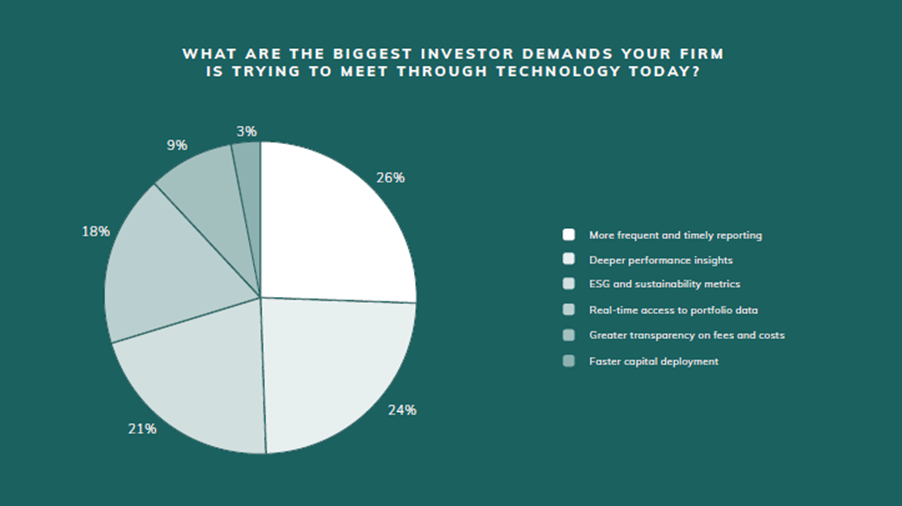
The findings from the AREF and Yardi technology report highlight the scale of this shift. When asked about the biggest investor demands firms are trying to meet through technology, respondents identified more frequent and timely reporting (26%) and deeper performance insights (24%) as their top priorities. Demand for ESG and sustainability metrics (21%) and real-time access to portfolio data (18%) further reinforces the growing expectation for transparency and immediate access to information.
As investor requirements evolve, reporting is moving beyond static documents and periodic updates. Instead, firms are increasingly adopting digital portals, interactive dashboards and self-service reporting tools that provide investors with continuous access to fund and portfolio information.
“Investors are expecting more real-time reporting. They like the idea of a fund portal to get all the information they want in one place. Quarterly reports will continue for compliance, but portals will become the first port of call.”
Senior Fund Manager, Real Estate Investment Firm
From periodic reporting to continuous access
This shift represents more than a change in reporting format. It reflects a broader transformation in how investors engage with information. Furthermore, rather than waiting for scheduled updates, investors increasingly want the flexibility to access data when they need it, explore performance metrics in greater detail and gain a clearer understanding of portfolio activity and risk.
Many firms also report a growing volume of ad hoc requests for ESG data, performance metrics, and asset-level information. These enquiries signal a move away from periodic disclosure towards continuous engagement, where investors expect timely answers and access to increasingly granular data.
Building the foundation for greater transparency
To meet these expectations, organisations are investing in technologies that enhance fund performance tracking, improve access to operational and occupier data, and provide greater visibility into asset performance. At the same time, firms are continually evaluating new platforms, partnerships and technologies that can help them respond more effectively to changing investor demands.
Underlying this evolution is the growing importance of connected data. Open interfaces and integrated technology ecosystems are enabling information to flow more freely between systems, making it easier to deliver accurate, timely insights through investor portals and reporting platforms. By reducing manual processes and improving data accessibility, firms can respond more quickly to requests while maintaining the rigour required in institutional fund management.
The future of investor communications
The challenge is no longer simply producing reports. It is delivering meaningful, trusted insights in a format that suits the needs of modern investors.
As transparency becomes an increasingly important differentiator, firms that can combine accurate data, real-time access and a seamless investor experience will be best positioned to build confidence, strengthen relationships and support long-term growth.
The future of investor communications will not be defined by the next reporting cycle. It will be defined by continuous access to information, deeper insight and greater transparency.
AI is only as good as the data underneath it. Yardi connects your portfolio, properties, and teams into one source of truth – so AI can finally work for commercial real estate.
One platform. One dataset. Smarter decisions.