

 Voyager Suite
 Virtuoso
 Investment Suite
 RentCafe Suite
 REACH by RentCafe
 CommercialCafe Suite
 Elevate Suite
 Procure to Pay Suite
 Aspire
 Yardi Kube Suite
 Yardi Corom












For fund managers, data is no longer just an operational concern; it has become a defining factor in investment performance. As markets grow more complex and investor scrutiny intensifies, firms are under pressure to deliver faster insights, greater transparency, and more sophisticated reporting. However, many real estate investment organisations are still facing challenges with fragmented data spread across systems, teams and geographies.
Our latest industry research with AREF reveals that data and reporting challenges are not isolated issues – they are universal across the sector.
Where Fund Managers Are Losing Time in Data and Reporting
When asked which data tasks consume the most time in investment operations, respondents highlighted a set of activities that are essential, yet largely manual:
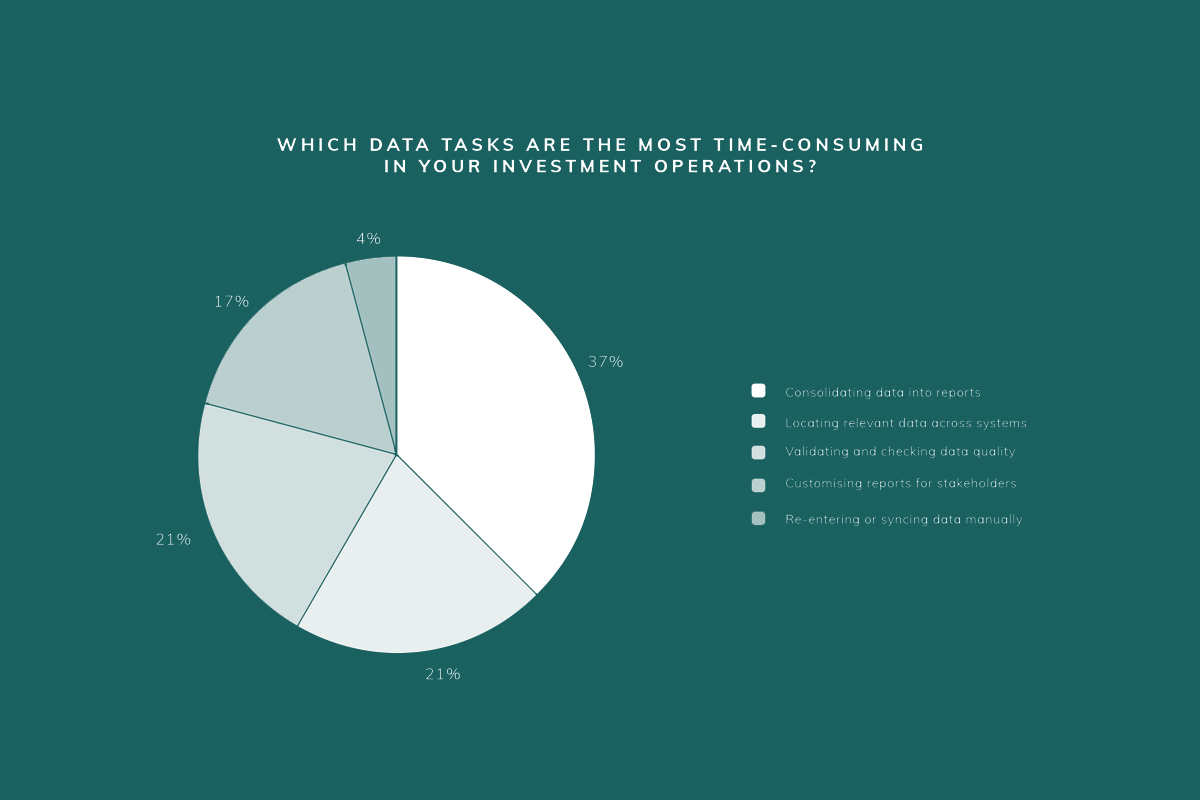
With 37% stating that “consolidating data into reports”, 21% that “locating relevant data across systems”, and 21% that “validating data quality” are the most time-consuming, this highlights how investment teams are spending significant time assembling data rather than analysing it. As the industry increasingly looks to AI for real estate investment and advanced analytics to gain a competitive edge, this is particularly notable.
Artificial intelligence can only deliver meaningful insights if the underlying data is accessible, accurate, and unified – conditions that many organisations have yet to achieve, according to this report.
Why Fragmented Real Estate Investment Data Limits AI Adoption
Real estate generates some of the most complex datasets of any asset class. Financial performance, leasing activity, operational metrics, market benchmarks, and ESG indicators all originate from different sources.
In many firms, this information sits across property management systems, accounting platforms, third-party providers, and internal models. Additionally, legacy structures and cross-border portfolios add further complexity. The result is a patchwork of disconnected data environments, which creates a major barrier to effective real estate investment technology adoption.
Without a unified data foundation, even the most sophisticated AI tools for real estate investors struggle to deliver value.
Why Spreadsheet Dependency Leads to Strategic Risk
Despite increasing digitalisation, spreadsheets remain deeply embedded in fund manager workflows for valuation modelling, forecasting, and consolidating portfolio data.
However, spreadsheet-driven processes introduce risks around version control, data integrity, and auditability. In addition, they can make it difficult to produce consistent reporting for investors and regulators.
In a market where transparency is critical, fragmented processes are evolving from operational inconvenience into strategic vulnerability.
The Shift Toward Modern Real Estate Investment Technology
Over 60% of participants cited operational efficiency as the main driver behind their tech strategies – the research also shows that firms are beginning to invest in more scalable solutions. Leading organisations are utilising centralised data platforms that integrate information from multiple sources and automate reporting workflows to move away from fragmented data.
Cloud-based data warehouses, automated pipelines, and improved governance frameworks are becoming core components of modern fund manager technology stacks.
These foundations are also enabling real-time insights into portfolio performance, which is increasingly essential for responding to market volatility.
Why This Matters Now
The real estate investment landscape is entering a period where speed and clarity of decision-making will separate leaders from those slow to adopt.
Investors expect more frequent updates, regulators demand greater transparency, and sustainability reporting requirements continue to expand. At the same time, firms are seeking to harness AI and advanced analytics to enhance performance.
None of this is possible without reliable, connected real estate investment data. In other words, solving fragmentation is not just an IT initiative – it is a business requirement.
From Fragmented Systems to a Unified Data Foundation
Firms that successfully unify their data will unlock several advantages:
- Faster reporting cycles
- More informed investment decisions
- Reduced operational risk
- Greater confidence in AI-driven insights
- Improved investor communication
Those who fail to act may find themselves constrained by slow processes and limited visibility as the rest of the industry becomes more data-driven.
Explore the Full Findings – Download the AREF x Yardi Report
To understand how leading organisations are addressing data fragmentation, and what it means for the future of real estate investment technology, download the full report.