Voyager Suite
 Virtuoso
 Investment Suite
 RentCafe Suite
 REACH by RentCafe
 CommercialCafe Suite
 Elevate Suite
 Procure to Pay Suite
 Aspire
 Yardi Kube Suite
 Yardi Corom












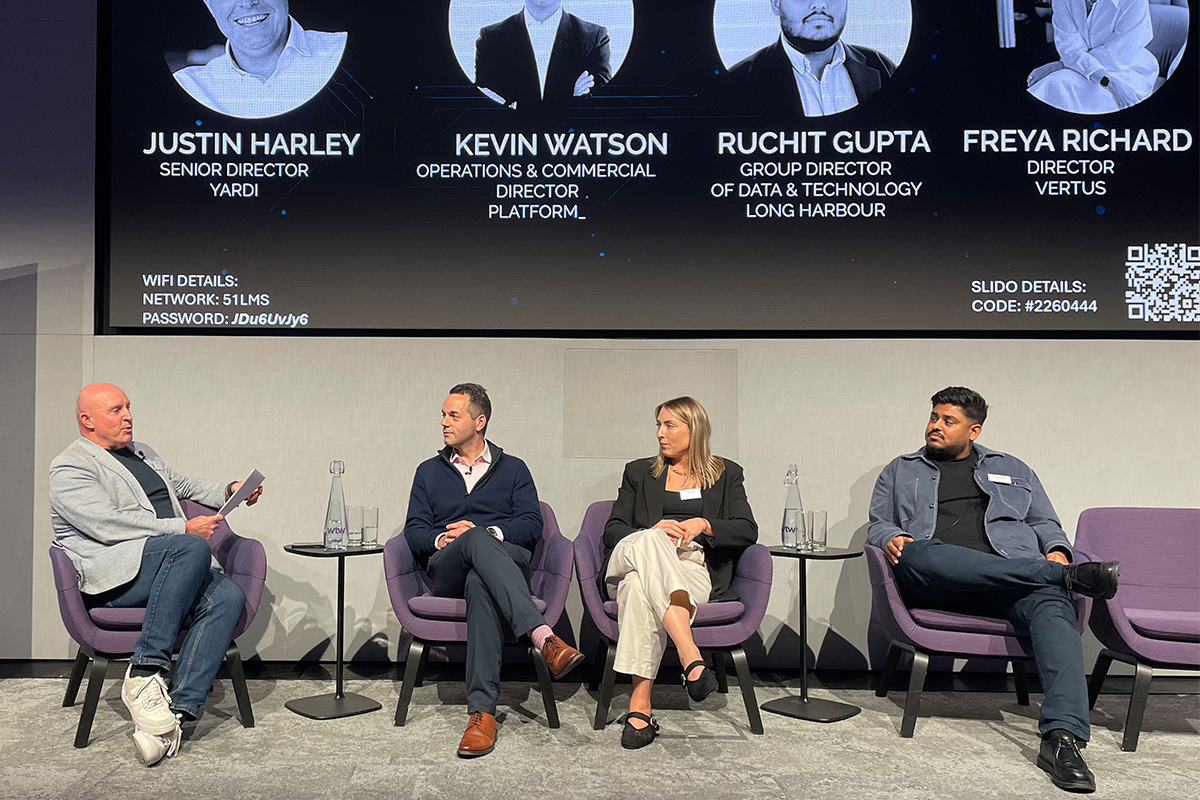
At this year’s ARL event in London, a panel discussion moderated by Justin Harley, senior director at Yardi, brought together three of the sector’s leading operators to explore the topic of artificial intelligence and how it can help reduce costs without compromising the quality of the resident experience. The panel featured Kevin Watson, operations and commercial director at PLATFORM_, Freya Richard, director at Vertus and Ruchit Gupta-Chaudhary, group director of data and technology at Long Harbour.
The session, titled “The Operational Perspective: Can AI Reduce Costs Without Reducing Service Quality?”, challenged the panel to look beyond the industry’s growing enthusiasm for AI and instead focus on what responsible, effective implementation looks like in practice. Four key themes shaped the discussion.
Chatbots: Shifting Perceptions, Shifting Expectations
Harley opened the discussion with a pointed observation – survey data suggesting that “90% of people prefer human interaction over AI and that residents rate chatbots just 2.6 out of five, compared to 4.5 for direct communication with staff.” Watson challenged the premise, questioning whether data of this kind reflects the technology as it exists today. He observed, “The rate of evolution of what we thought was a chatbot a few years ago versus what we could deliver now has changed massively.”
For Watson, the strongest case for AI-assisted communication lies not in replacing human interaction, but in extending availability beyond office hours. He noted, “A lot of people just want the right answer quickly. If we can serve your enquiry at 10 pm on a Tuesday when the office is closed – that’s completely good for them.” Gupta-Chaudhary further emphasises this notion and highlights Long Harbour’s operational track record, which offers compelling evidence – “over 50% of viewings are now booked with no human interaction whatsoever”, the result of five years of progressive automation across the lead-to-lease journey.
Richard, however, acknowledged the opportunity but emphasised that resident education must be central to any deployment strategy. She quotes that “some of it is about bringing residents along that journey with you – helping them understand why it is going to be a benefit to them if and where we do deploy it.” The message was clear – the success of AI in customer-facing operations will depend as much on communication and trust as it does on the technology itself.
Data: The Foundation That Cannot Be Overlooked
There was broad consensus across the panel that data infrastructure is the non-negotiable starting point for any meaningful AI strategy. Ruchit Gupta-Chaudhary described Long Harbour’s foundational approach – “establishing a single source of truth from the outset,” ensuring that whether teams are working across risk, compliance, marketing, finance or asset management, everyone is “looking at data in the same screen, in the same portal.” Alongside this, he emphasised the importance of an interoperable tech stack – systems built with open APIs that can be adapted quickly as the market evolves.
Watson illustrated what this looks like in practice. PLATFORM_ built an internal AI agent in half a day to automate utilities billing reconciliation – eliminating third-party costs, reducing manual effort and freeing staff to focus on higher-value activity. Individually modest, the approach reflects a deliberate strategy of identifying and resolving specific operational pain points at scale.
However, Richard offered an important check on near-term financial expectations. She cautioned that “for a short period of time, I do not think we are going to see a positive impact on NOI – because if anything, you are going to increase your costs” – as existing systems, middleware, and additional licence costs accumulate ahead of the efficiencies that follow. Investing in data foundations is rarely visible work, but it is the work that determines whether everything built on top of it will succeed.
The Human Element: Redeployment, Not Reduction
When Harley raised the prospect of AI reducing staff administration to near zero, Watson reframed the conversation entirely. He argued that “there is more thinking, more strategy, more customer interaction we can do – but it is also about who is doing the checking, who understands the process, who understands the regulation.” In a regulated industry, the human role as auditor and quality-checker will remain essential for the foreseeable future, irrespective of how capable AI becomes.
Richard highlighted an important operational dimension that is often underappreciated. She notes how “efficiency gains on the frontline are frequently offset by increased demands in IT” and technology teams managing a growing and more complex tech stack. She also pointed to a practical use case that tends to be overlooked – the ability to deploy AI as a reliable gap-filler when staffing levels are disrupted by absence, vacancy or seasonal demand.
While Gupta-Chaudhary reflected on the cultural dimension, noting that initial resistance among staff (often rooted in concern about job security) tends to transform quickly once individuals engage directly with the tools. He observed how “within two to three days of seeing what AI can do, employees get excited – because they realise that this is going to make their life easier and can help elevate them.” All three panellists agreed that the shift is best understood as one of redeployment rather than reduction. Therefore, the organisations that approach it in those terms will be better placed to bring their people with them.
Barriers: Culture, Capability and the Cost of Getting It Right
The panel spoke candidly about the distance between AI ambition and meaningful delivery. Gupta-Chaudhary identified the foundational challenge, he warned and highlighted how “great AI tools are largely ineffective if your workflows are wrong, your data is wrong or your tech stack is wrong.” Therefore, effective implementation demands investment not only in licences and technology, but in the process redesign and professional expertise that enables those tools to function as intended.
Whereas Richard identified team adoption as one of the most significant practical barriers Vertus had encountered, noting a striking gap between leadership enthusiasm and ground-level engagement, with a meaningful proportion of staff not yet using tools that had already been deployed. She stressed how “you can invest all the money you like in AI, but if the people on the ground are not invested in the same way that you are, it is not going to work.”
Watson agreed, adding that the obstacle is frequently not reluctance but the scarcity of time in an already stretched sector. His response has been to embed AI readiness into the organisation’s culture from the point of hire, explaining how “part of the interview process now is understanding people’s approach to AI.” And questioning the “why?”, as he points out candidates “have not done their presentation on a typewriter – so why would you be closed to what AI makes possible?” The takeaway was clear – the organisations that will realise the greatest value from AI are those that treat it not as a technology project, but as a cultural and strategic priority.
To understand how Yardi can help support your residential activities and future-proof your operations with an end-to-end solution, speak to a member of our team.